Tanglewood 2025
Tagged:Beauty
/
CatBlogging
/
Politics
We haven’t been to Tanglewood in… approximately forever? Ok, not for at least a decade. Last weekend, some friends helped us remedy that whole situation.
Arts Reviews on This Crummy Little Blog That Nobody Reads (CLBTNR)
Apparently, here at Château Weekend, we put up on this CLBTNR about one arts-related review post per year:
- For 2024: the Spectrum Singers farewell concert for music director John Ehrlich.
- For 2023: a trip to Symphony Hall to brood over the state of the world (also, there was music).
- For 2022: some thoughts about sculptures on the Charles Bridge in Prague. (Also for 2022: our first return to the BSO in years, in which I learned I understood approximately nothing about Charles Ives.)
- For 2021: about a crazy Finn who makes ephemeral winter sculptures.
- For 2020: an expedition to western Massachusetts in the autumn (and the seasonally de rigeur pumpkin trebuchet).
There’s nothing deliberate about any of that happening on an approximately annual basis, and indeed a closer inspection of this CLBTNR, with a charitable eye, might reveal more arts content.
But still, here we are. It’s about time for 2025, isn’t it?
Caveat lector: This is a post about a classical music performance. I am a barbarian in these matters. So what you will read here, like the posts above, is more about my wandering mind’s woolgathering, than about the music itself. For the latter, you must consult an expert, not me.
I recognize that in my barbaric capacity, I am a temporary guest at Tanglewood of the upper class and the culturally sophisticated class. I may chafe a bit at the former, but will address the latter respectfully.
I may not know much about the music, but will do my best to find inspiration of other worthy topics.
Tanglewood Prolegomena
 First, let us set the stage.
We have the great good fortune, Chez Weekend, to count as friends a couple who have a magnificent home in the Berkshires in western Massachusetts. Persistently incorrigible & habitual readers of this CLBTNR may have noted some grateful episodes in the past, with beautiful photographs taken from their home.
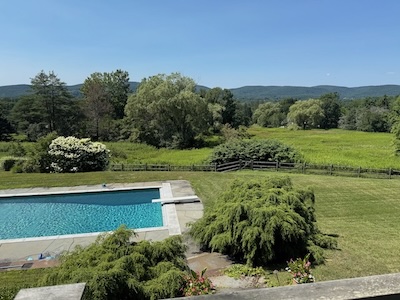
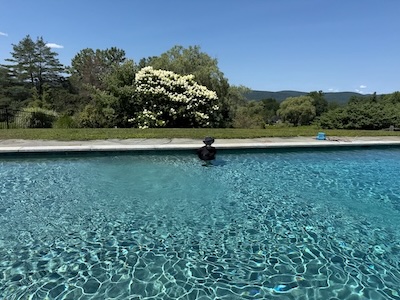
Last weekend, they again very generously offered a several-day stay with some other friends for a weekend of cooking, conversation, swimming, and so on. You can see the pool here, with the magnificent view of the hills just over the border in New York.
It was a lovely time: I brought some Yeats to read, and did a lot of walking in the pool to exercise my compromised knee without pain. If you squint carefully, the second picture shows your humble Weekend Editor in the pool, with a ridiculous amount of sun armor: Tilley hat, sunglasses, rashguard shirt, and so on. (That’s what happens to you at the confluence of age and having worked in cancer research for many years: you get a bit skittish about melanoma.)
The reading I was doing before and during the trip will set the stage for my mind-wandering below.
First, for a variety of reasons, I’d been woolgathering over a favorite passage from Virgil’s Aeneid:
… facilis descensus Averno;
noctes atque dies patet atri ianua Ditis;
sed revocare gradum superasque evadere ad auras,
hoc opus, hic labor est.The descent to hell is easy;
Night and day the door of black Dis is open.
But to retrace steps and escape into the air,
That is the hard work, this is the task.– Publius Vergilius Maro, a.k.a. Virgil, Aeneid, Book 6, ll 126ff
Or, as I sarcastically like to translate it (using “damn” not as the vulgar intensifier, but in its technical theological meaning):
Any damn fool can climb down into Hell.
Now, getting back out… that’s the hard part!
I’ve been known to put that in documentation comments at the front of large-ish software systems, to warn those about to read themselves into a project: are you sure you want to go down this path? Alas, that’s roughly how I feel about the US right now: possibly on a descent to Hell, but unlike the son of Anchises, likely to get stuck there.
Second, because whatever your religion or lack thereof, the notion of Hell is a sticky one. We all want to believe in an ultimate moral justice, but the idea of applying that to ourselves is, or at least should be, a solemn moment. Consider Mephistopheles in Marlowe’s play Faustus. He’s “out of Hell” to tempt Faustus, but “always in Hell” because of his nature and his memories of Heaven:
Faust. How comes it then that thou art out of hell?
Meph. Why this is hell, nor am I out of it.
Think’st thou that I who saw the face of God,
And tasted the eternal joys of Heaven,
Am not tormented with ten thousand hells,
In being depriv’d of everlasting bliss?– Christopher Marlowe, Faustus, Act I, Scene iii
I keep telling myself to listen to the voice in the back of my head that sounds like ol’ GK Chesterton: the essential lesson here is not so much that Mephistopheles remembers hell, but that he remembers heaven.
I hope that’s the lesson the US will draw after it emerges from a possible conflagration. But we’ve managed to avoid learning it for a couple centuries, now.
Just before we got ready to go to Tanglewood, I’d finished reading the WB Yeats poem, “The Stolen Child”, with the refrain echoing the amazing musical setting of this poem by Loreena McKennitt:
Come away, O human child!
To the waters and the wild
With a faery, hand in hand,
For the world’s more full of weeping than you can understand.– WB Yeats, “The Stolen Child”, refrain
Pretty clearly some part of me is thinking about being out of the world (with the Berkshires and Tanglewood taking the metaphorical role of a faerie realm outside mundane reality). That was sort of my mental context: an old man, thinking about the end of life, and what faces the possible end of democracy in my country.
(Yes, this is pretty dark, or dark-adjacent material. But (a) it’s à propos for the times, and (b) the really hardcore stuff for me is Byron’s Manfred, which you should never permit me to read again, ever. No, I will not link to it.)
Tanglewood Impressions
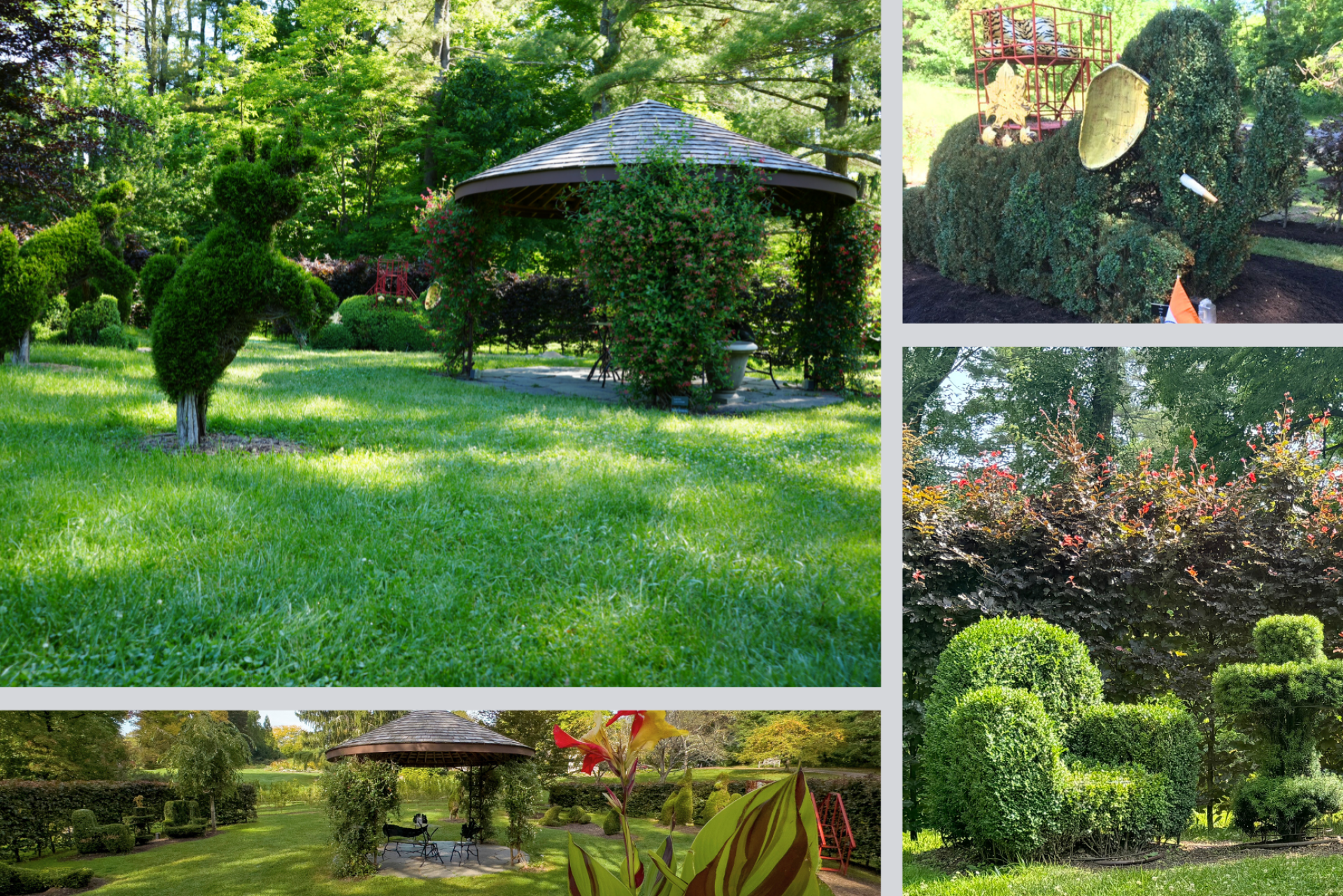 Tanglewood is like a temple: it hits pretty hard on the symbolic level, starting with the
landscaping.
Tanglewood is like a temple: it hits pretty hard on the symbolic level, starting with the
landscaping.
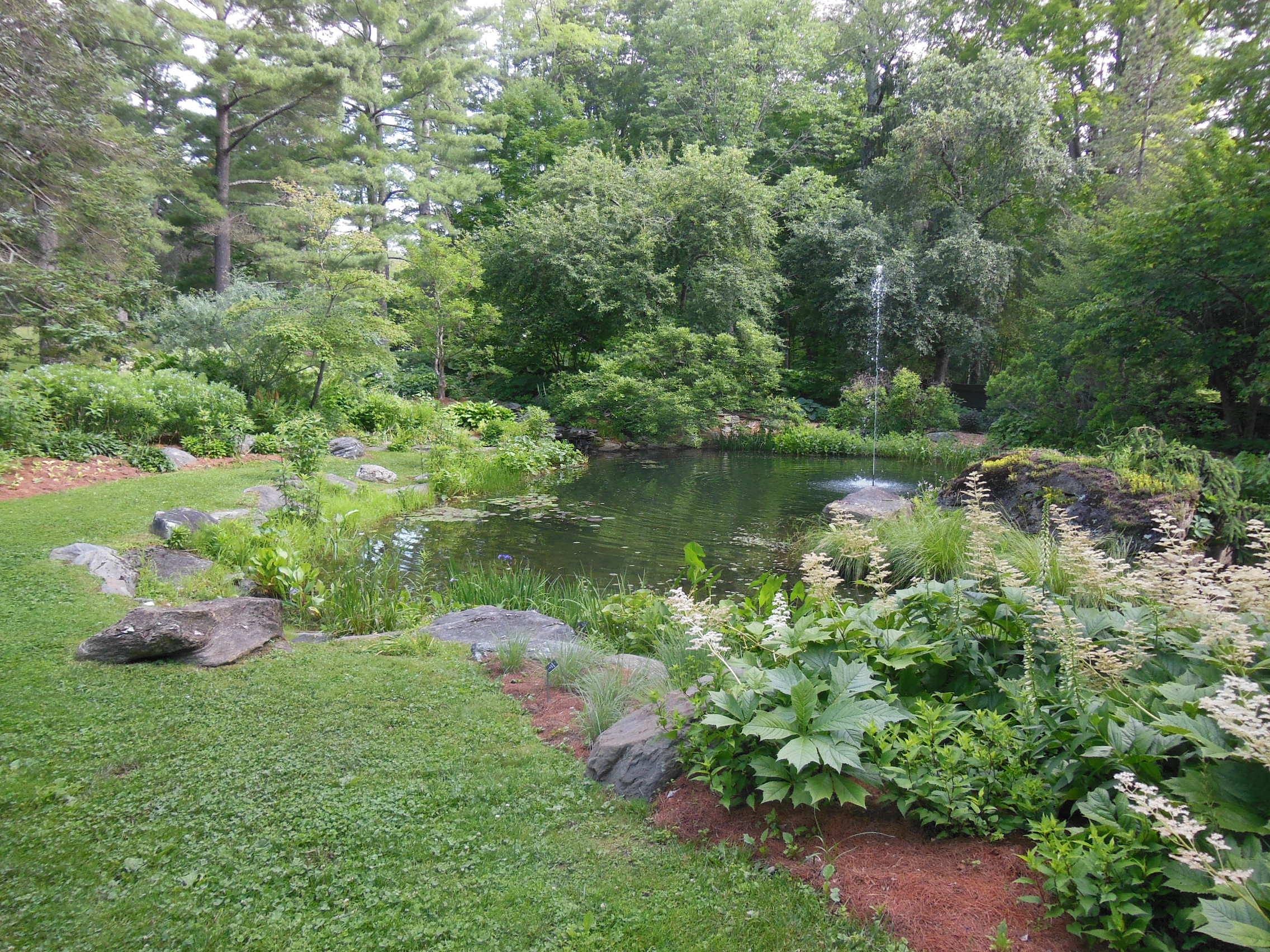
If I ignore my theology and let my imagination run wild, I imagine the prologue to an afterlife as a garden. (In my very personal fantasy, you get there by walking the Bridge of Flowers, also in western Massachusetts.) It’s arranged in a series of “rooms”, bordered by hedges and flowers, perhaps arranged in the shape of the 13th century Labyrinth at the Cathédral Notre-Dame de Chartres.
In each room in my dream, one can pause to consider the shortcomings of one’s life, and what manner of tikkun is required to repair it. Perhaps each room features a psychoactive tea from the plants growing there, empathogenic or entheogenic in their effects. At the center of the labyrinth, we eventually reach… something.
This is what I think about in formal gardens. (Yes, I am peculiar. Feel free to laugh, if you like. Go ahead, I’ll wait.) The garden shown here is at the Berkshire Botanical Garden, which is also worth a visit, should you ever find yourself in the Berkshires with some part of eternity to spare and want to walk some garden rooms to assess yourself.
Of course, no formal garden is completely free of topiary madness, as one can see here. (Who’s gonna sit in that giant hedge-chair?!) I don’t quite know why this is always the case, but I suspect it’s for the same reason I have Lewis Carroll in a place of honor on my bookshelf.
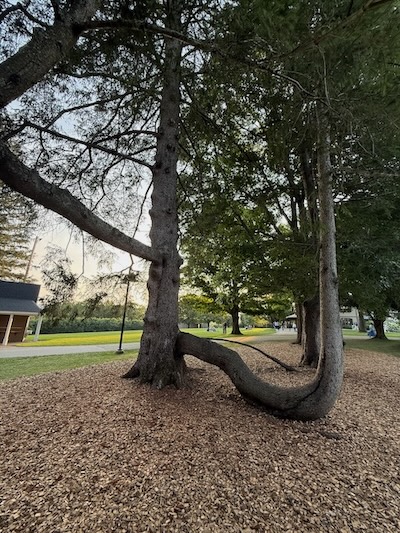 But at Tanglewood, the gardeners take surreal formal gardening quite a few steps further,
apparently engaging in topiary madness with actual, full-sized trees.
But at Tanglewood, the gardeners take surreal formal gardening quite a few steps further,
apparently engaging in topiary madness with actual, full-sized trees.
I’m sure there’s some “explanation” of the right-angle madness with which this tree has been trained, and I’m curious to know what it is. In the meantime, we’ll just enjoy the ambiguity and dream of the reasons, as Cabell wrote in Something About Eve: A Comedy of Fig-Leaves:
After dark, Antan always displayed eight lights, six of them grouped together in the middle of the vista with the general effect of a cross, and the other two showing much farther off to the northwest. About those never-varying lights Gerald had formed at least twenty delightful theories, all plausible as long as you remained upon Mispec Moor, whereas if you went to Antan not more at most than one of these theories could prove true.
To go to Antan thus meant the destruction of no less than nineteen rather beautiful ideas as to those lights alone.
Absent a formal garden tour awash with explanations, we’ll just have to enjoy the topiary ambiguity.
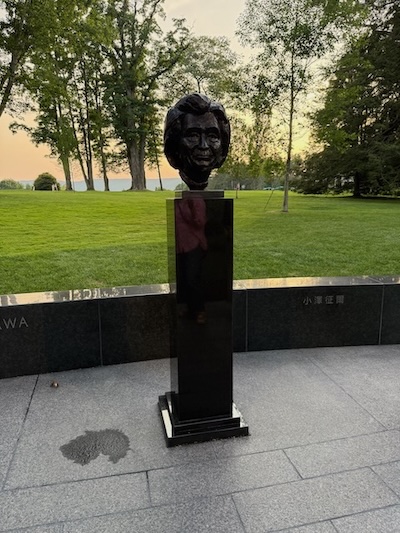 Other sights include monuments to musical stars of the BSO and Tanglewood, such as Seiji
Ozawa, seen here. He was unquestionably a giant of classical music in Boston, having
been the BSO music director for 29 years. He preferred to be called “Seiji”, rather than
the usual “maestro”.
Other sights include monuments to musical stars of the BSO and Tanglewood, such as Seiji
Ozawa, seen here. He was unquestionably a giant of classical music in Boston, having
been the BSO music director for 29 years. He preferred to be called “Seiji”, rather than
the usual “maestro”.
However, what I’ve read of him described his leadership style as being on the “autocratic” and “erratic” style. In particular, there was apparently quite a deep conflict with the faculty at Tanglewood, so it’s ironic to see his bust displayed so prominently here.
Perhaps both sides forgave each other. Or so one can hope.
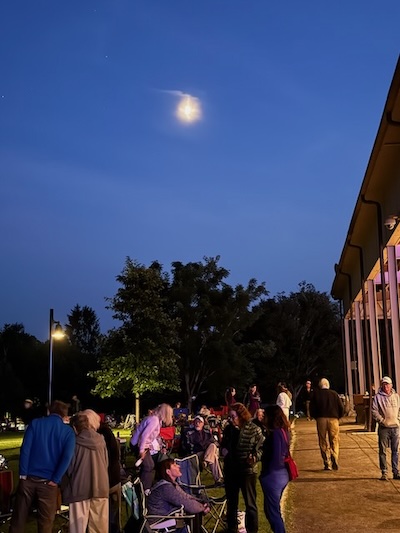 Since it was a midsummer’s night – though without Puck – it was nice to see a
summer half-moon. I believe
the name for the August full moon is the “Sturgeon Moon”,
so we are attending Tanglewood Under the Half-Sturgeon Moon… which is somewhat
lacking, poetically, rhetorically, and astronomically. (Though it would be fun to
fantasize that it’s named after Ted Sturgeon.)
So let’s just go with a beautiful moonlit midsummer’s eve, and let the Shakespearean echoes
rattle about us.
Since it was a midsummer’s night – though without Puck – it was nice to see a
summer half-moon. I believe
the name for the August full moon is the “Sturgeon Moon”,
so we are attending Tanglewood Under the Half-Sturgeon Moon… which is somewhat
lacking, poetically, rhetorically, and astronomically. (Though it would be fun to
fantasize that it’s named after Ted Sturgeon.)
So let’s just go with a beautiful moonlit midsummer’s eve, and let the Shakespearean echoes
rattle about us.
There’s a great deal more to be seen on the Tanglewood grounds, but we lacked time and daylight to capture much more. In particular, there are a couple of interesting mansions and a formal garden. (And now you know how I react to formal gardens, so you understand why I want to see that sometime during the daylight!)
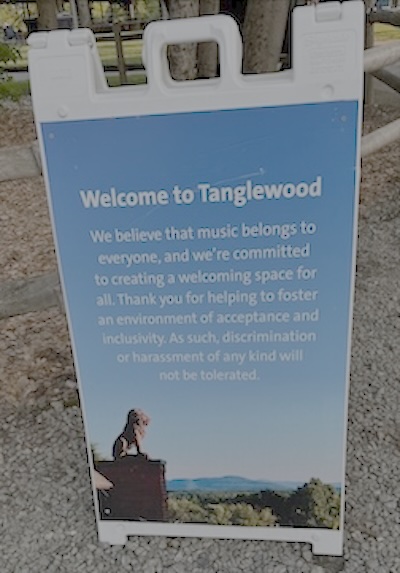 In these degenerate days, diversity/equity/inclusion (DEI) and wokeness (awareness of, and
intent to do something about, structural racism) have been turned into rage-spittle epithets
by American Republicans.
In these degenerate days, diversity/equity/inclusion (DEI) and wokeness (awareness of, and
intent to do something about, structural racism) have been turned into rage-spittle epithets
by American Republicans.
So it’s nice to see, as shown here, that Tanglewood has not yet bent the knee to Gadianton. This sign, right after “Welcome to Tanglewood” is one of the first things that greets you: discrimination or harassment of any kind will not be tolerated. (Though I’m not sure what the lion’s all about?)
It’s also nice to see a public acknowledgment of the idea of a commons, here in the claim that “music belongs to everyone”. Let us hope we are not about to re-enact the Tragedy of the Commons.
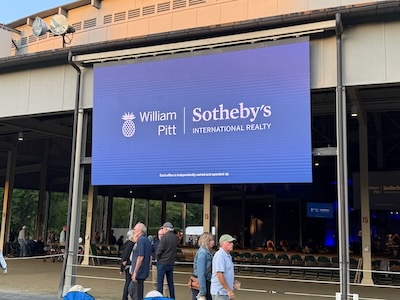 Still… it’s very much a class thing. When the giant video monitors start
advertising Sotheby’s international realty business, you know you’re among the 1%.
Still… it’s very much a class thing. When the giant video monitors start
advertising Sotheby’s international realty business, you know you’re among the 1%.
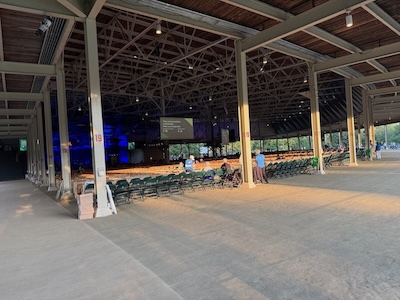
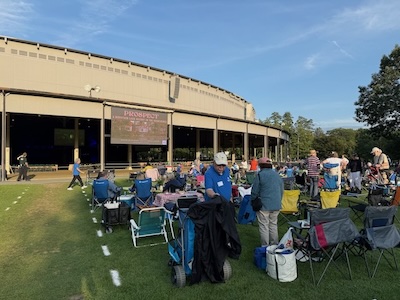 To some extent, this is reflected in the seating arrangements.
- At higher cost, you can purchase ‘shed’ tickets, which are under the roof of an open-air facility. It is yclept ‘the shed’ with the faux modesty of yesteryear’s upper class. In fact, it is an engineering marvel of acoustics which manages to be echo-free, amplifying and focusing the sound from the stage both within the shed itself as well as pushing out significant sound to the lawn.
- At more ordinary cost, there are ‘lawn’ tickets. The beautifully manicured lawn around
the shed is used as a picnic space before concerts, and as a blanketed spectator space
during the concerts. This area also has its subtle technological marvels:
-
The acoustics are some mix of speakers and direct sound from within the shed whose nature I couldn’t divine: they managed to make coherent sound over a large area without distortions, delays, or echos.
If you’ve ever had 2 Zoom calls in the same room, you know how difficult that is!
-
The screens show you what’s going on at the stage, with various views from either a shed spectator’s or the musician’s point of view. What’s interesting about that is that, while they can be seen clearly after dark, they can also be seen before sunset, when they are in full sunlight. Have a look at that Sotheby’s advertisement above: that picture was taken of a a western-facing monitor in full sunlight, but still bright enough that it can be seen!
This is… extraordinary. I wonder how long it’s been that good?
-
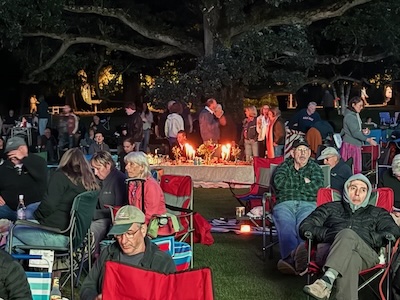 Our hosts, who are about as down-to-earth as one can get, have the usual social class
stories one encounters at Tanglewood. Once they were wheeling in their picnic cart (yes,
people have “picnic baskets” that require wheeled carts, example shown here). A couple of
“blue-haired old ladies” were overheard to say, “Oh, look! The lawn people are here.”
Our hosts, who are about as down-to-earth as one can get, have the usual social class
stories one encounters at Tanglewood. Once they were wheeling in their picnic cart (yes,
people have “picnic baskets” that require wheeled carts, example shown here). A couple of
“blue-haired old ladies” were overheard to say, “Oh, look! The lawn people are here.”
So… yeah. We’re the lawn people. And proud of it.
About those “picnic baskets” that require something the size of a shopping cart to move around… Some people take this really seriously, complete with candelabra. Shown here is one such construct, strongly resembling a religious altar. It was conspicuous enough to be useful to me as a navigational beacon in the dark, upon returning from the restroom. In a way, it was an altar, to a refined culture. Yes, Tanglewood is a mixed message about class, but it also teaches very high cultural tastes. (Yes, I know that is very non-postmodern of me. I am, in fact, very much non-postmodern; mild but unreconstructed fan of structuralism, in some ways. Or perhaps i should say, “undecostructed”?)
The Music
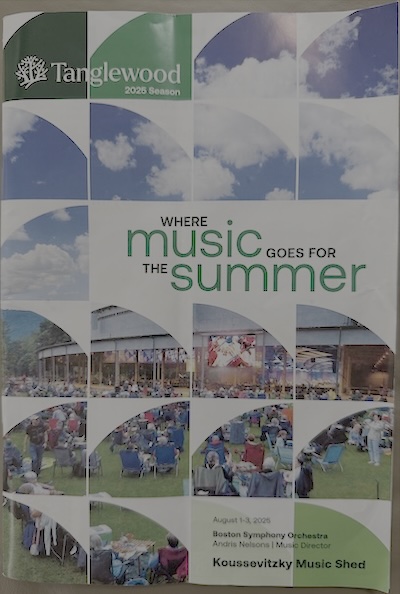 Here’s the program for the evening’s revels.
There were 2 rather big pieces performed:
-
Erich Korngold’s Violin Concerto in D, Opus 35.
I knew nothing of Korngold (let alone anything of this particular piece), and didn’t want to be That Guy reading the program notes by the light of my phone, instead of listening. Nor will I pretend to know what I’m talking about after reading a couple of Wikipedia articles. Suffice to say that it was good – though I’m unlikely to have appreciated much of the nuance, being a barbarian.
I do note, however, that Korngold was born in 1897, composed this in 1937 at about age 40. This will be interesting momentarily.
-
Sergei Rachmaninoff’s Symphony No. 2 in E Minor, Opus 27.
I’ve at least heard of Rachmaninoff, to the extent that I can even spell his name, in some Romanization or other of the Cyrillic original. Again, it was a pleasant experience, but my barbarian limitations prevent me from having much of anything useful to say about it.
It is worth noting here that Rachmaninoff was born in 1873, composed this piece in 1906-1907 at about age 33-34. Hold onto that fact, too.
-
The guest conductor for the evening was Elim Chan.
Again, I knew nothing of her before this, because… you know, barbarian here. Her biography says something like “born in Hong Kong, went to Smith, conducted here, and here, and here, and here, …” and so on at rather alarming length. In other words, she’s conducted just about every major world orchestra. You don’t get invited to do that without having something going on, so I kind of wanted to see what it was (q.v.).
She was born in 1986, and was 38 years old on the night of the concert.
Society often thinks of classical music as something like “music for old rich people”.
But note the ages here:
- Korngold composing at age 40,
- Rachmaninoff composing at age 33-34, and
- Chan conducting at age 38.
All were in their mid to late 30s (very mildly stretching a point for Korngold), so they are each of comparably young ages! Sure, this is adult music, but it was composed, conducted, and to an extent performed by young-ish adult people.
So the “music for old rich people” thing is another shibboleth of which we must let go.
The Experience, Through Barbarian Eyes
Perhaps in my capacity as Guest Barbarian, I may point out some side aspects to the concert that those of you who are more musically baptized did not see?
The Players
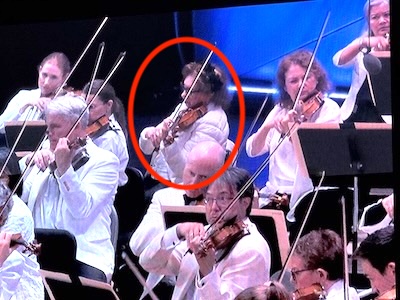 It gets cold(ish) at night in the Berkshires… at least, according to the Weekend Editrix.
According to me, 60-65°F is quite comfortable. But, apparently this is a minority opinion.
It gets cold(ish) at night in the Berkshires… at least, according to the Weekend Editrix.
According to me, 60-65°F is quite comfortable. But, apparently this is a minority opinion.
For musicians, this is an issue: like athletes, they must keep their muscles warm to perform properly. So check out the violinist, in technical compliance with the dress code colors, wearing a white down jacket. In August, but she knows what she’s doing!
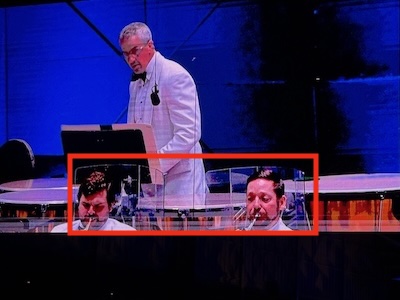 Next, note the plastic barrier behind the heads of the brass players, in front of the tympani.
Probably it’s to prevent going home with a headache from having your head inside a tympani
all day.
Next, note the plastic barrier behind the heads of the brass players, in front of the tympani.
Probably it’s to prevent going home with a headache from having your head inside a tympani
all day.
But… my over-active imagination demands a better reason:
In the eternal war between percussionists and brass, the tympanists occasionally express their disapproval with small arms fire. This was brought to an end with a treaty establishing a light bulletproof screen. Should the tympanists violate this treaty, the brass players will reach under their seats to pull out the bazookaphone, an instrument usually reserved for the Boston Pops 4th of July concert on the Esplanade, in the artillery movement of the 1812 Overture.
There. Isn’t that more fun than “don’t go home feeling like you’re that guy inside the drum in The 5000 Fingers of Doctor T” (which is what my childhood musical education was like)?
The Conductor
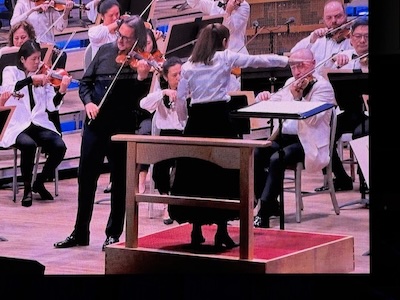 First, we must note that Elim Chan is a tiny person.
Here we see her on the stand behind the podium, wearing heels. (Those are thick heels, like the Cuban heels of my long-ago youth, because she will be jumping about quite a bit. Stiletto heels would pose a danger both to herself and to all nearby.)
Note that, with both of those effects, she is still shorter than Leonidas Kavakos, the violin soloist. When they briefly embraced at the end of the piece (which I unfortunately did not capture, because I am a terrible photographer), he was still taller than her.
I think being tiny has made her feel she must prove herself physically, leading to a very kinetic conducting style that’s fun for the audience to watch. (The musicians seemed pretty ok with it, as well.)
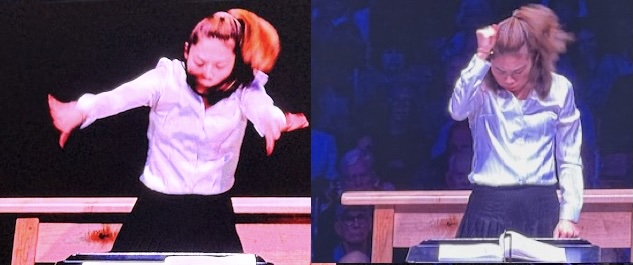
She also wears her hair in a ponytail, which is in full fling, flying about as she conducts, as you can see here. I’m pretty sure this is a deliberate, choreographed effect she employs to have a larger physical presence.
Honestly, she reminds me of Natalie Merchant in her long-ago 10,000 Maniacs days. She would dance while she sang, and fling her hair about in an utterly captivating way. Here’s an example singing “Don’t Talk” from her YouTube channel. (If the music isn’t entirely to your taste, just briefly consider her dancing, e.g., at 1:30.) It’s so clear she’s having an absolutely wonderful time, you can’t help but feel the same.
Chan is, I believe perhaps consciously, attempting to convey that same joy and enthusiasm by – almost – turning her conducting into a dance performance. Understanding whether she’s dancing for the musicians or for the listeners… well, that’s above my pay grade.
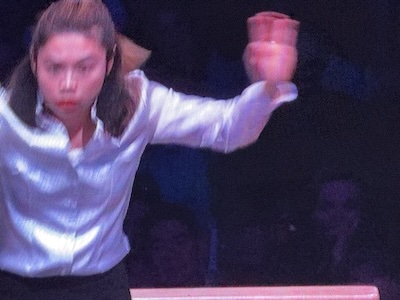 Occasionally, the camera from the viewpoint of the musicians catches here in an intense
look, like the one shown here. You’d do what she asked too, if she looked at you like
that! There were several other moments which I failed to capture photographically (again
because I’m awful with a camera):
Occasionally, the camera from the viewpoint of the musicians catches here in an intense
look, like the one shown here. You’d do what she asked too, if she looked at you like
that! There were several other moments which I failed to capture photographically (again
because I’m awful with a camera):
-
At one point, she grinned at the horns just after a particularly showy passage. I imagined her congratulating them, saying:
Yeah, you just did that. I heard it. Everybody heard it! You’re cool.
-
She apparently does not use a baton, or at least did not for this performance. She has at least 10 batons, to which we barbarians usually refer as “fingers”.
At the beginning of one movement, we saw her grin at the musicians, and tug up each sleeve, in the classic “nothing up my sleeves” move beloved of stage magicians. I imagined her saying:
See? Nothing up my sleeves. No baton! I don’t need a magic wand to work magic on you. I can squeeze Rachmaninoff out of you by the strength of my bare hands… and you will thank me for it!
One (minor) odd note: With a conducting style that kinetic, she has to raise her arms quickly many times, leading to her otherwise lovely silk blouse becoming untucked from her nice long black skirt. So she conspicuously tucked it back in, at the end of every movement. Someone get this woman a tunic! She needs a top that does something like cinch at the waist, but then flow over the skirt, perhaps even with a weighted border (as the British royals are rumo(u)red to do with curtain weights in skirts and kilts).
But, fine. We might as well tell her, “Look, if you’re gonna be that interesting to watch, then just tuck all you want. We’ll wait.” I could watch her conduct a pretend orchestra with no sound, just for the choreography.
The Weekend Conclusion
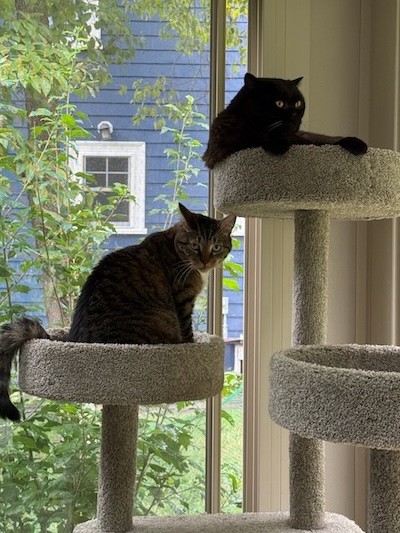 The true aristoi Chez Weekend are, of course, the Weekend Publisher and the Assistant
Weekend Publisher, shown here.
The true aristoi Chez Weekend are, of course, the Weekend Publisher and the Assistant
Weekend Publisher, shown here.
Not for them the plebeian lawn seats! Oh, no: they are seen here ensconced in their customary box seats from which they may survey and judge the hoi polloi, who are both physically beneath them and socially infra dig.
In case you’re curious about the sound track backing the writing of this post, start with, e.g., Michelle McLaughlin, “Middle Way”, from The Beginning of Forever and variations suggested by one of my Pandora channels.
Not really the same, of course, as what we heard at Tanglewood. But sometimes this sort of ambient piano music puts me in a spiritual frame of mind.
Sort of like a formal garden. :-)
So that was our trip to Tanglewood, with lovely friends. Or at least, it’s what I can perceive from my merely barbarian musical state.
(Ceterum censeo, Trump incarcerandam esse.)
Notes & References
Nope.
Gestae Commentaria
Comments for this post are closed pending repair of the comment system, but the Email/Twitter/Mastodon icons at page-top always work.