
The Lawnmower Battery Surgeon Never Really Goes Away
Tagged:CatBlogging
/
Physics
/
ϜΤΦ
Every couple years, the battery on my now-antiquated electric lawn mower stops taking a charge. It’s been a couple years since last time, so…
The Third Session with the Lawn Mower Battery Surgeon
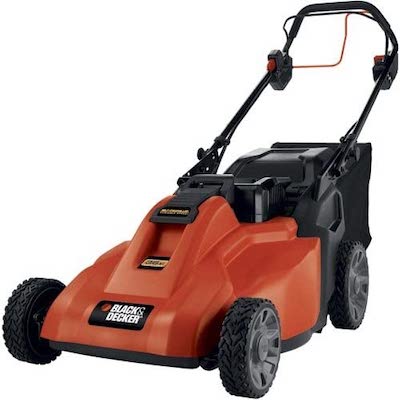
The Venerable Black & Decker SPCM1936
 It is a truth universally acknowledged
that anyone, having acquired a suburban American house, must be in need of a lawn mower.
It is a truth universally acknowledged
that anyone, having acquired a suburban American house, must be in need of a lawn mower.
And so it was, Chez Weekend, with the purchase of Château Weekend some 15 years agone. The mighty mowing machine in question has been the Black & Decker SPCM1936 battery-powered self-propelled lawn mower. We have no particular complaints about the machine, beyond 2 facts:
- It is no longer made, so there are no replacement parts to be had anywhere.
- The battery is also no longer made, so when it gives out, things become difficult.
It’s worth pointing out: batteries are consumables, eventually ceasing to function because of the formation of internal dendrites or the like. If you don’t manufacture replacement batteries, the tools dependent on them become useless. If you’re a manufacturer, no doubt you’re hoping consumers will just buy newer equipment from you, ensuring repeat sales of big-ticket items.
If you’re a consumer, you may have other ideas on this subject, some of them rather testy.
We’ve had a snowblower become useless that way, so we replaced it with another model from a company whose batteries fit all their tools. So right now, the snowblower, leaf blower, and string trimmer all use the same battery form factor. They can’t stop manufacturing the battery unless they trash their entire product line, which is the kind of leverage I like as a consumer. If we replace the lawn mower next year, it will be with a model using that battery system.
In the meantime, our venerable SPCM1936 is determined to make itself useless. We managed to scrounge one replacement battery around 2018, but that one had been sitting on a warehouse shelf somewhere for years, and hence had dubious battery chemistry. Since then, we have twice opened up the battery, yanked the 3 sealed lead-acid cells for recycling, and replaced them, following in the footsteps of numerous sages of YouTube. [1] [2]
This… works, but is a pain.
Today we have to do it again, making this our 5th battery in 15 years.
Say it with me: batteries are consumables.
The Surgery
 After first propitiating the various trickster deities (most of whom are related to
Wolfgang Pauli, waiting to pounce upon aging
theoretical physicists attempting anything practical), we began the surgery.
After first propitiating the various trickster deities (most of whom are related to
Wolfgang Pauli, waiting to pounce upon aging
theoretical physicists attempting anything practical), we began the surgery.
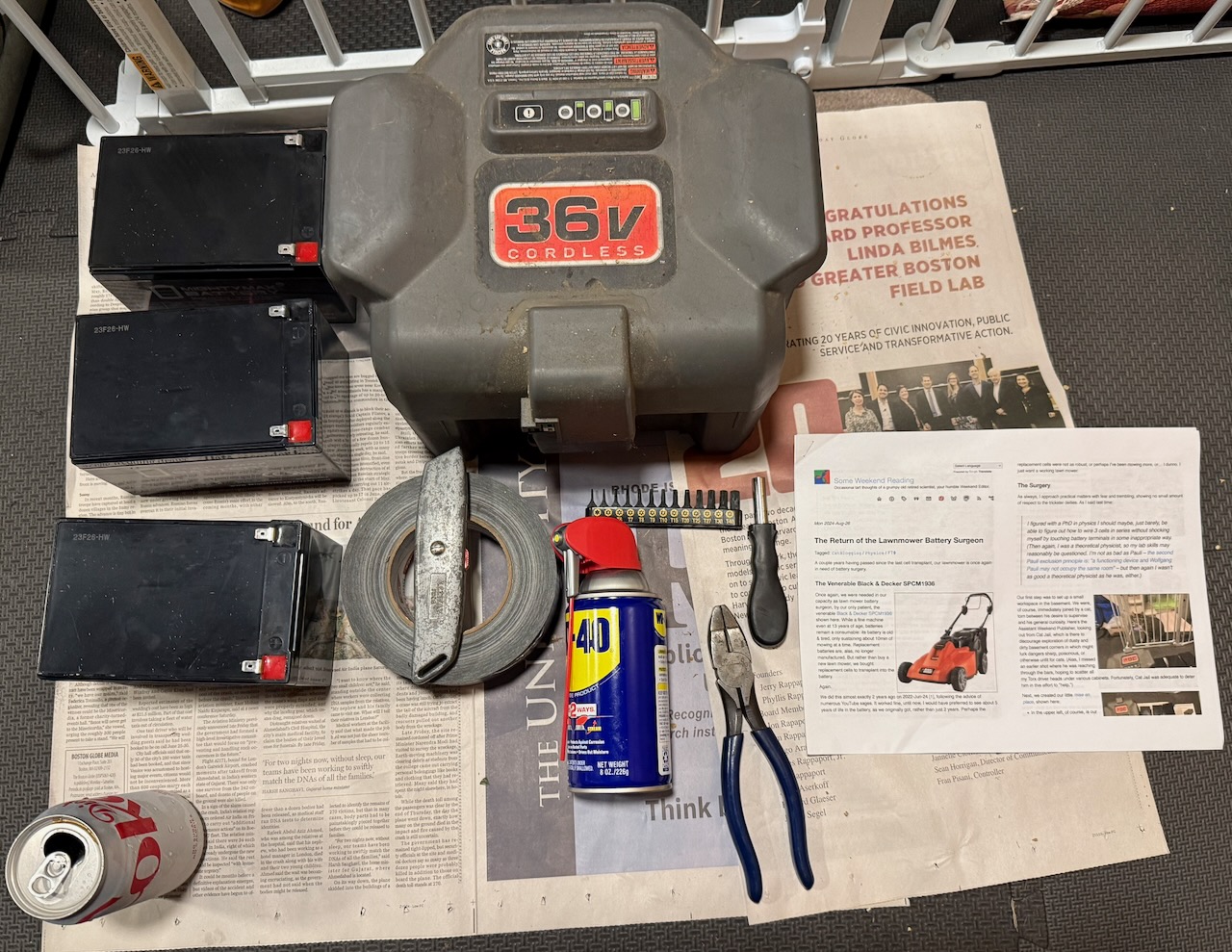
Here you see our mise en place. Unlike the previous time, we were not this time under the supervision of the Assistant Weekend Publisher — the junior cat Chez Weekend — as he was assisting the Weekend Publisher in some urgent cat-napping business. So nobody was in Cat Jail this time, eager to bat small parts into dark basement corners under heavy cabinets.
- Top center is the main attraction, our patient etherized upon a table, ready for organ replacements.
- To the right are 3 replacement organs, in this case 12 volt sealed lead-acid batteries to be wired in series for 36 volt service.
- The surgical tools include torx drivers (T20 is the one you want), some pliers and WD-40 in case of recalcitrant parts, and a utility knife with duct tape. Because… duct tape.
- Also, because I am not foolish, or at least not foolish in that way, there is a printout of our escapades in battery surgery from 2 years ago, to remind us where the various internal organs are located and what hazards lie in wait.
- A small caffeine refueling tank, in the form of Diet Coke, is for your humble Weekend Editor, who also runs out of charge pretty easily nowadays.
- As always, the venerable Globe undergirds all.
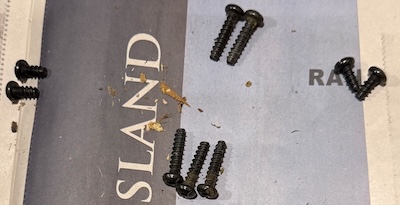
 The next step, of course, is the initial incision — or in this case, turning the
battery upside-down and removing the screws holding the lid shut with the T20 torx driver. We
lay them out as shown, in the same geometry as they go back on the lid at the end. Note
that they are of different lengths, so we would confuse this if offered the
opportunity. We always respect
the wisdom of Sgt Oddball, played by Donald Sutherland in the 1970 movie Kelly’s Heroes, about getting
out of trouble quicker than we got into it.
The next step, of course, is the initial incision — or in this case, turning the
battery upside-down and removing the screws holding the lid shut with the T20 torx driver. We
lay them out as shown, in the same geometry as they go back on the lid at the end. Note
that they are of different lengths, so we would confuse this if offered the
opportunity. We always respect
the wisdom of Sgt Oddball, played by Donald Sutherland in the 1970 movie Kelly’s Heroes, about getting
out of trouble quicker than we got into it.
(Ask me sometime how long it took me to learn that lesson.)
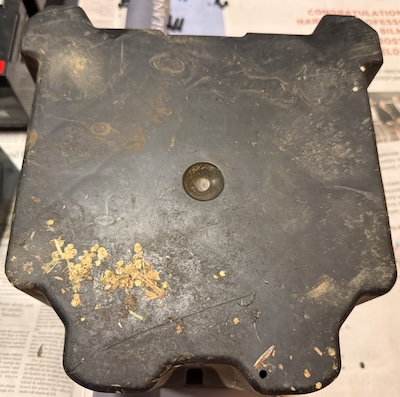
Backing up a bit to look at the larger picture of the bottom of the battery, we noticed something peculiar. In the lower right of the picture, there’s a drainage hole in the bottom of the battery casing. Now, the lid is screwed on tight with a rubber gasket, so it can’t be they think it’s gonna fill with rain water. Somebody decided, if the batteries leak, the liquid needs to drain out of the battery. So far, so good. But the genius who decided that also decided to leak battery acid on the lawn mower underneath, which is much more expensive than the battery!
I really do wonder about engineers, sometimes. Most times, really.
(Like the guy who invented the torx: do we really need something in addition to flathead and Phillips head screwdrivers, and incompatibly different? No, we do not. But, as all the existentialists say: nevertheless, here we are.)
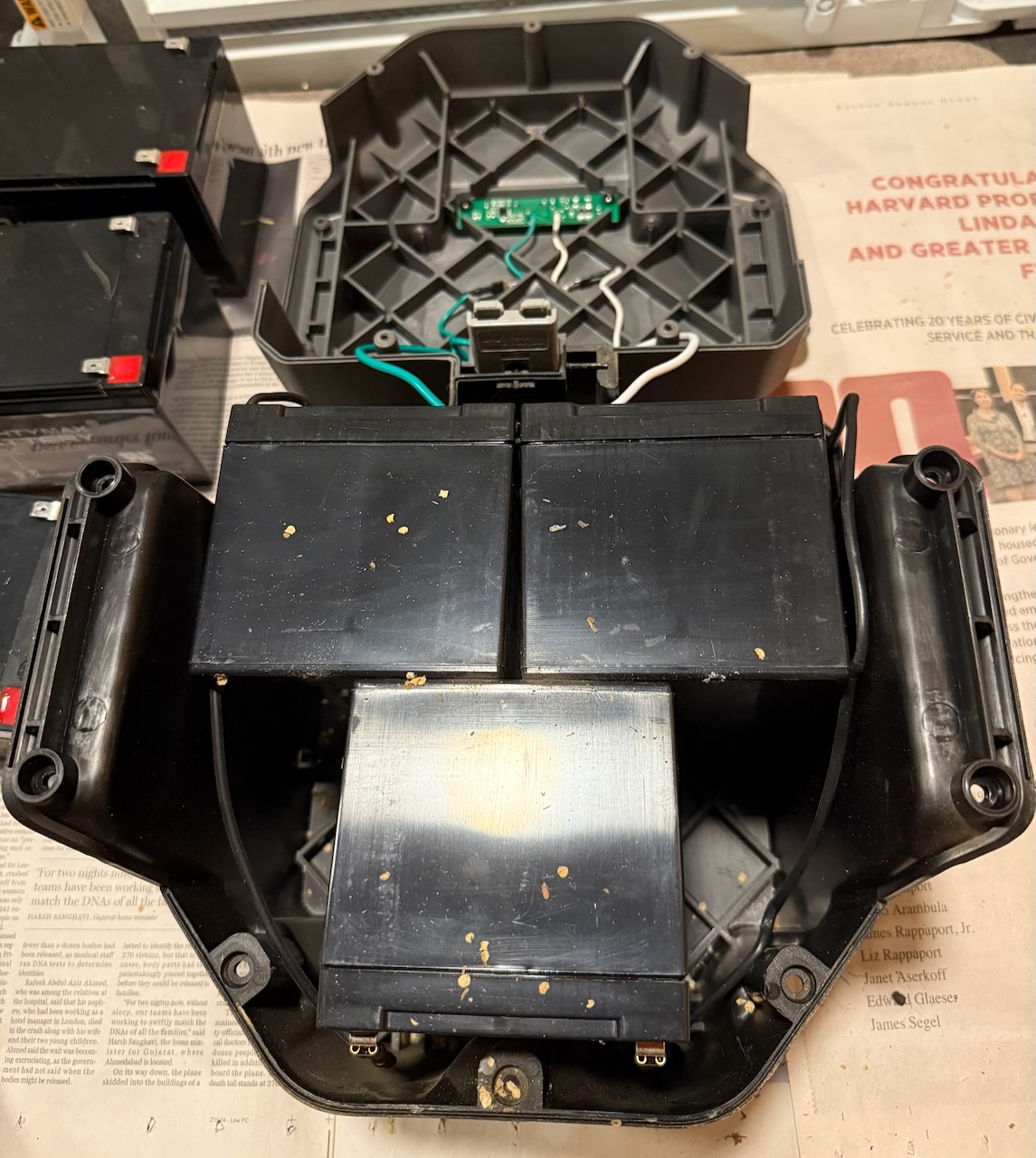
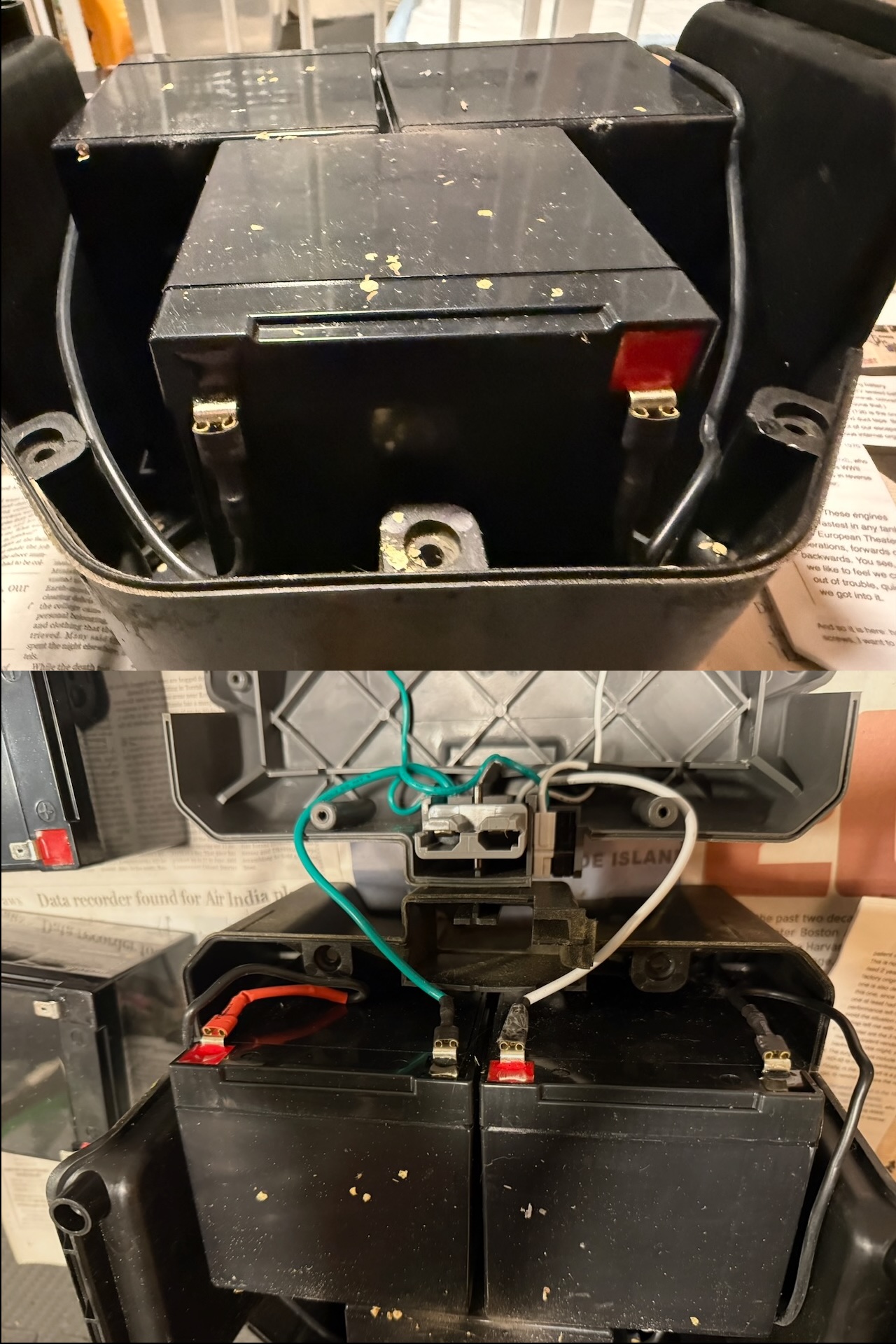 Next, we carefully turn the battery right-side up, taking care not to spill the guts.
Here’s a view from the top, showing the 3 cells and the little circuit board built into the lid. Oddly, it appears the old cells are not swollen, like their predecessors. But at least nobody’s leaking.
Because I’m a nasty suspicious old bastard, here also are pictures taken from the front and the back, showing which colors of wires connect to which colors of terminals. Honestly, a lot of this is just about not offering myself opportunities to Do Dumb Stuff. As we noted last time:
- Front cell: red terminal on the right, two black wires connecting routed from each side.
- Back 2 cells: red terminals on the left (looking down, remember this on the other side so the cells have been rotated). Black wire comes around on the left and acquires a red jacket, other black wire comes around on the right and stays black. Green and white wires connect to the middle terminals, as shown.
- Somewhat harder to see: in the gray clip just above the cells, there’s a small metal rod that holds the clip in position. If you look at it sideways, it will fall out and roll obstinately under some inconveniently heavy object. Do not permit it to do that.
After that, the surgery was straightforward, though one should always be careful not to commit the crime of Bad Touch on the battery terminals. Yes, it’s supposed to be an open circuit. But I have only 1 heart to use as a circuit tester, and I’m not going to risk using it up on this.
Upon reassembly, pushing the charge indicator on the top showed 3 lights. As terrible an approximation to battery state as that is, it’s what the manufacturer made and so what we believe.
The Weekend Conclusion
 The patient lived, and showed good appetite post-surgery by mowing tall, wet grass. Best I
can ask of a 15 year old mower with its brave new little battery transplant.
The patient lived, and showed good appetite post-surgery by mowing tall, wet grass. Best I
can ask of a 15 year old mower with its brave new little battery transplant.
Though the Assistant Weekend Publisher was not available to be Attending Cat in the surgery, he was available for valuable editorial assistance in writing this blog post. He wishes to remind everyone that there are often higher priorities, such as properly loving one’s cat.
He is correct.
(Ceterum censeo, Trump incarceranda est!)
(Et ceterum censeo, index Epsteiniani divulganda est!)
Notes & References
1: Weekend Editor, “My Brief But Spectacular Career as a Lawnmower Battery Surgeon”, Some Weekend Reading blog, 2022-Jun-24. ↩
2: Weekend Editor, “The Return of the Lawnmower Battery Surgeon”, Some Weekend Reading blog, 2024-Aug-26. ↩
Gestae Commentaria
Comments for this post are closed pending repair of the comment system, but the Email/Twitter/Mastodon icons at page-top always work.