Some Seasonal Observations
Tagged:Beauty
/
Math
/
CatBlogging
/
Obscurantism
/
Physics
/
Religion
/
TheDivineMadness
My favorite time of the year is in the depths of winter, with the cold and the dark and the various holiday observations that come with it.
The Analemma
 Incorrigible veteran readers of this Crummy Little Blog That Nobody Reads (CLBTNR) will
perhaps remember a number of previous posts around this time of year, noting the analemma
and that the day of earliest sunset is not the same as the shortest day of the
year. [1] [2]
Incorrigible veteran readers of this Crummy Little Blog That Nobody Reads (CLBTNR) will
perhaps remember a number of previous posts around this time of year, noting the analemma
and that the day of earliest sunset is not the same as the shortest day of the
year. [1] [2]
That’s all due to a wonderful former colleague who wrote an annual letter [3] many of us. For people who have no use for the idea of getting up at dawn, the time of sunset is the most important matter determining useful daylight!
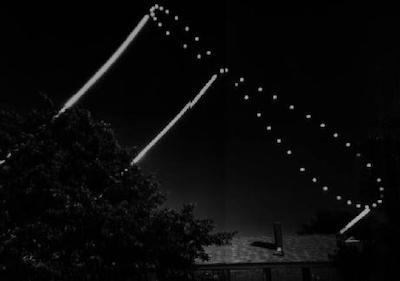
If you were to photograph the position of the sun in the sky at the same solar time each day, say at local solar noon, you’d see a picture like the one shown here. [4] There’s considerable math to be done here [5] [6], about the earth’s orbital dynamics. The spin axis is tilted (causing seasons) and the orbit is slightly elliptical leading to… well, peculiarities like the analemma.
 In times past, I’ve done a custom calculation for the current year. But… honestly,
the earthy’s orbit doesn’t change that much. The date of earliest sunset at my latitude
might move 1 day, but it’s always December 7 or so.
In times past, I’ve done a custom calculation for the current year. But… honestly,
the earthy’s orbit doesn’t change that much. The date of earliest sunset at my latitude
might move 1 day, but it’s always December 7 or so.
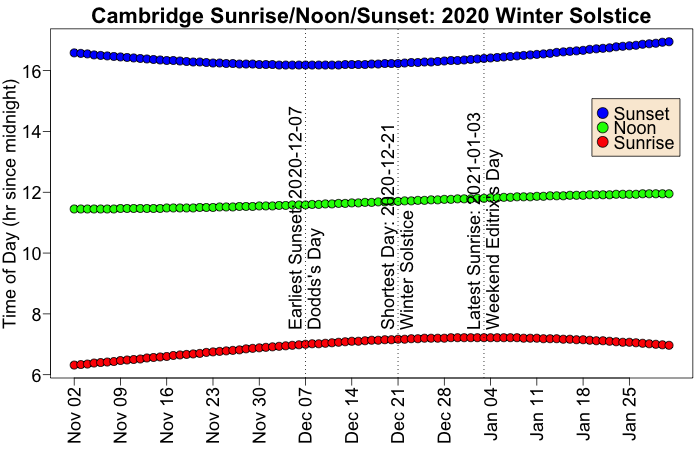
Here’s the plot from a calculation I did in 2020 for the Boston/Cambridge latitude, showing the date on the horizontal axis and the time of day for various solar events on the vertical axis. The time of sunrise is the red curve on the bottom, local solar noon is the green curve in the middle, and sunset is the blue curve at the top.
As you can see:
- the earliest sunset was December 7,
- the good ol’ solstice will be in its customary seat at December 21, and
- the latest sunrise – for those of you leading a tortuously early-rising lifestyle – will be on about January 3rd.
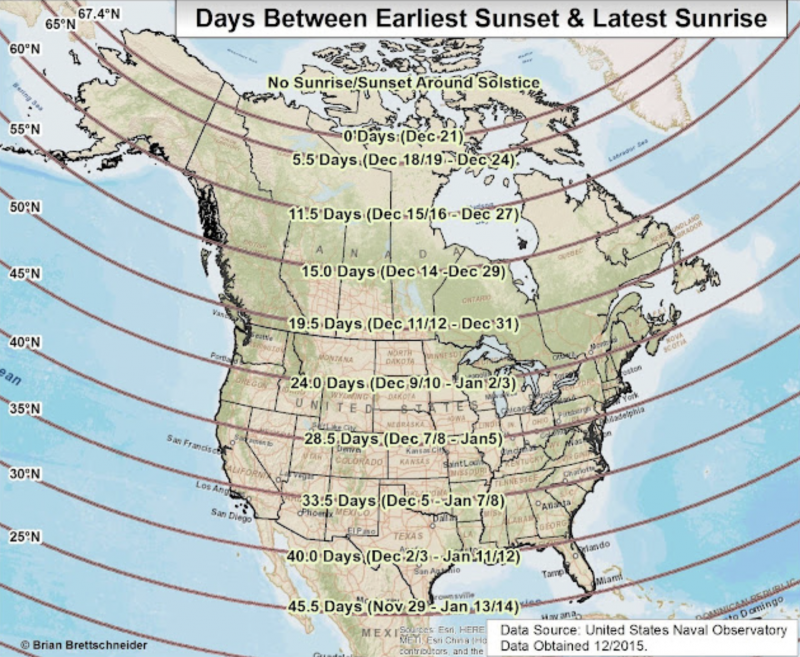
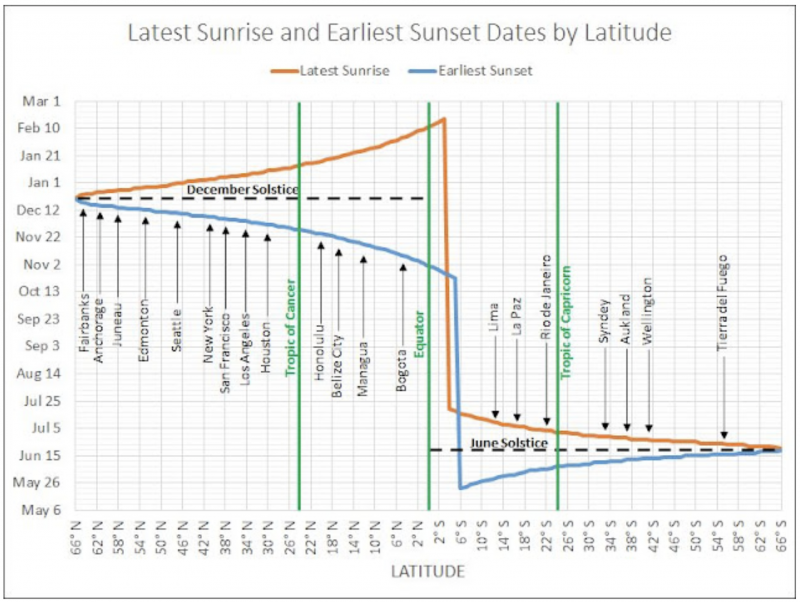 For those of you who live at other latitudes, of course the result will be different.
Rather than repeat my eccentric calculation above, you can simply read McClure at
EarthSky’s account [7] summary of some results calculated
by climate scientist Brian Brettschneider.
For those of you who live at other latitudes, of course the result will be different.
Rather than repeat my eccentric calculation above, you can simply read McClure at
EarthSky’s account [7] summary of some results calculated
by climate scientist Brian Brettschneider.
- Here on the map of North America you see the dates of earliest sunset and latest sunrise (along with the number of days in between), for various latitudes. It’s a function of latitude, so Europeans and Japanese can simply look at their latitudes on this map to get local results for their homes.
- If you’d like to get a full picture, including the southern hemisphere, have a look at
the plot. It shows the earliest sunset and latest sunrise dates as a function of
latitude all over the planet.
- Of course no such thing happens at the poles, so the latitudes don’t go above 66°.
- And of course everything reverses in the southern hemisphere.
- And, the equator is a funky place indeed! The window between earliest sunset and latest sunrise is widest there, but… the difference in times is minimal there! So you’re seeing the smallest effect sustained for the longest time at the equator.
Now, personally, I’m a fan of cold and dark and snow. Winter is The Good Stuff. But I admit this is a minority taste. If you, like the Weekend Editrix, long for the return of the light… your sunsets are already moving in your favor, toward more light.
(Now, if only we can get “more light” in the US’s political situation, that would be good. And no, I do not mean “mehr licht” in the sense of Goethe’s last words!!)
So: the denizens of Château Weekend wish you more light, both physical and metaphorical.
Reminding Ourselves of Better Things
 As another holiday custom, we like to attend some of the many, many musical celebrations
of the holidays offered in the Boston area.
As another holiday custom, we like to attend some of the many, many musical celebrations
of the holidays offered in the Boston area.
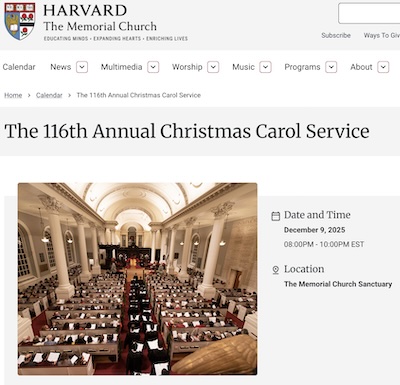
This year, as in recent years, that included the 116th annual Christmas Carol Serivce at Harvard’s Memorial Church.
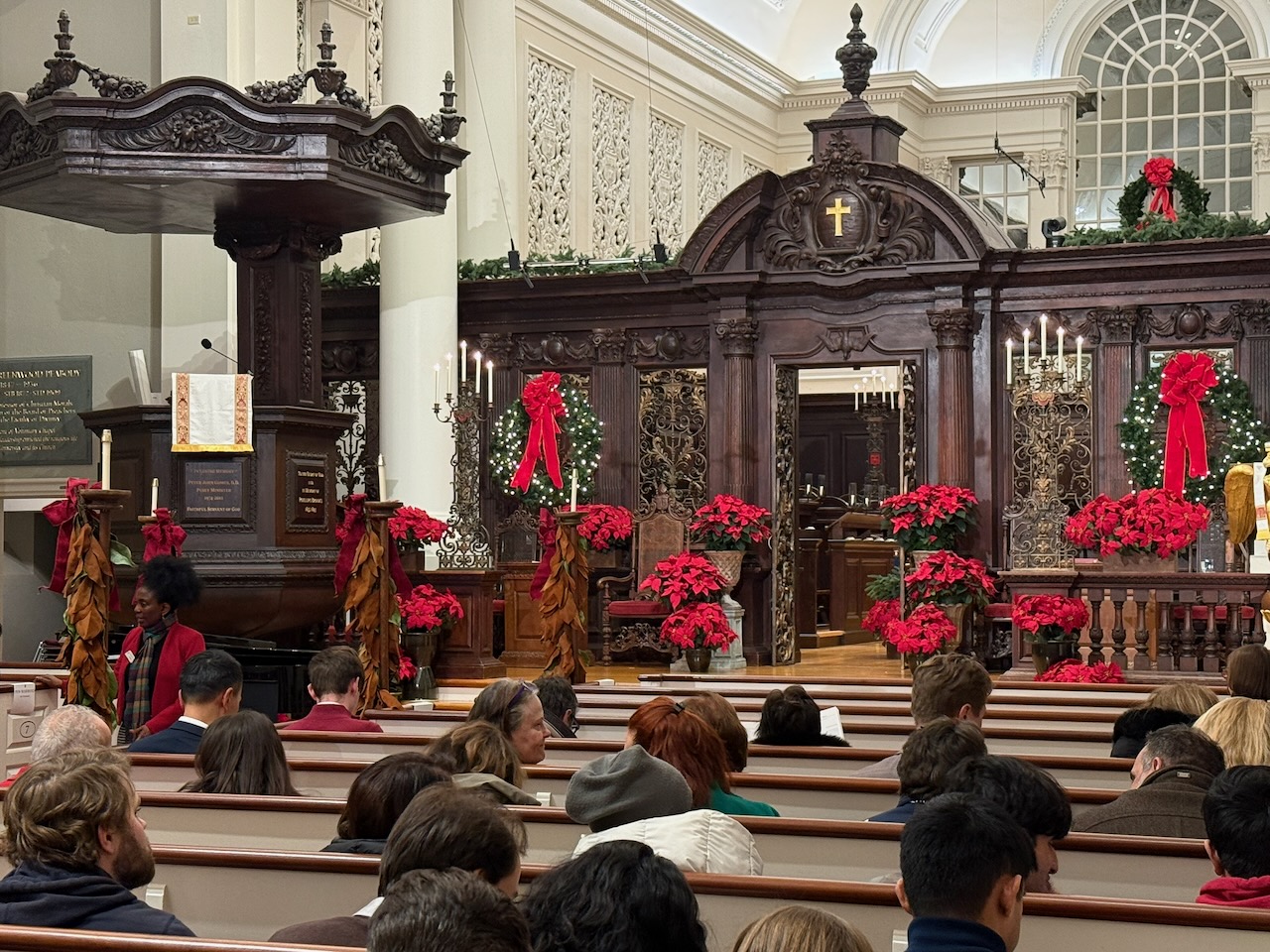
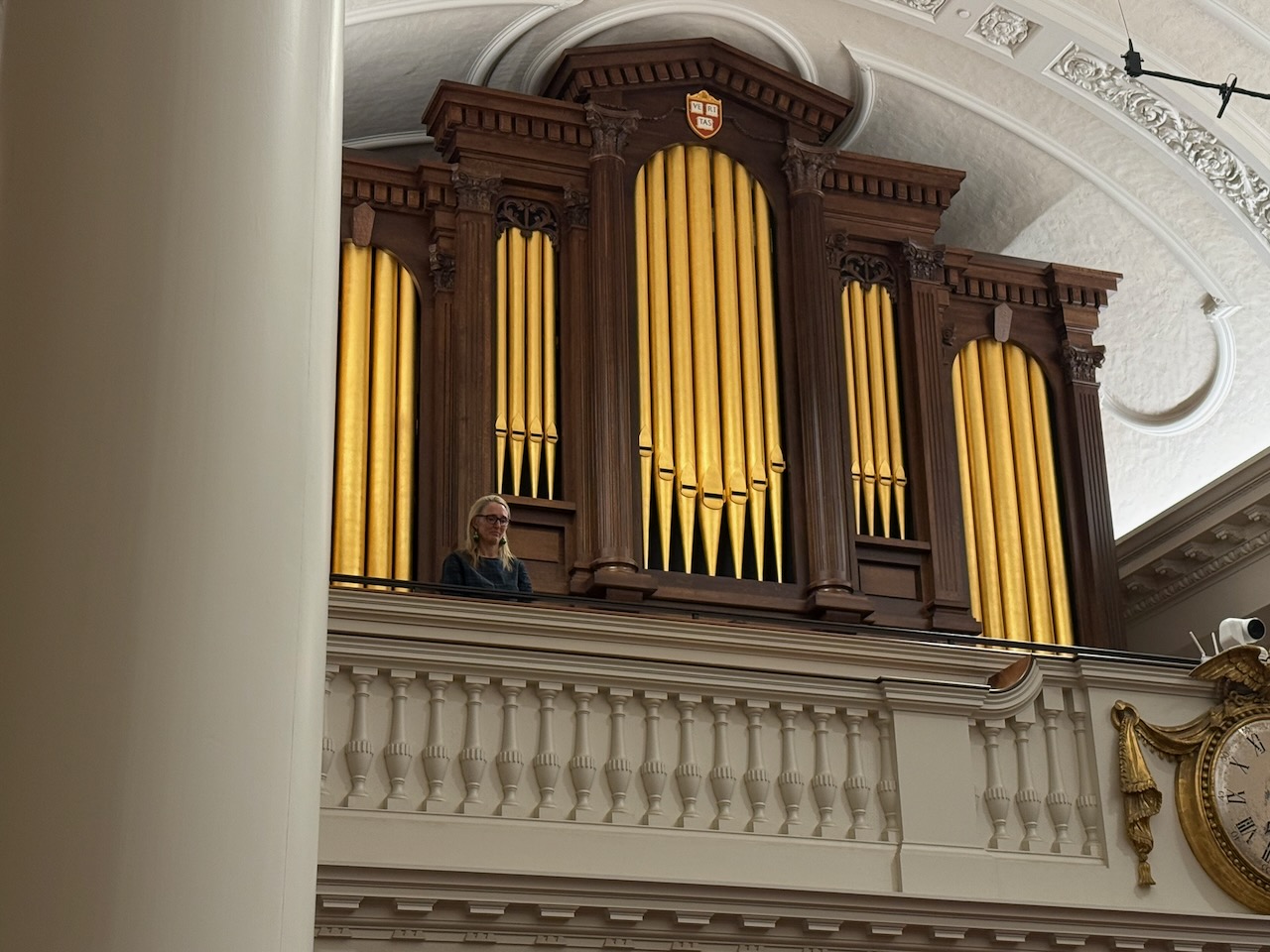
 Now, this is a very beautiful space, both for religious use and for concert use, and that
night we had both. Sometimes it’s important to let the space operate on you, to see what
emotions it will bring up, and what insights bubble up out of your subconscious.
Now, this is a very beautiful space, both for religious use and for concert use, and that
night we had both. Sometimes it’s important to let the space operate on you, to see what
emotions it will bring up, and what insights bubble up out of your subconscious.
Some things that struck me:
- The decorations worked subtly and well.
- The flowers and ribbons in red contrast nicely with the dark wood, without glaring.
- The candles (not especially visible in this photo) add a nice flicker effect that to me somehow lets me drift out of the mundane world. (I probably loved it even more as a kid; my adult self is uncomfortably aware of fire hazards in crowded old buildings.)
- I also liked the rood screen at the front. It’s usually found in Catholic, Anglican, and Episcopalian contexts, so it’s a but unusual in what is billed as a “non-denominational Protestant” space. Still, it subtly suggests to me that “there’s something more here, beyond the usual space you’re in just now.”
- In the balcony/choir loft above and behind us, there is an impressive pipe organ! Combined with the effect of having the choir above and behind you, this has a strong effect of making the sound 3-dimensional, situating you in space rather than in just a room.
-
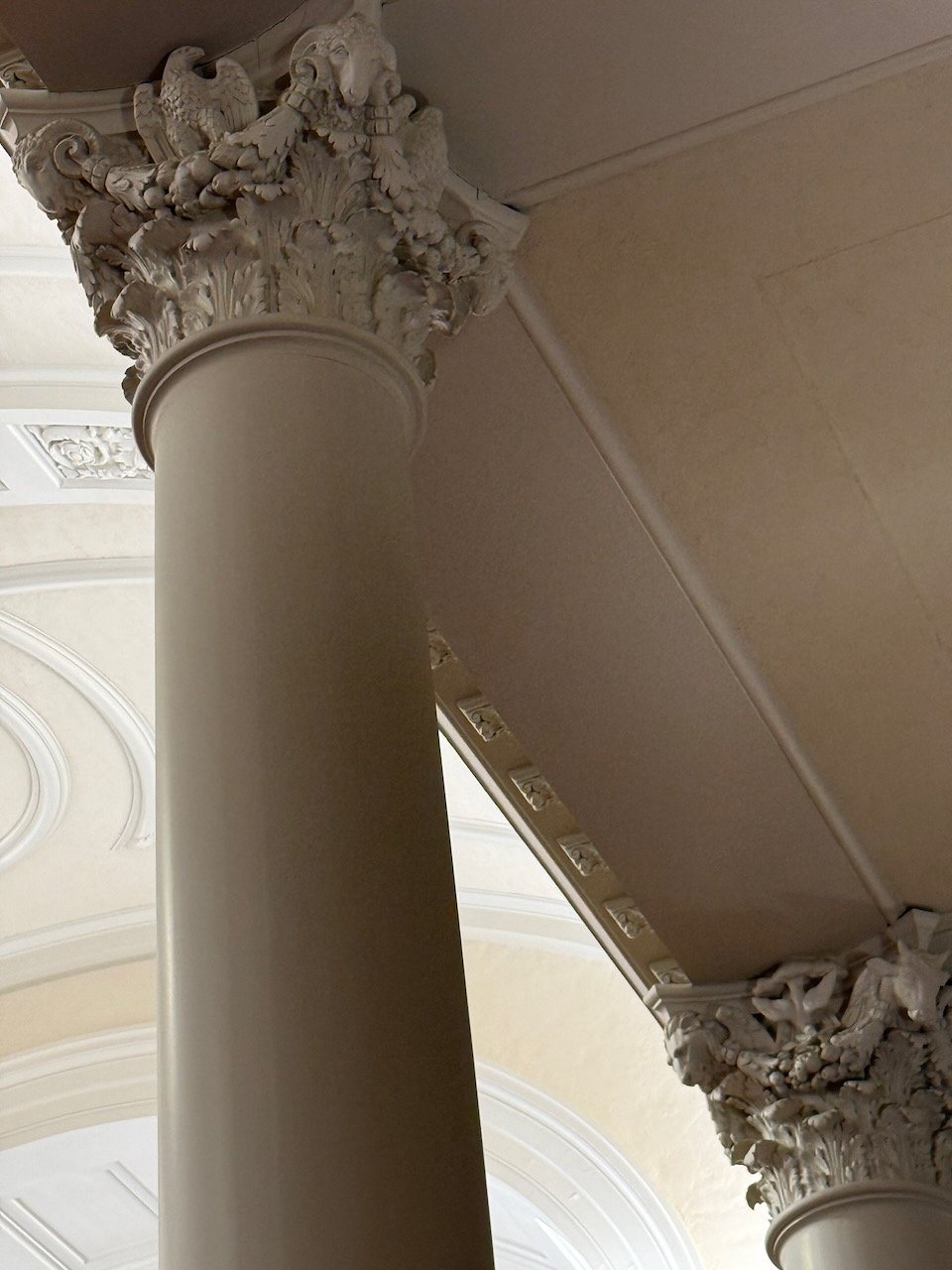
The supporting columns are kind of interesting, when you look closely at the sculptures on their capitals. I’m always fascinated by that sort of detail: somebody went to a lot of effort to design and create those elaborate carvings; what might they have been trying to communicate?
Some of it, at least, is clear.
This is a memorial church, dedicated to the memory of those who died in the world wars. The names (at least of those Harvard associated) are carved on the walls, which always makes me feel a little creepy.
Look closely at the photos of consecutive columns: they center alternating sculptures of a dove descending and an open-winged eagle. The dove descending is pretty straightforward: a reference to the holy spirit descending at the time of Jesus baptism, almost universally in Christianity parsed as a symbol of a divine blessing of peace. The eagle is pretty clear too, as a symbol of war – just look at some of the royal European escutcheons for some examples. So the columns say “alternating war and peace”, in a place of peace dedicated to the memory of war dead. That’s just about perfect.
(When I mentioned this to the Weekend Editrix, she looked at me strangely and said, “You said that last year.” So much for my memory.)
(Ok, there’s also a ram, a bull, and a lion at the corners of the capitals. As to the message there, I got nothin’.)
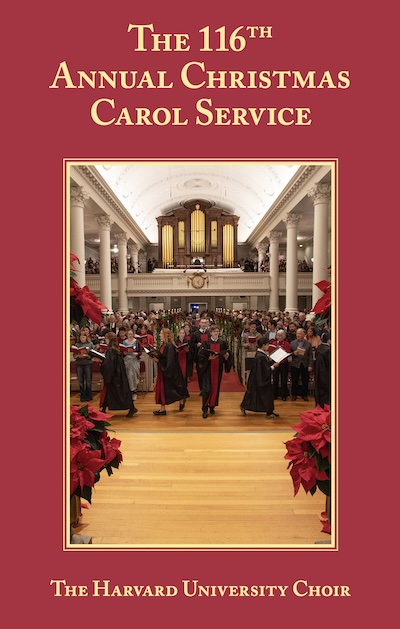 If for some reason you had the misfortune not to find yourself in Boston on the necessary
date, you can watch the service on YouTube
as shown here, and
look through the program yourself.
It’s worth your time.
If for some reason you had the misfortune not to find yourself in Boston on the necessary
date, you can watch the service on YouTube
as shown here, and
look through the program yourself.
It’s worth your time.
The prelude music by and large didn’t move me much, but the introit (@35:42 in the video) was deeply moving and so other-worldly it brought goose-bumps. No, not from cold. The sentiment of Populus qui ambulabat in tenebris (“people who were walking in shadow”) has a lot of impact on me. Not the least because the US is currently walking in some very deep shadows.
The processional (@ 38:47 in the video) had a similar impact on me. Singing in Latin (“Adeste fideles”) of course is a strong childhood memory and here it was done in a building in which, for ages, people were expected to know at least some Latin. Its effect was multiplied by being in a group, in winter, in a building designed to work on my subconscious, with flickering candlelight… It was hard to keep emotional control then, and I’m tearing up a bit now just writing about the memory.
At this point, I believe I am legally required to approve, under the General Laws of the Commonwealth of Massachusetts. And I do so approve. Firmly.
The next piece, Palestrina’s “Alma Redemptoris Mater” (kind mother of the redeemer), also really got to me. The general 3D effect of having the choir above and behind us, the echos of the acoustic space, and the candlelit Latin polyphony really pushed my buttons. The words were attributed to Hermann of Richenau (1013-1054), so I felt connected to millennia of similar sentiments by those who came before me.
“Solstice”, by Carson Cooman, also struck me though in a different way (@ 1:03:00 in the video). It was composed specially for this performance. I liked the metaphor of darkness at solstice as like a high tide, with darkness lapping at our shores. It reminds me of many of the Davidic psalms, starting with a consciousness of darkness and falling short, then turning sharply (with a marked change in the tone of the organ music) toward the possibility of redemption:
We are going down now into darkness
And the plume-dark night, longest of all,
Looms just ahead. Each day long shadowy waves
Wash deeper on shores of light
But the high-water mark still stands
As we await high darkness,
Deep night spread out on our sands
Until no light is left;And then at the bend of the year
Slow ebbing springs day free
As we, washed bright from night by night,
Leap shouting, bare, exultant
Over glittering sands of light.
(So, you see, I can react to singing not in Latin! Ok, it wasn’t my favorite music, but the meaning behind it packed quite a punch for those who could perceive it.)
“While Shepherds Watched”, by Alice Parker (@ 1:08:30 in the video) improvising on an 18th century theme by Supply Belcher, also was quite good. It was composed for the 100th annual service, back in 2009. Ok, it didn’t move me emotionally quite as much, but I did like the lively, almost round-like structure of the singing.
“Personent Hodie”, from the Piæ Cantiones of 1582 is one of my favorite songs of the season. Alas, they chose a Holst/Rutter adaptation which is… not my favorite. Check out the version from Loreena McKennitt, or the one from the Medieval Bæbes.
There was a congregational singing of “Hark! The Herald Angels Sing”, which always makes me giggle, because I am too much of a nerd:
- A herald is a messenger of a royal court, sent to give a message from a king.
- “Angel” comes from Greek ἄγγελος (angelos), or “messenger” as they carry messages from heaven.
- “Hark!” means “hey, listen – I’ve got a message for you”.
So the title is “Listen up to my message of the messenger messengers singing.”
(You’re just gonna have to trust me that that’s funny… to minds sufficiently twisted a-widdershins.)
So what was the general theme?
The theme of all of the pieces that spoke to me, in retrospect, were about acknowledging our faults and sins, hoping to do better and be forgiven. Always a good sentiment; I was somewhat oddly thinking of the parallels to Jewish tikkun olam at the same time. Apparently my subconscious is inhabited by some crazy old syncretists.
There’s an emotion we inexplicably don’t talk about much: elevation. It’s how we feel when we imagine, witness, or participate in acts of great moral goodness. It makes me feel not just appreciation, but a profound, often tearful appreciation for how the world could be better, how I personally could be better, and that the work of making it so should be a happy working.
More of that, please.
A lot more.
For all of us.
The Weekend Conclusion
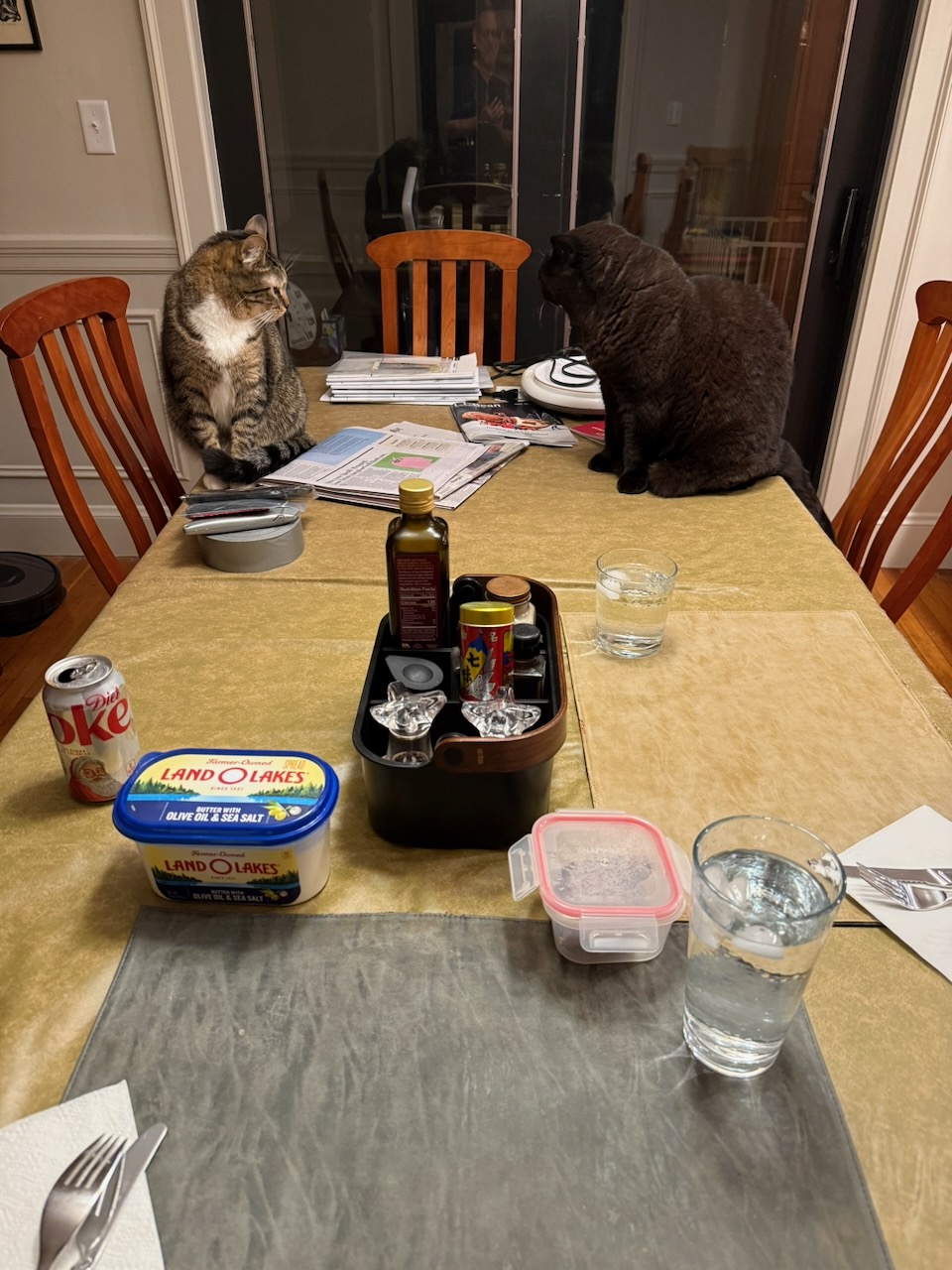 The Weekend Publisher and the Assistant Weekend Publisher wish me to remind you that cats
have holiday traditions, as well. Here you see them attempting to confer, consult, and
otherwise hobnob at the dinner table. (They are allowed on the table as long as they
behave like gentlemen and remain at the Cat End of the table.)
The Weekend Publisher and the Assistant Weekend Publisher wish me to remind you that cats
have holiday traditions, as well. Here you see them attempting to confer, consult, and
otherwise hobnob at the dinner table. (They are allowed on the table as long as they
behave like gentlemen and remain at the Cat End of the table.)
They particularly like this season, but not because they are religious in any way that I can discern. Rather, it is Box Season. Large numbers of boxes begin arriving at the house. Their human servitors remove the annoying contents but leave the boxes, so that all is as it should be in Cat World.
You may not, personally, find boxes to be particularly fascinating. [8] Nevertheless, our holiday wish for you, from Château Weekend, is for your life to have more of a stream of things as delightful to you as boxes are to The Cats of Chez Weekend.
The times are dark. Let us try to bring in more light for each other.
And for any deities watching, who might feel inclined to indulge a fervent wish: Ceterum censeo, Trump incarcerandam esse.
Also, as recently seen: Index Epstein divulgandus est. (The Epstein files must be released – a worthy addition to the sentiment above, in its Cato-esque phrasing.)
Notes & References
1: Weekend Editor, “Winter solstice, Dodds’s Day, and the Weekend Editrix’s Day”, Some Weekend Reading blog, 2020-Dec-21. ↩
2: Weekend Editor, “Tis the Season… of the Analemma”, Some Weekend Reading blog, 2021-Dec-15. ↩
3: DW Dodds, “Analemma, my Anlemma”, Some Weekend Reading blog, 2020-Dec-21.
This was once a much-anticipated annual email from Doug to all his colleagues. ↩
4: D di Cicco, “Exposing the Analemma”, Sky and Telescope, June 1979, pp. 536-540. ↩
5: CH Holbrow, “Build Your Own Analemma”, arχiv 1302.0765, 2013-Feb-05. ↩
6: P Lynch, “The Equation of Time and the Analemma”, Irish Math Soc. Bull. vol 68, Summer 2012, pp. 47-56. ↩
7: B McClure, et al., “Your earliest sunset comes before the winter solstice”, EarthSky, 2025-Dec-07.
Images quoted here from EarthSky were taken, with permission, from the blog of Alaskan climatologist Brian Brettschneider:
B Brettschneider, “Daylight-Twilight-Astronomical Maps”, Brian B.’s Climate Blog, 2016-Jun-16. ↩
8: Unless you are a cat. If you are a cat who can read this blog, I would really like to hear from you. Please use the email or social media links at the top of each page. ↩
Gestae Commentaria
Comments for this post are closed pending repair of the comment system, but the Email/Twitter/Mastodon icons at page-top always work.