Who Uses AI?
Tagged:ArtificialIntelligence
/
CorporateLifeAndItsDiscontents
/
JournalClub
/
Sadness
/
Statistics
Who actually uses the LLM AIs, and what sorts of people are they?
A Study of AI Users and Their Personality Types
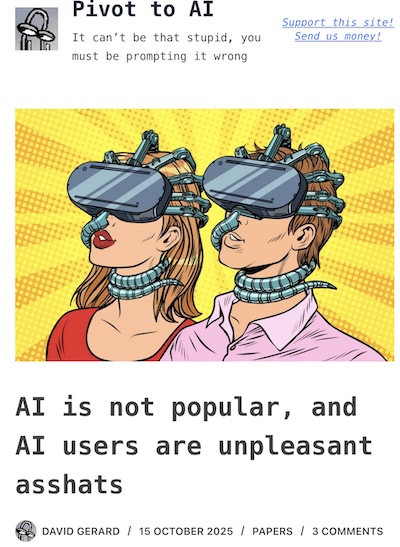
 Somewhere I came across a blog by David Gerard called Pivot to AI, largely consisting of rather
well-reasoned critiques of AI and a hefty side of snark. (Motto: “It can’t be that
stupid, you must be prompting it wrong.”) One recent article [1]
is about how much people actually, measurably use AI, and what kinds of personality
types are associated with that.
Somewhere I came across a blog by David Gerard called Pivot to AI, largely consisting of rather
well-reasoned critiques of AI and a hefty side of snark. (Motto: “It can’t be that
stupid, you must be prompting it wrong.”) One recent article [1]
is about how much people actually, measurably use AI, and what kinds of personality
types are associated with that.
You can probably take a guess where this is going, given the illustration shown here: virtual reality goggles clamped firmly in place by crab-like arms around the back of the head, a tube to interfere with breathing, and a tentacle about the neck. This is clearly a riff on the face-hugger monsters such as those in the old 70s horror flick Alien.
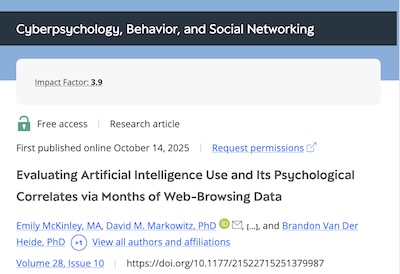
He’s reporting on a recently published – and thus peer-reviewed – paper by McKinley, et al. [2], in which they studied 2 pretty good-sized populations, measuring amount of AI usage and administering 2 different personality type tests to see what sort of people used AI more than others. (NB: McKinley, the lead author, is a PhD candidate. If this very good paper is any indication, she will have a heck of a thesis and a good start to her career!)
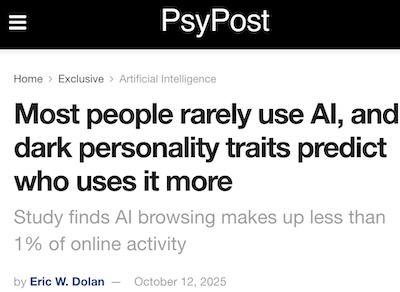
There’s another summary of the same paper and some brief interview material with McKinley, by Dolan at PsyPost [3].
The results are about what I’d hoped (LLMs are really not very popular) and feared (LLMs tend to get used by people who are more Machiavellian, narcissistic, or psychopathic). In other words, the good news is most people ignore LLMs, but the bad news is that bad people use it. This makes a degree of sense: LLMs are basically BS engines, so BS artists probably regard them as valuable time-savers.
Prolegomena
They studied 2 separate populations:
- Students from 2 universities, $N$ = 499
- General public (selection criteria somewhat unclear to me), $N$ = 455.
They did not rely on self-reports of use of AI, though they did record that too. (See below on how inaccurate the self-reports were.) Instead, they filtered for subjects who used the Chrome browser, and were competent to install their plugin to measure web site usage. This has 2 effects: by giving up on measuring phone/app usage, they’re biasing it to older subjects (“the desktop is for geezers”, as one commenter put it), and even so they are only accepting those with enough technical competence to install their plugin. Both of those issues will have to be revisited in any followup studies attempting replication, though the authors are up-front about it.
The study period was for 3 months.
They annotated the web sites visited by subjects in a couple dozen categories, which we can summarize here as “AI” or “not AI”. The initial AI sites were from a repository curated by AI researchers. For the rest, they (alas!) used ChatGPT to classify the web sites according to a widely used taxonomy from the Interactive Advertising Bureau. While I despise the idea of trusting ChatGPT to tell the truth about anything, they did at least have 2 people hand-check a random sample of 200 web sites, finding only 1 error, a web site which could not be accessed for assessment. Maybe good enough for a start, but it’s a weak point that makes me itch!
They also administered some well-thought-of psychological tests to the participants:
-
The TIPI, or ten-item personality inventory, is a version of the well-regarded Big Five personality traits. It rates subjects on scales for Extraversion, Agreeableness, Conscientiousness, Emotional Stability, and Openness to New Experience. It has high reproducibility.
You can take the Big Five test for yourself to see if it seems to capture what you know about yourself.
-
The SD3, or short dark triad personality test, measures for the Dark Triad personality traits of Machiavellianism, Narcissism, and Psychopathy. These well-defined terms are personality traits with well-documented clinical correlates, e.g., diagnosing Narcissistic Personality Disorder, Antisocial Personality Disorder, and so on.
You can take the Short Dark Triad test yourself to see if you recognize anything about the darker side of yourself.
-
Other tests measured attitudes toward AI, its ease of use, perception of its usefulness, general technology acceptance, political ideology, etc.
(They also computed Cronbach’s $\alpha$, a measure of internal consistency/reliability of the tests; we won’t go into detail about that.)
There were a lot of measurements, but the two that stand out to me are:
- What personality traits predict more use of AI?
- If we separate the prolific AI users from the rest, how are they different in personality traits?
Since the distributions of AI usage were decidedly non-normal (more like a power law?) they decided to use of Spearman rank correlation $\rho$. (I hope this means they rank-ordered the data first, but the word salad was a bit unclear to me.)
Results: Frequency of Use of LLMs & Personality Type Correlates
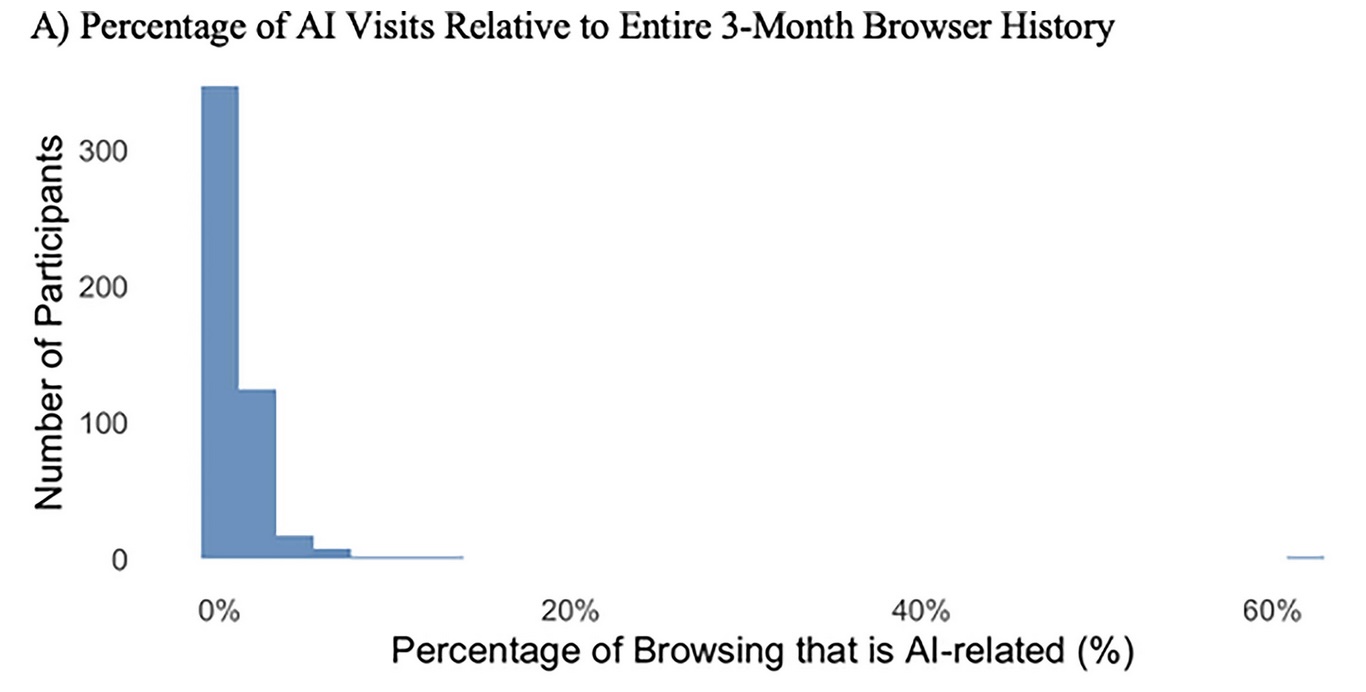
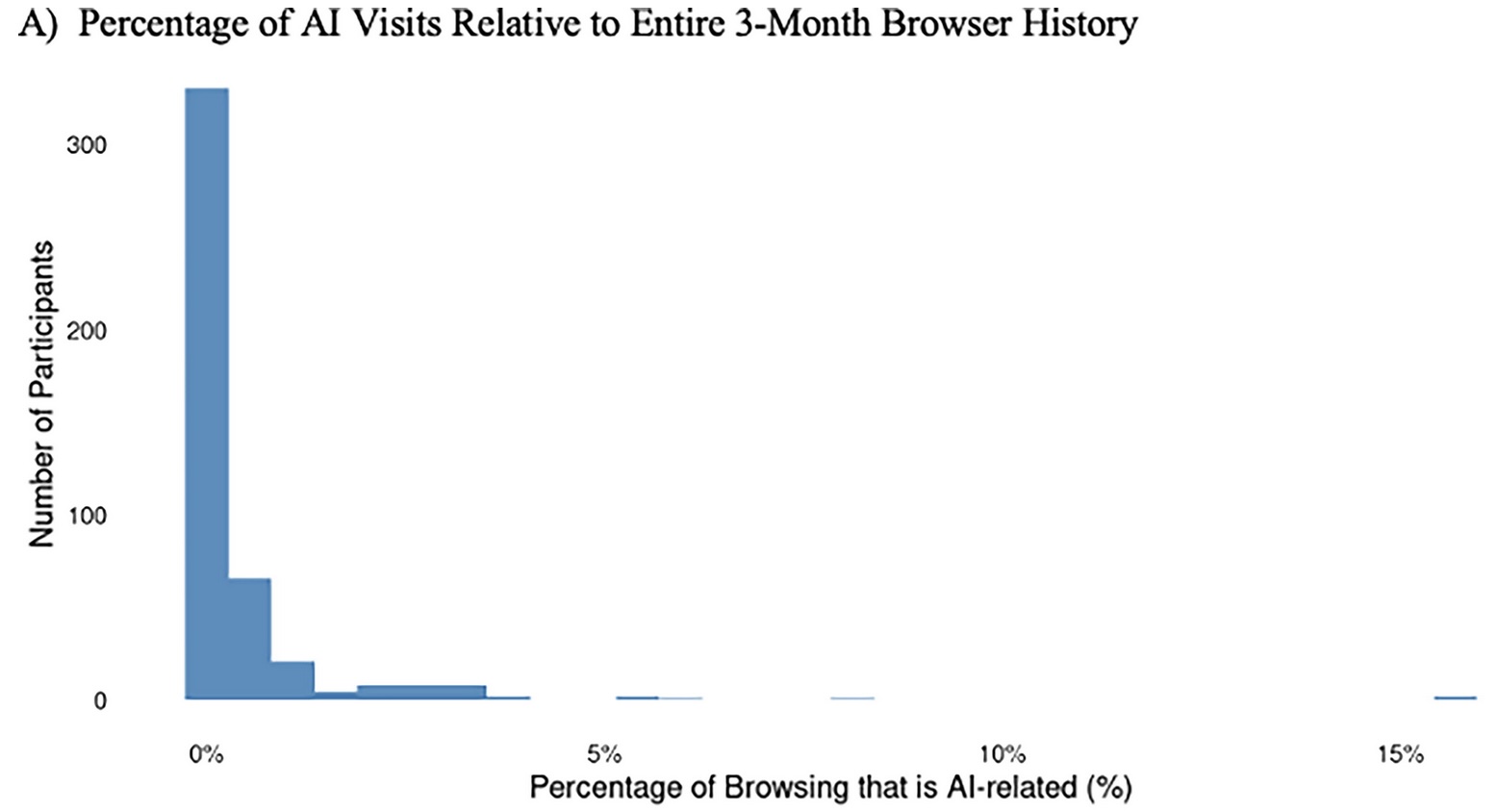
 Here’s the observed distribution of number of “AI” sites visited, for the student
population (top) and general public (bottom). Note the difference in horizontal scales:
the general public used AI sites much less. This is over the whole study period, which
remained pretty constant; there were no observable trends over time.
Here’s the observed distribution of number of “AI” sites visited, for the student
population (top) and general public (bottom). Note the difference in horizontal scales:
the general public used AI sites much less. This is over the whole study period, which
remained pretty constant; there were no observable trends over time.
The authors note this is decidedly non-normal, and thus punted to rank-order statistics like Spearman’s $\rho$. That’s… sort of okay, I guess? I’d have tried some distribution tests to see what’s at least close to the observations. They speculate it’s a power law, but do no analysis to test this. My favorite method for power laws in empirical data is from Cosima Shalizi’s group [4], which not only gives stable methods for estimating the parameters but recommendations for other distributions to test and compare with likelihood ratios.
That’s not a fatal flaw in the paper, and the rank statistic tactic is probably acceptable. But in the future, or even in a reanalysis of these data, the Shalizi tests could be informative in that they enable more specific statistical methods once the distribution is identified.
 Here’s the top-line result: over 90 days, about 1% of the sites visited by students were
AI sites, and about 0.44% of the sites visited by the general public. That’s…
very low.
Here’s the top-line result: over 90 days, about 1% of the sites visited by students were
AI sites, and about 0.44% of the sites visited by the general public. That’s…
very low.
Also, when comparing self-reported AI use with measured AI use, they got a Spearman $\rho \sim$ 0.329, with an associated significance of $p \sim$ 0.001. (It seems this was done only in the general public test population, and not for students?) That’s statistically significantly different from 0, but still pretty low. It was a good idea to measure AI use directly, because the self-reports were not accurate. (They do not say if the self-reports were higher or lower than the measurements.)
Conclusion: AI use in both populations is much lower than expected.
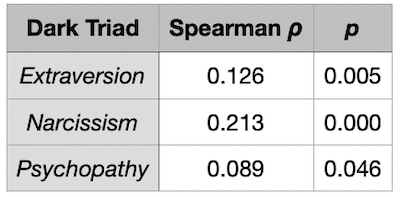 Looking at the student population, they computed Spearman correlation of number of AI
sites visited with the Big 5 personality types and the Dark Triad personality disorders.
The statistically significant ($p \le$ 5%) Spearman rank correlations were as shown here:
mild to moderate association, but statistically significant (i.e., reproducible).
Looking at the student population, they computed Spearman correlation of number of AI
sites visited with the Big 5 personality types and the Dark Triad personality disorders.
The statistically significant ($p \le$ 5%) Spearman rank correlations were as shown here:
mild to moderate association, but statistically significant (i.e., reproducible).
They also report that, in the student population, Extraversion on the Big 5 personality test is correlated with both Narcissism and Psychopathy. This leads one to think Narcissism and Psychopathy are the root elements, and bring Extraversion along with them.
In the general population, there was much less AI use and thus it was harder for Spearman rank correlations of AI use with personality measurements to reach statistical significance. Nothing really made the usual $p \lt$ 0.05 cut; the closest was Machiavellianism at $\rho \sim 0.080$, $p \sim$ 0.087.
Conclusion: In younger people, AI use correlates with Extraversion, Narcissism, and Psychopathy scores. In the general public, AI use was low enough that it was hard to tell, though there was a hint at a relationship to Machiavellianism.
Results: Personality Types for Prolific LLM Users
They did another study, focusing on the differences in personality between prolific AI users (more than 4% of URLs during the study period) vs everybody else. Since the AI usage in the general population was pretty low, the prolific population was too small for analysis. So this is just for the student population.
They looked at the test scores between the student prolific and non-prolific AI users, and tested for a difference in mean with a Welch (unequal $\sigma^2$) $t$-test. Commendably, they also tested for effect size with Cohen’s $d$.
Obviously, the limiting factor for statistical significance is the small number of prolific users:
- Prolific: N=20
- Non-Prolific: N=479
There were no significant differences in the Big 5 personality factors ($p \gt$ 0.15), i.e., the prolific AI users were about the same in Extraversion, etc.
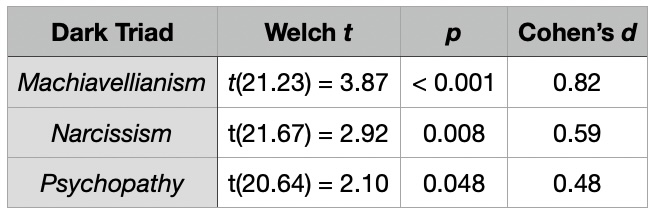 However, it’s quite disturbing that all 3 of the Dark Triad personality disorders
were statistically significantly associated with prolific AI use (by Welch’s $t$ test).
The effect size, according to
the usual tables for interpreting Cohen’s $d$,
ranged from medium (0.5) to large (0.8).
However, it’s quite disturbing that all 3 of the Dark Triad personality disorders
were statistically significantly associated with prolific AI use (by Welch’s $t$ test).
The effect size, according to
the usual tables for interpreting Cohen’s $d$,
ranged from medium (0.5) to large (0.8).
In the spirit of “correlation is not causation”, we must mention that we do not know if Dark Triad people tend to use AI more (“game recognizes game”, so BS artists like BS engines), or whether prolific AI use made them that way.
This is a serious question: as we’ve written before [5] on this Crummy Little Blog That Nobody Reads (CLBTNR), there is now significant anecdotal evidence of extreme AI use causing mental illness.
Either way, this result is alarming.
Conclusion: Prolific AI users in the student population scored higher on tests for all 3 of the Dark Triad personality disorders. This was both statistically significant and a medium to large effect size.
The Weekend Conclusion
We’ll leave the final word to Gerard’s Pivot to AI post, since I kind of cringe at using the sort of vocabulary required for sufficient emphasis:
So AI is not actually popular, and AI users are unpleasant assholes.
Cruder than I’d put it, but you won’t forget it.
(Ceterum censeo, Trump incarcerandam esse.)
Notes & References
1: D Gerard, “AI is not popular, and AI users are unpleasant asshats”, Pivot to AI blog, 2025-Oct-10. ↩
2: E McKinley, et al., “Evaluating Artificial Intelligence Use and Its Psychological Correlates via Months of Web-Browsing Data”, Cyberpsych Behavior & Soc Net 28:10, 2025-Oct-14. DOI: 10.1177/21522715251379987. ↩
3: EW Dolan, “Most people rarely use AI, and dark personality traits predict who uses it more”, PsyPost, 2025-Oct-12. ↩
4: A Clauset, CR Shalizi, & MEJ Newman, “Power-Law Distributions in Empirical Data”, SIAM Review 51:4, 2009. DOI: 10.1137/070710111.
NB: The preprint on arχiv is not paywalled. ↩
5: Weekend Editor, “AI LLMs: A Way to Make Yourself Crazy… Literally!”, Some Weekend Reading blog, 2025-Aug-16. ↩
Gestae Commentaria
Comments for this post are closed pending repair of the comment system, but the Email/Twitter/Mastodon icons at page-top always work.