
On the History Behind 'Whitebread Racism'
Tagged:Politics
/
Sadness
/
ϜΤΦ
It turns out the term “whitebread”, used to insult white American racists/nativists has some actual history, involving actual… white bread?!
White Bread and Your Humble Weekend Editor
When I grew up in the American midwest in the 1950s - 1960s, white bread was sort of the “default” bread. Anything else was some ethnic variety (“German rye”), or for food nuts who wanted whole wheat.
Now at my advanced age, I’ve learned to appreciate the virtues of many kinds of bread: whole wheat, pitas, tortillas, baguettes, and so on. While our usual starch Chez Weekend is Japanese rice, I nonetheless bake white bread from time to time. It’s mostly:
- Japanese shokupan (a very soft & moist Japanese bread flavored with milk and enhanced moisture uptake using a yudane/tangzhong technique to force water into the flour), or
- Mark Bittman’s famous recipe from the New York Times for no-knead bread, which yields a boule with a nice rustic crust and a chewy, tasty crumb.
The latter was particularly the bread of choice during the pandemic. In our religious community, it became the bread we baked for our religious gatherings, and people really liked it!
But mostly, during my childhood, bread at home was a manufactured bread: Wonder Bread, which got no respect at all. The crust always tasted kind of burnt to me, and the crumb tasted like… nothing at all. I hated the stuff as a kid!
White Bread in the US & Racism & Fear of Foreigners
“Whitebread” has become a term of opprobrium in the US for a certain kind of white racist and nativist, or even just for someone who is culturally narrow and confined to a rural white American viewpoint. There are often comments about mayonnaise as well (though I think the detractors as well as their targets neglect the fact that mayonnaise is a French invention.).
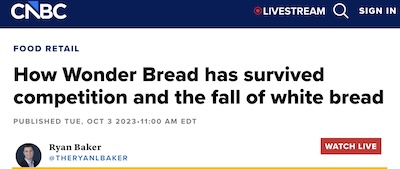 Today I learned from an old colleague about some of the history here, in a CNBC article a
few years ago. [1]
Today I learned from an old colleague about some of the history here, in a CNBC article a
few years ago. [1]
- Ironically, the company behind “Wonder Bread” also makes “Dave’s Killer Bread” and “Nature’s Own”, which have more or less the opposite image.
- Still, even an old brand like Wonder Bread can sell: about \$484 million in 2022 and about \$300 million in the first half of 2023!
-
The brand’s emergence is related to a fear of immigrants, who owned a lot of small bakeries. They were suspected of being ‘dirty’, and having ‘disease’ on their hands. So the sloganeering involved factory bread that was “untouched by human hands” (emphasis added):
“It’s a time when you see newspaper headlines saying, you know, dangerous bakeries menace the city and germs lurk in your bread. And there’s all this kind of huge fear-mongering about dangerous bread from small bakeries — except when you look, no one’s actually getting sick or dying from bread,” said Aaron Bobrow-Strain, professor of politics at Whitman College and author of “White Bread: A Social History of the Store-Bought Loaf.”
…
“Industrial Wonder Bread-type bread was everything that the counterculture was against. It was corporate. It was chemical. It was bland. It was white. And so it was essentially the establishment or ‘the man’ in bread form,” said Bobrow-Strain.
So… ok. “Whitebread racist” has some history, though it would be more accurate to call it “Wonderbread racist”. (Though the latter would probably be bait for hostile attention from the team of lawyers the company no doubt has to police such things.)
The Weekend Conclusion
I still like a baguette, now and then. I still like my shokupan. I still like my no-knead boule.
But we should all try not to be “whitebread racists”. I wonder if we can make “whole-wheat anti-racist” happen? (Ok, probably not.)
(Ceterum censeo, Trump incarceranda est!)
(Et ceterum censeo, index Epsteiniani divulganda est!)
Notes & References
1: R Baker, “How Wonder Bread has survived competition and the fall of white bread”, CNBC, 2023-Oct-03. ↩
Gestae Commentaria
Comments for this post are closed pending repair of the comment system, but the Email/Twitter/Mastodon icons at page-top always work.