Vaccines, Cardiovascular Health, and Alzheimer's
Tagged:CatBlogging
/
COVID
/
JournalClub
/
Math
/
PharmaAndBiotech
/
Politics
Remember when the right-wing nuts went crazy about vaccines, claiming they killed randomly with heart attacks, myocarditis, “turbo cancer”, and such? Well… some time has passed, and we now have some big studies with long baseline data on that. Guess which way it comes out. I dare you.
COVID-19 Vaccines vs Cardiovascular Health
 Right-wingers have all sorts of fears about COVID-19 vaccines (indeed, fear seems to be
one of the indicators of right-wing & authoritarian follower
personality [1]).
Right-wingers have all sorts of fears about COVID-19 vaccines (indeed, fear seems to be
one of the indicators of right-wing & authoritarian follower
personality [1]).
For example, there was a time when they worried extremely loudly about the possibility of myocarditis post-vaccination, especially in young men. This turns out to be a real, but very low probability event, which in any case leads to mild cases that normalize quickly when treated. But you know what else gives you myocarditis, with higher probability and deeper severity? Getting COVID-19! So you’re still way better off with the vaccine, even if you think this rare risk applies to you for some reason.
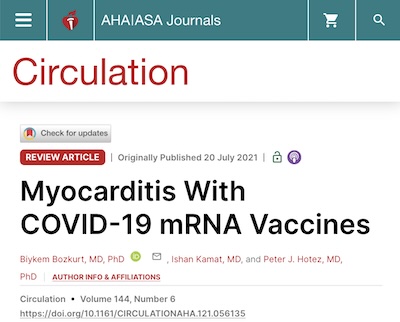 As Bozkurt, Kamat, and Hotez reported in Circulation [2],
the myocarditis risk from COVID-19 vaccination is both rare and less severe than the
myocarditis one risks from COVID-19 itself:
As Bozkurt, Kamat, and Hotez reported in Circulation [2],
the myocarditis risk from COVID-19 vaccination is both rare and less severe than the
myocarditis one risks from COVID-19 itself:
According to the US Centers for Disease Control and Prevention, myocarditis/pericarditis rates are ≈12.6 cases per million doses of second-dose mRNA vaccine among individuals 12 to 39 years of age.
…
Despite rare cases of myocarditis, the benefit-risk assessment for COVID-19 vaccination shows a favorable balance for all age and sex groups; therefore, COVID-19 vaccination is recommended for everyone ≥12 years of age.
 Now, via the estimable med-chem blogger Derek Lowe’s In the Pipeline, comes
news [3] of an excellent study on the COVID-19 vaccine’s
cardiovascular protection.
Now, via the estimable med-chem blogger Derek Lowe’s In the Pipeline, comes
news [3] of an excellent study on the COVID-19 vaccine’s
cardiovascular protection.
It is also summarized by Lauren Chan in STAT News. [4]
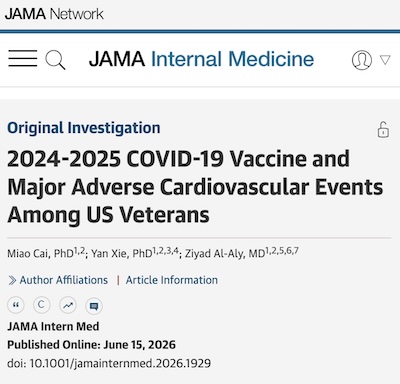
The formal, peer-reviewed scientific publication is in the big-time journal JAMA Internal Medicine. [5] The research question behind the whole thing was:
Question Is receipt of the 2024-2025 COVID-19 vaccine associated with a lower risk of COVID-19–associated major adverse cardiovascular event (MACE)?
To cut to the chase, the answer is an emphatic “yes”: COVID-19 vaccination does lower all sorts of cardiac risks. This makes abundant sense, because getting COVID-19 causes all sorts of cardiac events. Less intuitively, they also found that a COVID-19 vaccine lowers all-cause cardiac events, i.e., even those not associated with getting COVID-19. That’s… gratifying, but a bit mysterious and is something we’ll look into below.
 The first thing to note is that this is a huge study! It’s one of those things that can
only be done by mining electronic medical records (EMR) systems. We usually see those in
Europe, where there’s universal health care and universal EMR systems. In the US,
we… don’t have that. But we almost have it for veterans, when we consider
their post-service healthcare. And that’s what we have here.
The first thing to note is that this is a huge study! It’s one of those things that can
only be done by mining electronic medical records (EMR) systems. We usually see those in
Europe, where there’s universal health care and universal EMR systems. In the US,
we… don’t have that. But we almost have it for veterans, when we consider
their post-service healthcare. And that’s what we have here.
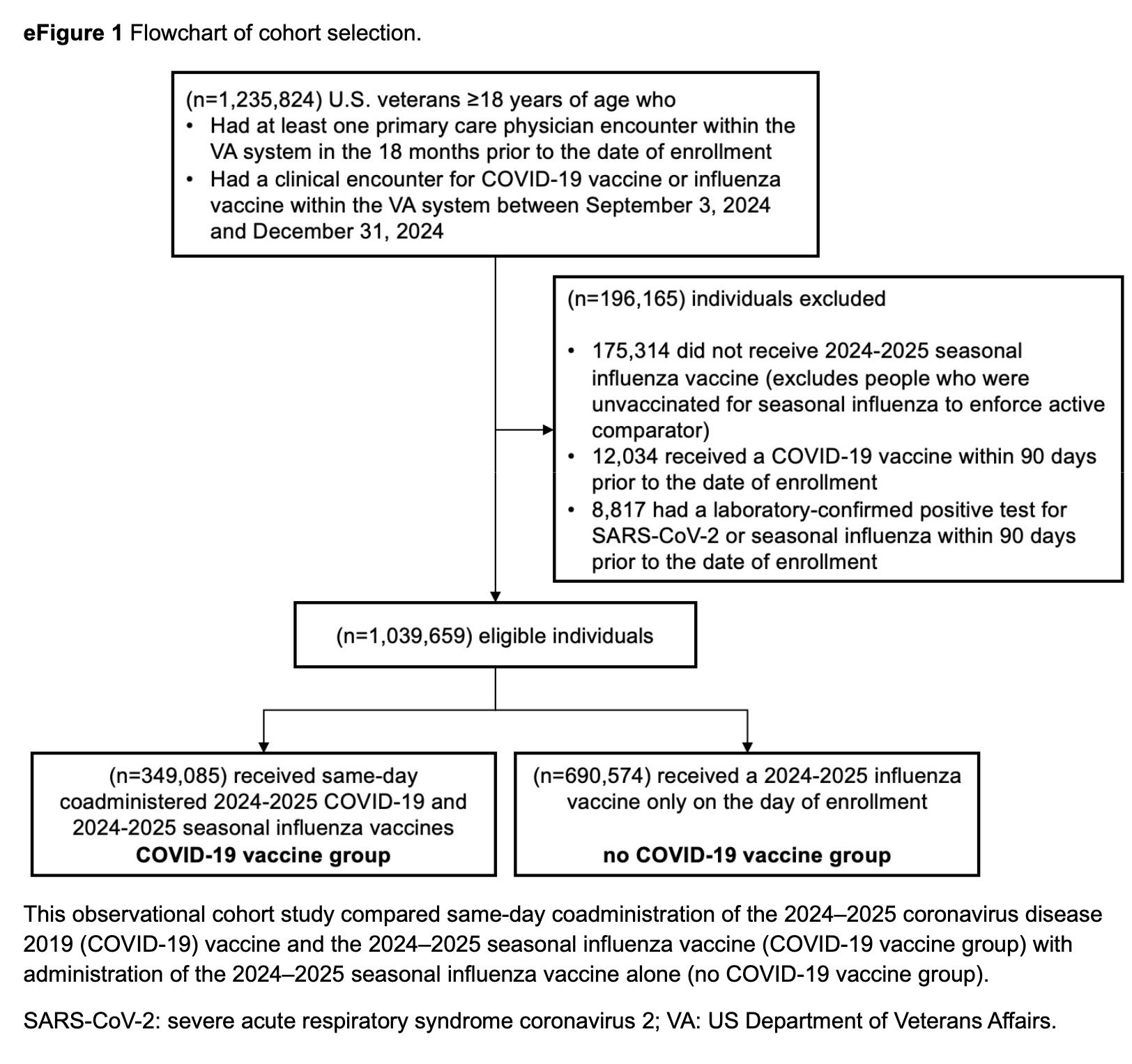
We see the CONSORT diagram shows an intake of 1,235,824 veterans over age 18 who had one kind of medical encounter or another. Of those, 196,165 were excluded for a variety of reasons, like vaccine refusal, recent COVID-19 vaccination outside the study, or having COVID-19 at the time. That leaves us with a whopping $N\ =\ $ 1,039,659 subjects!
- Of those, 349,085 (about 1/3) got both a flu shot and a COVID-19 shot.
- The 690,574 remaining (about 2/3) chose to get only a flu shot.
With a study like this, there is no question of statistical power. In fact, you’re powered to go hunt bears, if that’s what you want.
Their modeling accounted for all sorts of possible confounders using baseline covariates of demographic & socioeconomic factors, vaccination history, location & time, current health status & vital signs, clinical risk measures, comorbidities, and health care utilization. Basically, all the stuff you’d expect them to be cautious about, they were cautious about.
I wasn’t entirely clear about their treatment of censoring, since it didn’t appear that they used Cox proportional hazards. There was some stuff about inverse probability weighting instead, but that’s a method with which I’m unfamiliar.
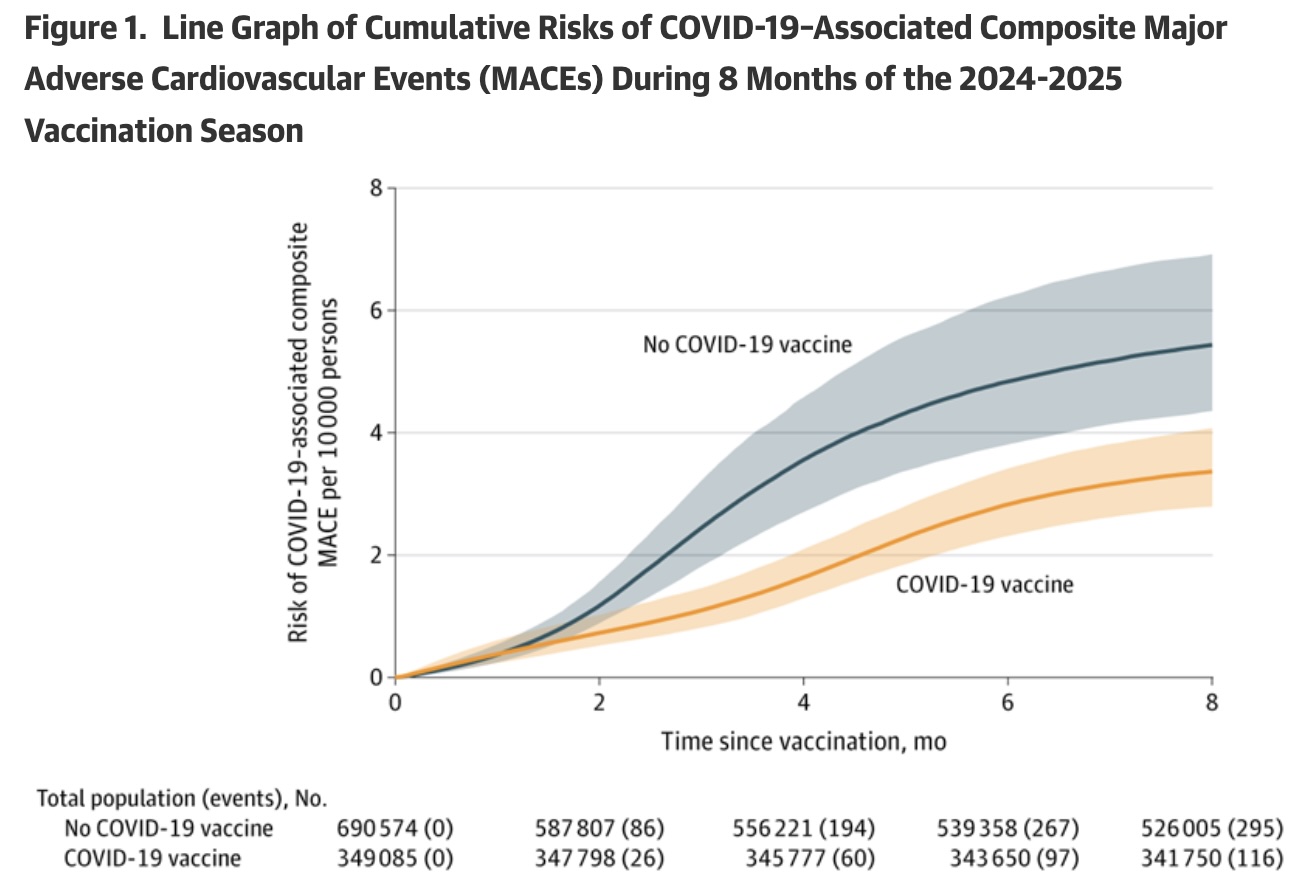 Their results were startlingly good:
- 37.7% (95% confidence interval 18.2% - 54.9%) MACE risk reduction, largest effect in elders
over age 75 or those with chronic conditions like kidney or lung disease.
- Their Figure 1, reproduced here, shows the cumulative risk of all types of MACE events combined, over time. The two curves are for those with no COVID-19 vaccine (blue upper curve) and with the vaccine (orange lower curve). The colored bands indicate statistical uncertainty. NB: The group with the COVID-19 vaccine was always at lower risk, even if you interpret the uncertainty bands in the most hostile fashion!
- This is further broken down into cardiovascular death, myocardial infarction (“heart attack”), stroke, and hospitalization for heart failure, with significant protective results in each category. The paper’s supplement shows similar plots for those subcategories of MACE.
- 23.7% [95% CI, 14.1% - 34.7%]) reduction in all-cause cardiac events, not just COVID-19 associated. Translation: that means ~3500 MACE and ~2400 deaths annually per million. If we scale that up to a population of 330 million in the US, that’s 1,155,000 MACE and 792,000 deaths annually that could be avoided.
The last bit is sort of mysterious: why should a COVID-19 vaccine reduce all-cause MACE events? It’s probable that there’s an untracked burden of COVID-19 in the general population: people feel a little sick, don’t think much of it, but show up at the ER a week later with a heart attack. Obviously if that were COVID-19, the vaccine would have helped.
One moral to draw from the story is that every COVID-19 infection does damage, even including the “mild” cases.
Conclusion: COVID-19 vaccination lowers your risk of cardiac problems, by quite a lot. It may even do so for people who never get COVID-19 (though probably everybody gets enough COVID-19, even in mild cases). COVID-19 vaccination and periodic boosters are good for you!
How About Other Vaccines & Other Health Outcomes?
 In the words of Robert Califf, cardiologist and former FDA commissioner, in a commentary
on the above paper reported in STAT:
In the words of Robert Califf, cardiologist and former FDA commissioner, in a commentary
on the above paper reported in STAT:
There are many, many studies now that show that vaccinations of various types seem to reduce the risk of chronic diseases, including cardiovascular disease … this is not inconsistent with what the other studies have shown.
What’s an example of this risk reduction of chronic diseases, allegedly not associated with a particular vaccine?
Alzheimer’s.
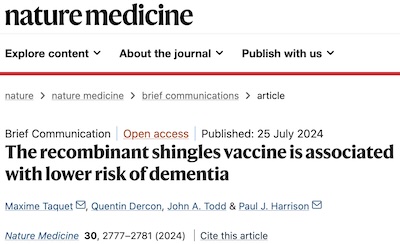
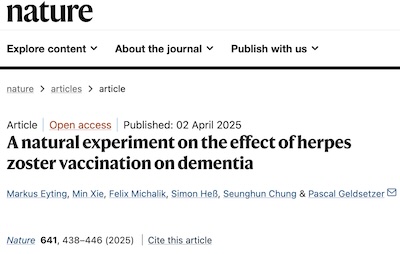
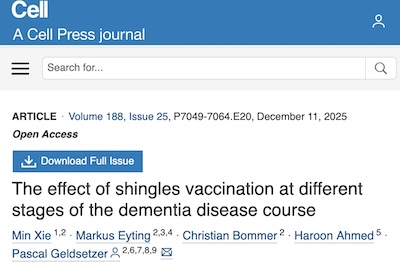
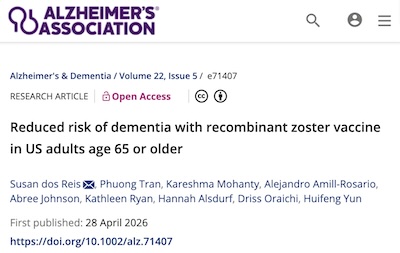
Alzheimer’s is a subject of acute interest to Chez Weekend, as we age. (Ok, maybe not so much the cats. But the rest of us.) There are a number of studies now, over a number of years, showing that the modern recombinant vaccine against shingles protects against the risk of Alzheimer’s disease in particular, and maybe dementia in general. This has been studied both in clinical populations and “in the wild”. Here are 4 of them that come readily to mind (“vest pocket scholarship”, as a mentor of mine used to say with some derision when I did this). [6] [7] [8] [9] There are many others!
And it’s not a small effect: depending on the source you read, there’s 20% - 28% reduction in risk of Alzheimer’s and a 33% reduction in risk of vascular dementia.
This is A Good Thing. If you’re old enough to be eligible for the Shingrix vaccine for shingles, you should get it. Even if you’ve previously gotten the older Zostavax vaccine (which was the case for me).
The Weekend Conclusion
As Derek Lowe notes in the blog post above that pointed us in this direction in the first place(emphasis added):

… coronavirus vaccines not only keep people out of the hospital with severe viral infections - a fact that has been irrefutably proven in many large studies - but also help to keep elderly patients from dying of major cardiac events. Add that to the mounting evidence that the shingles vaccine helps to prevent dementia in these same age groups, and the recommendation has to be that older patients should be getting vaccinated far more often than they do. … Because I really think that it would be irresponsible to do otherwise.
The Weekend Publisher and the Assistant Weekend Publisher, shown above, are not so concerned with COVID-19 or Alzheimer’s as they are with who gets the sunny spot. In a way, I wish I could emulate their nonchalance, and step back from the news of our horrible world now run by horrible people doing horrible things. But that feels like an abdication of responsibility, so… here we are.
Just as the existentialists have been saying for almost a century: nevertheless, here we are. We must deal with this world.
But get vaccinated (COVID-19 and shingles), so you can live longer to deal with it more effectively!
(Ceterum censeo, Trump incarceranda est!)
(Et ceterum censeo, index Epsteiniani divulganda est!)
Notes & References
1: D Osborne, “Why Some People Follow Authoritarian Leaders—And The Key to Stopping It”, Scientific American, 2025-Apr-03. ↩
2: B Bozkurt, I Kamat, & PJ Hotez,_ “Myocarditis With COVID-19 mRNA Vaccines”, Circulation, 144:6, 2021-Jul-20. DOI: 10.1161/CIRCULATIONAHA.121.056135. ↩
3: D Lowe, “Covid-19 Vaccinations and the Heart”, In the Pipeline blog at Science, 2026-Jun-15.↩
4: L Chan, “Covid vaccination cut risk of adverse heart events, large study finds”, STAT News, 2026-Jun-15. ↩
5: M Cai, Y Xie, & Z Al-Aly, “2024-2025 COVID-19 Vaccine and Major Adverse Cardiovascular Events Among US Veterans”, JAMA Internal Medicine, 2025-Jun-15. DOI: 10.1001/jamainternmed.2026.1929. ↩
6: M Taquet, et al., “The recombinant shingles vaccine is associated with lower risk of dementia”, Nature Medicine 30:pp2777-2781, 2024-Jul-25. DOI: 10.1038/s41591-024-03201-5. ↩
7: M Eyting, et al., “A natural experiment on the effect of herpes zoster vaccination on dementia”, Nature 641:pp438-446, 2025-Apr-02. DOI: 10.1038/s41586-025-08800-x. ↩
8: M Xie, et al., “The effect of shingles vaccination at different stages of the dementia disease course”, Cell 188:25, pp7049-7064, 2025-Dec-11. DOI: 10.1016/j.cell.2025.11.007. ↩
9: S dos Reis, et al., “Reduced risk of dementia with recombinant zoster vaccine in US adults age 65 or older”, Alzheimer’s & Dementia 22:5, e71407, 2026-Apr-28. DOI: 10.1002/alz.71407. ↩
Gestae Commentaria
Comments for this post are closed pending repair of the comment system, but the Email/Twitter/Mastodon icons at page-top always work.