The Flocks of License Plate Readers
Tagged:CorporateLifeAndItsDiscontents
/
Politics
Now you can track Flock surveillance cameras and other automated license plate readers. Why is there a cluster of them on every approach to Tufts University in Massachusetts?
Automated Surveillance of Car Traffic
There are these things called “automated license plate readers” (ALPRs). They’re basically a camera, a computer, and a network interface that picks out and reports car license plate numbers, along with date/time/location stamps. They then report this data to various authorities, usually either police or some large institution that owns them (see below for an example of the latter). The license plate data then gets looked up in a state database to find the owners of the car, and with slight effort also in insurance databases to find the licenses of the associated drivers to get individual names.
Key point: They do this all the time, without any discrimination whatsoever about which cars they grab. Pure unwarranted search (though court cases have apparently found loopholes for cops to use).
The key questions for me are:
- Why are there so many of them?
- Where are they placed?
- Are we using them in a racist way to surveil minority or poor neighborhoods?
- Are we using them to make virtual gated communities around wealthy neighborhoods?
- Are they being used for surveillance of neighborhoods whose politics oppose those in power?
- Are they placed permanently, or temporarily? When contracts with surveillance companies are ended, are they ever actually removed?
- Who gets to see the results, for how long, and for what purposes?
- Why can’t we have a no match/no memory rule, where any plate associated with a person
for whom there’s no current arrest warrant or not in hot pursuit is ignored?
- And can we get camera operators audited to enforce conforming with such a rule?
Now we can answer some of those questions, and the answers are not pretty:
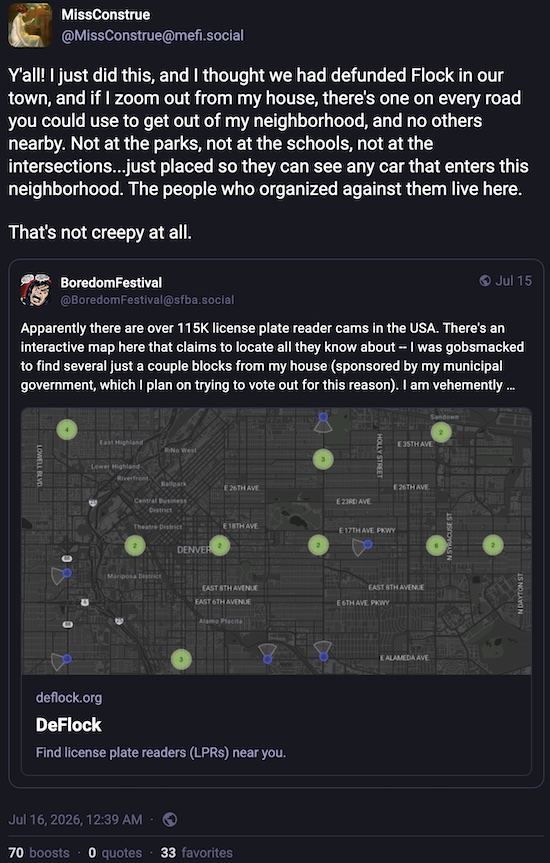
As reported here by an acquaintance on social media, there are ways to track such cameras (more ways below). Some are via crowdsourcing, some are via requiring disclosure from local governments (usually reluctantly with much foot-dragging), and some are just from objective tracing WiFi and cellular signals.
MissConstrue reports 2 quite interesting facts:
- There are a lot of these involuntary surveillance cameras: around 115,000 at the time she looked, and 119,104 reported by Deflock when I just ran it this morning (2026-Jul-23). (This is presumably within the United States, possibly the continental US, but I haven’t checked.)
- The placement is not random! In her case, people in her neighborhood successfully got their town to defund the Flock cameras. Some were removed, but all the ones pointed into her neighborhood of people who resisted surveillance were kept! This is brazen, warrantless surveillance for political purposes.
It appears our fears above of racist or political motivation of surveillance were correct.
So what does Flock have to say for itself?
Forbes reporter Tom Brewster interviewed Flock CEO and co-founder Garrett Langley. There’s a lot of disturbing content, such as their claim to be able to operate lawlessly by “being ahead of the legislation”, full-throated support for surveillance support for ICE kidnappings, and so on.
But at 11:52 - 13:22 there’s an interesting bit about citizen resistance to involuntary surveillance (paragraphing, punctuation, spelling correction, and emphasis added for clarity to this automated transcript; otherwise a verbatim quote):
Yeah, so I mean I think there’s really two groups of activists.
Uh, you’ve got organizations like the ACLU and the EFF who take an above board approach to fight for their point of view. And thankfully we live in a beautifully democratic capitalistic country where we can fight in court, and I have a lot of respect for those groups because they have reasonable debates and we we follow the law.
And then unfortunately there’s terroristic organizations like Deflock whose primary motivation is chaos. They are closer to Antifa than they are anything else and that I think is unfortunate because we don’t want chaos, or I don’t want chaos. I like law and order.
The fascist & racist dog-whistles couldn’t be clearer:
-
He describes his opponents as a “terroristic” organization. When you subject people to involuntary surveillance with cameras that are clearly placed to serve racist or right-wing political ends, you don’t get to call other people terrorists.
(Personal gripe: “terroristic” sounds semi-literate to me, given that “terrorist” is perfectly suitable as both an adjective and a noun. But a search confirms it’s a real word, so that’s just my personal reaction and thus should probably be ignored.)
-
He says they’re like “Antifa”, the famous bugaboo of Republicans everywhere which… does not exist.
I mean, this is just as ignorant as saying there are Martian invaders in flying saucers. This kind of talk shows allegiance to fascist delusion, not fact.
-
He extols “law and order”. Nothing wrong there, except… anybody with the slightest acquaintance with American politics over the last 50 years recognizes this as a racist dog-whistle going back to Richard Nixon.
Republicans use “law and order” as an excuse to stifle public pushback to their policies. The policies that presume crime is a Black or Hispanic problem make this just coded racism, that no politician with reasonable situational awareness would use.
So… that pretty much confirms my suspicions about the sort of people behind this.
The reaction is predictable, in that there are now more ways to track the trackers, given that they have to use either cellular or WiFi to report data:
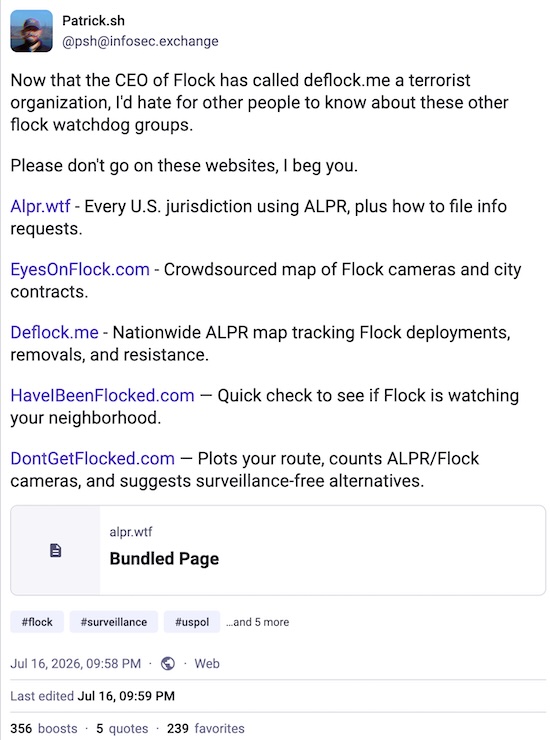
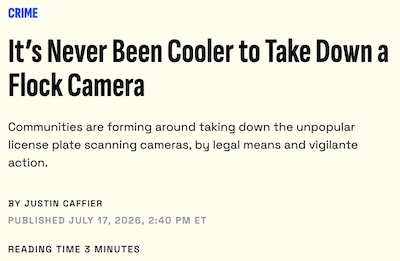 Just finding the cameras is a start, but many communities want to go further. As
reported by Justin Caffier in Gizmodo [1], it’s gotten
really, really angry out there:
Just finding the cameras is a start, but many communities want to go further. As
reported by Justin Caffier in Gizmodo [1], it’s gotten
really, really angry out there:
Backlash against the $7.5 billion startup Flock Safety—the maker of AI-powered, license plate-scanning, pole-mounted surveillance cameras—has gone from brewing to boiling over in recent weeks, much to the chagrin of the police state and its Silicon Valley boosters.
There is significant legal and political pushback, trying to force local officials and police who agreed to Flock agreements to terminate them. Somewhat harder has been to get the cameras actually removed, even if the agreements are terminated.
This has led to a number of vigilante actions, involving spray-paint, axes, and disassembly to steal & sell the copper and gold from the contacts inside the cameras (apparently 2g Au + 1kg Cu, worth about \$300?). Though lawless, this will no doubt continue until the political system starts responding to people instead of money.
(Note the phrasing of the headline in the article above: “take down” can be understood as lawful efforts to get politicians and police to terminate contracts and remove cameras, but “take down” could also mean vandalism. One should, of course, prefer the former.)
Hunting Flocks of Surveillance ALPRs in Deepest, Darkest Boston Suburbia
So, of course, I couldn’t resist trying it out. The maps.deflock.org site didn’t work
for me in Firefox, though admittedly I was reluctant to grant it as much Javascript and
remove as many blockers as it wanted. It also didn’t work in Safari, but did work in a
(regrettably permissive) Chrome installation.
My particular suburban Boston neighborhood was not too bad, with cameras only at some major intersections where accidents apparently happen. I hate the surveillance aspect, but documenting car accidents might be ok, if the data were publicly available.
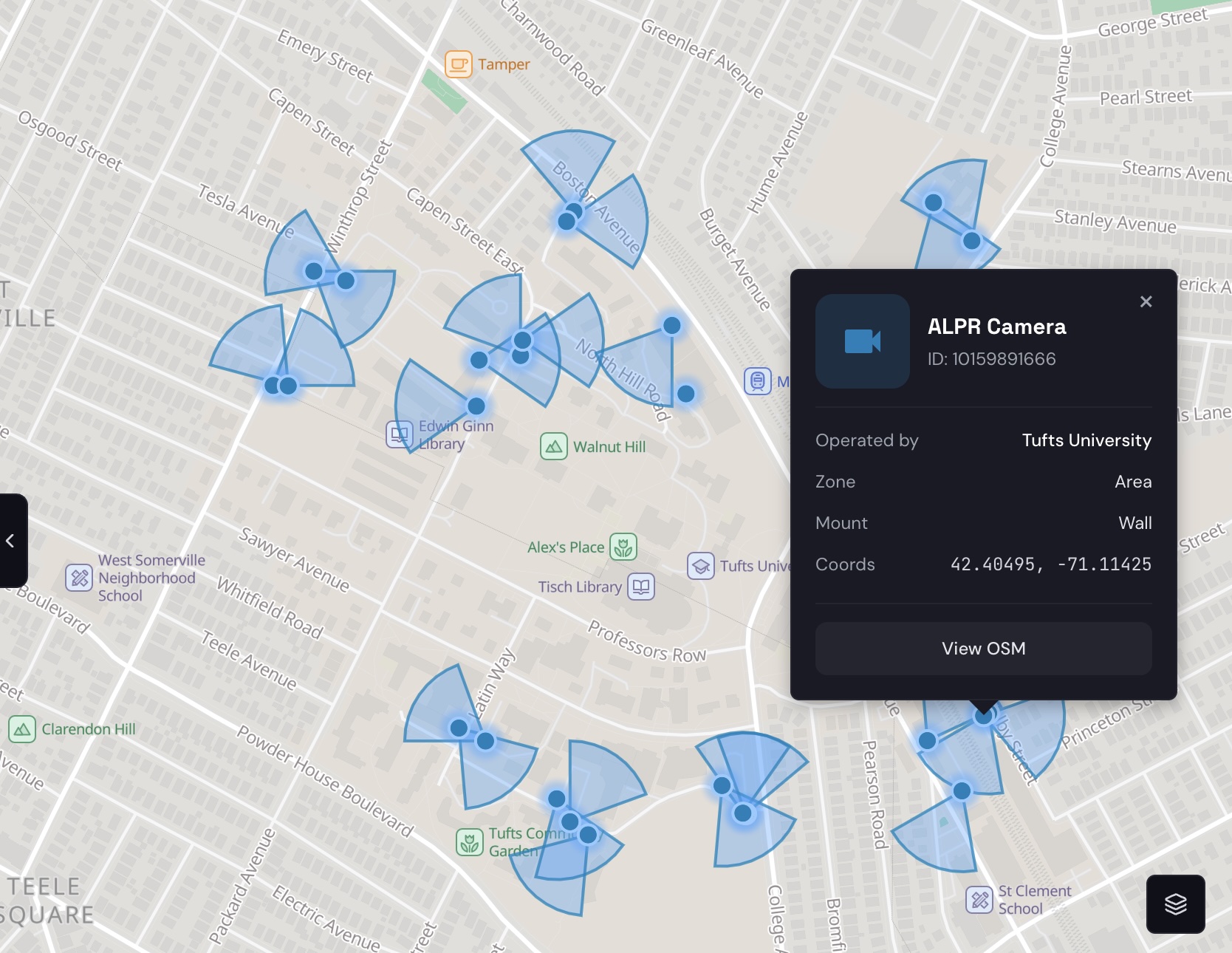 Things got more ominous when I zoomed out. A broader picture of neighboring towns showed
relatively sparse usage, with one exception that really stands out against the background:
Tufts University in Medford, Massachusetts.
(NB: If you use that URL, you will be getting updated info that might have changed
from the time I looked.)
Things got more ominous when I zoomed out. A broader picture of neighboring towns showed
relatively sparse usage, with one exception that really stands out against the background:
Tufts University in Medford, Massachusetts.
(NB: If you use that URL, you will be getting updated info that might have changed
from the time I looked.)
There are a minimum of 28 license plate surveillance cameras surrounding Tufts, apparently guarding every approach to campus. Inspection of each one shows that they are owned and operated by Tufts itself, as shown in this screen capture taken on the morning of 2026-Jul-23.
Tufts has decided to surveil itself.
They probably are on Tufts-owned private property, so it’s probably legal (though I don’t know what Massachusetts state law says about privately-owned surveillance cameras).
Why would Tufts do that?
- Do they think there is a wave of crime, perpetrated by criminals dumb enough to drive to a crime scene in their own cars?
- Do they want to track students?
- Do they want to track faculty & staff, particularly their work hours?
- Who in the Tufts administration or police force has access to this surveillance data, for how long, and for what purposes?
- How – if ever – are they audited to ensure privacy policy compliance, whatever that privacy policy might be?
I’m willing to bet that the answer to all those questions is, for now, “Pretty much nobody knows, and those who do know aren’t telling.”
The Weekend Conclusion
Panopticon crap like this is making people really, really angry (including your humble Weekend Editor, as you may perhaps have noticed). We hate surveillance capitalism. We hate ICE. We hate AI data centers. But the powerful… they love those things.
This is all directly downstream of:
- extreme wealth inequality & unrestrained political spending that give our oligarchs such power over government, and
- the near-total lack of enforcement of anti-trust laws that allows extreme corporate consolidation into oligopolies that needn’t bother with competing for consumer favor.
Elections are in November. Vote for Democrats, no matter what. Put a stop to this.
(Ceterum censeo, Trump incarceranda est!)
(Et ceterum censeo, index Epsteiniani divulganda est!)
Addendum 2026-Jul-30: The Venerable Globe Weighs In on Massachusetts Backlash Against Flock
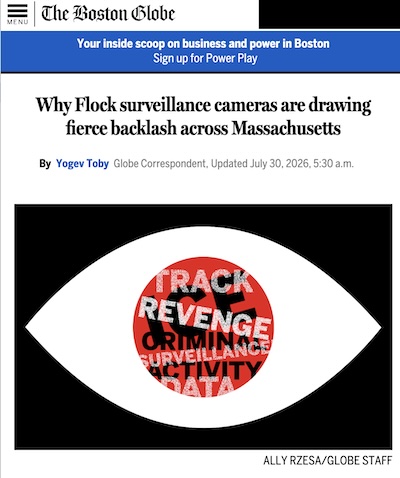 Just today, the venerable Globe weighed in [2] on the
apparent backlash across Massachusetts against Flock surveillance cameras and ALPRs for
tracking innocent people.
Just today, the venerable Globe weighed in [2] on the
apparent backlash across Massachusetts against Flock surveillance cameras and ALPRs for
tracking innocent people.
It’s one thing to acknowledge that approximately everybody has a phone with a camera. People who think you’re committing a crime or who witness police violence may record this and publish the result. That’s at least under individual control.
On the other hand, we’re — regrettably — inured to some kinds of surveillance cameras, such as Ring doorbells. We get even less comfortable when we find that the data, stored in the cloud, is used by police to surveil our neighborhoods. The fact that this is all done with no warrants whatsoever is even more galling.
Yes, they help solve crimes. Yes, they are also blatantly unconstitutional searches. Given power and the secrecy with which to use it, it is inevitably abused and lied about to cover up that abuse (emphasis added):
At the same time, some uses by law enforcement have been more controversial: Authorities in Texas, which has a near total ban on abortions, allegedly accessed Flock data to investigate a woman suspected of having an abortion, claiming they were working on a missing person’s case; some jurisdictions have shared people’s data with Immigration and Customs Enforcement, or ICE.
Another concern privacy advocates raise is the lax oversight over searches in the system. To conduct a search, officers must select a reason for the search and have a case number. But the American Civil Liberties Union says it found officers often just put down a single word: “investigation.” Earlier this year, two officers in Milwaukee used the technology to search for their ex-girlfriends — one reportedly did so more than 120 times.
So police, tending to the far right politically, tend to abuse these systems in ways that are driven by their far right politics: tracking people who might be seeking reproductive health care, tracking ex-girlfriends, offering locations to ICE for their kidnappings, and so on.
Most galling to me is the show of complete contempt for the requirement of justification, with the single word “investigation”: they think there should be no limits on what they can do, and any requirements to the contrary are just going through the motions.
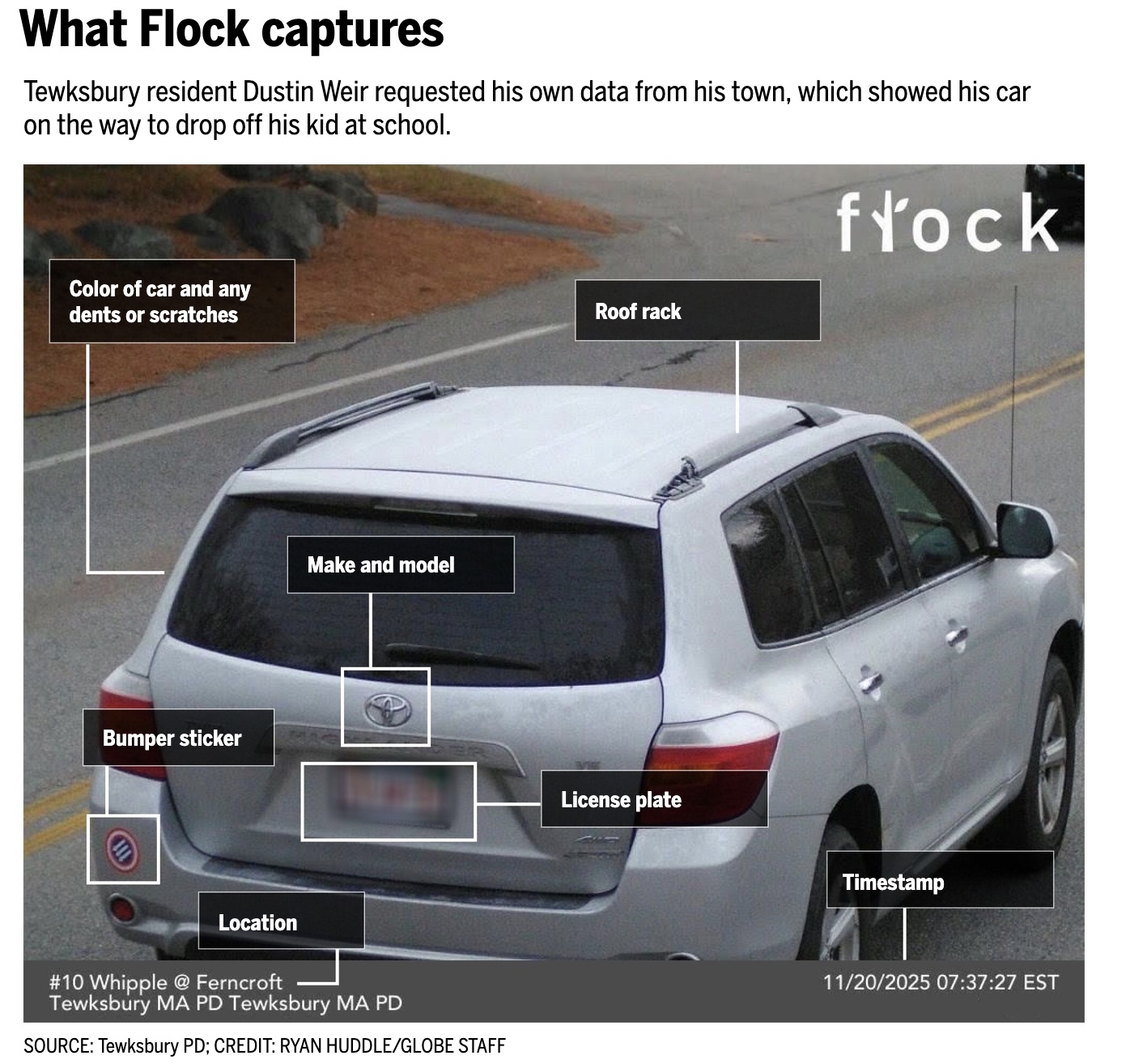 There are no restrictions on what police departments can do with the data, and no
restrictions on how long they can keep it if they download it. If you’re an activist
against ICE or police violence, expect them to know every trip you make in your car, for
years.
There are no restrictions on what police departments can do with the data, and no
restrictions on how long they can keep it if they download it. If you’re an activist
against ICE or police violence, expect them to know every trip you make in your car, for
years.
The excuse-making is also nearly endless:
Some of the opposition to Flock has its origins in the Trump administration’s controversial campaign to step up deportations of immigrants. While Flock says it does not contract directly with ICE, the immigration agency has been able to access its data through cooperating law enforcement agencies that subscribe to Flock, according to published reports.
So Flock says it does not itself share data with ICE, it is happy to supply data to police who do share data with ICE, with enthusiasm. The link doesn’t even have to be direct: your police department might share data with another police department in, say, Texas which has no hesitation at involving ICE.
Notes & References
1: J Caffier, ” It’s Never Been Cooler to Take Down a Flock Camera”, Gizmodo, 2026-Jul-17. ↩
2: Y Toby, “Why Flock surveillance cameras are drawing fierce backlash across Massachusetts”, Boston Globe, 2026-Jul-30. ↩
Gestae Commentaria
Comments for this post are closed pending repair of the comment system, but the Email/Twitter/Mastodon icons at page-top always work.