Memorial Day 2026: Thoughts on the Melian Dialogue and Philosopher Cats
Tagged:NotableAndQuotable
/
Politics
/
Religion
/
Sadness
Some (slightly belated) thoughts on US Memorial Day, 2026.
Memorial Day and the Melian Dialogue
It’s Memorial Day again. It seems that every year (2022, 2023, 2024, 2025) this causes some sad introspection, because of the nature of our times (and, to be fair, because of who I am).
I’m absolutely sick of hearing the right-wing patriotic talk of how the US is great, has never started a war, never taken territory, never committed war crimes, and other lies. On the other hand, I’m also sick of hearing historically uninformed diatribes painting the US as absolute evil.
So I’ve been wondering what a historically informed view of the US right now would look like. We’ve previously on this CLBTNR (crummy little blog that nobody reads) invoked the Melian dialogue from Thucydides, about the arrogance of the wealthy, the politically powerful, and their eagerness to wield military power in our New Gilded Age:
The strong do as they will; the weak do as they must.
In the Melian dialogue, more or less personally witnessed by Thucydides [1], the powerful Athenians in their war with Sparta attempted to coerce the surrender of the weaker, but neutral, Melians. Either they serviced Athenian warships, or the Athenians would murder all their men, enslave their women & children, and take what they wanted anyway.
This of course betrayed every ideal of Athens. But it has, for centuries, been a foundational idea for the “pragmatists” and those bent on realpolitik.
Of course I’m uncomfortable with that; I was wondering exactly from whence that discomfort came, other than the generally deplorable policy preferences of those who keep quoting it.
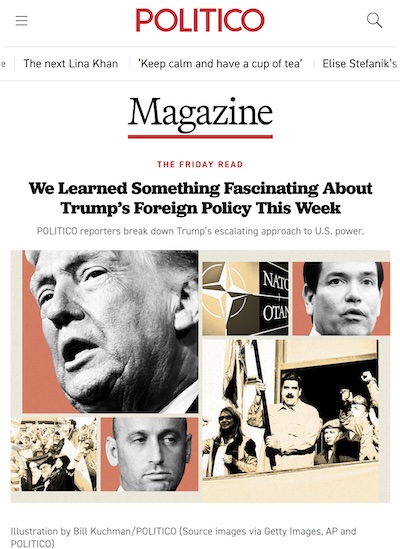 It’s obviously completely relevant right now. Stephen Miller, Trump’s execrably racist enforcer of
kidnap-&-deport policy on immigrants, says almost exactly this as quoted in
Politico: [3]
It’s obviously completely relevant right now. Stephen Miller, Trump’s execrably racist enforcer of
kidnap-&-deport policy on immigrants, says almost exactly this as quoted in
Politico: [3]
Ward: To quote Stephen Miller: “But we live in a world, in the real world … that is governed by strength, that is governed by force, that is governed by power.”
Stokols: Exactly.
Bazail-Eimil: Thucydides would be so happy with Stephen Miller.
Toosi: Oh dear.
I doubt Miller knows Thucydides; he doesn’t seem the well-read sort. But he’s been soaking in the racist right-wing marinade for so long, it’s unsurprising he has the idea.
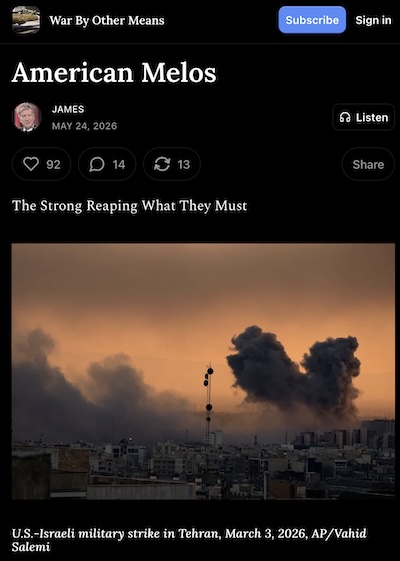 The penny finally dropped when I – somehow – came across an article by the
semi-anonymous ‘James’ at War by Other Means. He tells us what the rest of Thucydides
has to say about how to interpret the Melian dialogue. [2]
The penny finally dropped when I – somehow – came across an article by the
semi-anonymous ‘James’ at War by Other Means. He tells us what the rest of Thucydides
has to say about how to interpret the Melian dialogue. [2]
He points out that one can only draw the realpolitik-adjacent conclusion by ignoring the rest of Thucydides:
The Melian dialogue is, properly understood, a tragic construction meant to demonstrate the imperial hubris that had swept over Athens and led to her downfall.
They began the Peloponnesian War against Sparta as the most powerful group in Greece, at the head of the Delian Alliance, and part of a vastly wealthy trading network. They were lauded by Pericles as the “School of Greece”, for all their democratic practices. No, they were not perfect. This is a comparison to what else was going on at the same time. Athens was known for reason, law, and democracy.
In other words, a superpower.
Their attempt to use coercion and power instead of negotiation and alliance led to the end of all that. They squandered their alliances, their military strength, and their wealth on attempts to beat others into submission. In the end, they lost the war and just about everything else.
We are doing the same thing. We are squandering military resources that will take years to replace: THAAD interceptors, Tomahawk missiles, JASSSMs, and many more. We are deeply antagonizing our allies, to the extent of the likely breakup of NATO, previously unthinkable. We are squandering our wealth, by Republican-led deficits and pointless military operations. We are destroying our future by doubling down on the petroleum preferences of our billionaires, rather than green energy.
As ‘James’ puts it:
Like Athens, we are squandering the resources at our disposal on poorly considered foreign excursions at the behest of leaders increasingly guided by vanity, impulse, and the pursuit of their legacies.
That is what I think the Melian Dialogue means for America on Memorial Day 2026.
The Weekend Conclusion
It’s hard, reading the news nowadays. I feel like my usually-fragile mental health is under continual attack. This, probably, is an intentional effect of the Republican “flood the zone” strategy.
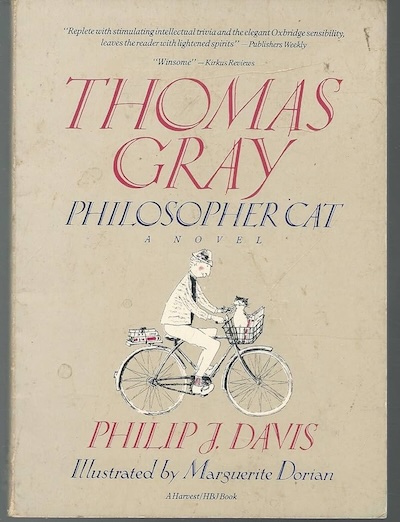 There’s a lovely old book by Philip J Davis, called Thomas Gray, Philosopher Cat. [4] It’s a slow, gentle book about the slow, gentle life of a
Cambridge don in years gone by, as he solves academic puzzles accompanied by his
cat. (It’s sort of life I desperately wanted to have as a young man; alas, the world has
mutated in ways too hostile for that to happen any more.) The main character avoids
reading newspapers, since they are too troubling. Instead, he reads them in the Common
Room on New Year’s Day, to catch up:
There’s a lovely old book by Philip J Davis, called Thomas Gray, Philosopher Cat. [4] It’s a slow, gentle book about the slow, gentle life of a
Cambridge don in years gone by, as he solves academic puzzles accompanied by his
cat. (It’s sort of life I desperately wanted to have as a young man; alas, the world has
mutated in ways too hostile for that to happen any more.) The main character avoids
reading newspapers, since they are too troubling. Instead, he reads them in the Common
Room on New Year’s Day, to catch up:
“It might be concluded from this description that Lucas Fysst was of a melancholy, saturnine disposition, but this was not the case. He was generally cheerful; well, let us say, as often as the sun shone in Cambridge, and this cheerfulness he attributed to the fact that he read no newspapers except on December 31st when the summary of the past year was published. ‘Gestæ conservatorum,’ he called it, the Deeds of the Conservatives.”
To preserve my mental health, such as it is, I may have to follow the advice of a philosopher cat and do likewise.
(Ceterum censeo, Trump incarceranda est!)
(Et ceterum censeo, index Epsteiniani divulganda est!)
Notes & References
1: Thucydides, “History of the Peloponnesian War”, late 5th century BCE.
The Melian Dialogue (Book 5, chapters 84-116) was a dramatization by Thucydides of negotiations between Athens and Melos. Melos was neutral in the war of Athens and Sparta. However, Athens insisted on surrender due to their military might, saying “the strong do as they wish and the weak do as they must”.
This, of course, contradicted everything for which the Athenians stood, in terms of ethics and democracy. However, it exposed the “pragmatic school” of international relations, in which politicians obsessed with power wave aside all other considerations.
Today in the US, we see the economic & class equivalent, where the rich use their means to preserve and propagate their views, while the poor sink beneath waves of obscurity. ↩
2: ‘James’, “American Melos: The Strong Reaping What They Must”, War by Other Means blog on Substack, 2026-May-24.
I can’t pin the author ‘James’ on any particular person. I don’t normally quote anonymous sources (though I admit the irony of saying that from a semi-anonymous blog!). But he’s pretty good, it seems, and I want to make an exception for him.
His very blog name, War by Other Means, will of course be recognized as an ironic inversion of a famous phrase from von Clausewitz. See Carl von Clausewitz, On War, Chapter 1, section 24: “War is a mere continuation of policy by other means.”
So… politics is a continuation of war by other means? Hmpf.↩
3: N Toosi, E Stokols, E Bazail-Eimil, D Nerozzi & I Ward, “We Learned Something Fascinating About Trump’s Foreign Policy This Week”, Politico, 2026-Jan-09. ↩
4: PJ Davis, “Thomas Gray, Philosopher Cat”, Harcourt Brace Jovanovich, 1988. The quote is from Chapter 5, “Her Conscious Tail”, p. 32 in the First Harvest/HBJ paperback edition of 1990.
The chapter title is itself a riff on the Thomas Gray poem, “Ode on the Death of a Favorite Cat” whose second stanza begins “Her conscious tail her joy declared”.↩
Gestae Commentaria
Comments for this post are closed pending repair of the comment system, but the Email/Twitter/Mastodon icons at page-top always work.