Department of Justice Denied Access to State Voter Rolls… Again
Tagged:CorporateLifeAndItsDiscontents
/
MathInTheNews
/
Politics
/
R
/
Statistics
The Trump Department of Justice has now lost 20 out of 20 lawsuits to obtain state voter registration information. What should a Bayesian believe about their probability of success in the future?
States Control Elections… But Trump Wants To Control Them Instead
Over the last decade or so, Trump has repeatedly claimed that voting is infested by illegal immigrants who somehow always vote for Democrats. There is, of course, no evidence that any such problem exists, let alone that it biases anything in favor of Democrats. Actual rates of noncitizen voting are vanishingly small, and almost always because somebody misinformed a foreign resident.
 Still, the Trump régime wants to ‘fix’ the problem, and thus demands Democratic
states give up to him their Constitutionally-mandated control of voter registration, so he
can – allegedly – purge them of non-citizen voters. This is, prima facie,
just a declaration on Trump’s part to engage in voter suppression. Since they can’t
reliably win fair elections, they’ll just make it harder to vote in blue states, until
only the red states matter.
Still, the Trump régime wants to ‘fix’ the problem, and thus demands Democratic
states give up to him their Constitutionally-mandated control of voter registration, so he
can – allegedly – purge them of non-citizen voters. This is, prima facie,
just a declaration on Trump’s part to engage in voter suppression. Since they can’t
reliably win fair elections, they’ll just make it harder to vote in blue states, until
only the red states matter.
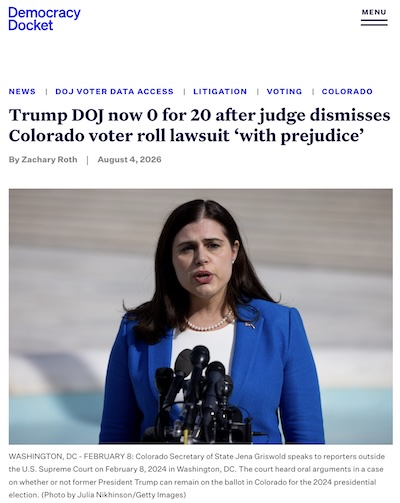
Fortunately, American democracy still has defenders. One remarkable such defender is Democracy Docket, apparently run by attorney Marc Elias and his firm. They’ve opposed the Trump administration in court every time it’s attempted to usurp control of elections. They’ve just reported their 20th win in a row [1], which really makes you wonder about the Department of Justice folk who keep crashing into the same wall, over and over and over again!
NB: As the article points out, this suit from the Trump administration was dismissed by the US District Judge Philip Brimmer with prejudice. Regrettably, Americans live in a time when we all have to learn a bit of legal jargon, so: “with prejudice” means “don’t ever come back, we never want to see this in any court ever again”. In other words, this is really screwed up and should never have happened in the first place.
Judge Brimmer was appointed by GW Bush and is himself a Republican. Of the 20 DoJ failures, 12 came from Republican-appointed judges, and 8 appointed by Trump himself. One simply cannot say this is a left-wing judiciary here!
Alas, here we are, in a world where Trump makes even stupid things dangerous.
What Should We Believe About DoJ’s Probability of Success Going Forward?
Congratulations to Elias and his crew, of course. I follow them on YouTube and BlueSky, and find them frighteningly informative.
But they’ve now presented us with what scientists call a natural experiment: a dataset in which something gets repeated, more or less, in a quantifiably comparable way, even though it was not designed as an experiment. Twenty times the DoJ has attempted to control state voter registrations, and in the 20 cases where it’s been fought, they’ve lost all of them.
What should we believe about the probability of success if they try it again? Because stupid & stubborn fascists never give up until you remove them by force or by prison sentences, so this is worth knowing.
The Math: Repeated Coin Flips
This is essentially the problem of observing $N$ coin flips of which $k$ come up heads, and asking whether the coin is loaded.
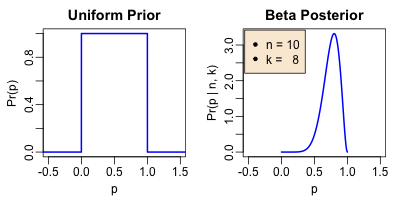 Let $p$ denote the unknown probability of success of the DoJ in lawsuits to get control of
state voter registration. Then, being charitably unbiased, we can posit that we know nothing of
the value of $p$ before seeing some examples. We would say, as Bayesians, that it has an
uninformative prior like a uniform distribution on [0, 1]:
Let $p$ denote the unknown probability of success of the DoJ in lawsuits to get control of
state voter registration. Then, being charitably unbiased, we can posit that we know nothing of
the value of $p$ before seeing some examples. We would say, as Bayesians, that it has an
uninformative prior like a uniform distribution on [0, 1]:
Now, we’ve observed $N = 20$ trials of which the DoJ has won $k = 0$. We can assume the number of successes should be independently identically distributed under a binomial distribution, with success probability $p$:
\[\Pr(N_{Successes}) = \binom{N}{k} p^k (1-p)^{(N-k)}\]But once we have evidence about $N$ and $k$, how should we update our beliefs about how $p$ is distributed? Obviously one temptation is the point estimate of $p \approx k/N$, but that’s an overcommittment, neglecting uncertainty due to the finite number of observations. We know the value of $p$ is small, but it still might be nonzero. It’s well known, at least among people who know such things, that the result is a Beta distribution of the first kind $p$:
\[\Pr(p | \alpha, \beta) = \frac{p^{\alpha - 1} (1 - p)^{\beta - 1}}{B(\alpha, \beta)}\]where the normalization is $B(\alpha, \beta)$ is the complete Beta function. Here, $\alpha = k + 1$ and $\beta = N - k + 1$.
This is something we’ve done many times on this Crummy Little Blog That Nobody Reads (CLBTNR). It’s a trick that should be much more widely known!
The Application
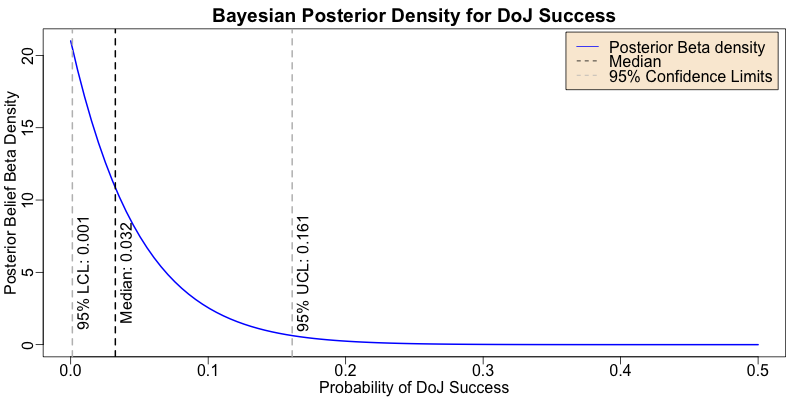 So let’s see what it says about our case:
- The blue curve shows the posterior distribution, reflecting our updated beliefs about $p$ after observing 20/20 losses.
- The vertical lines show the median (best single estimate), and the 95% confidence limits of our remaining uncertainty about $p$.
Conclusion: We’re pretty sure the probability of any future success by the DoJ is about 3.2%. We’re 95% sure it’s somewhere between 0.1% & 16.1%.
The R script to do this is, as usual, available for your inspection and peer review. [2]
The Weekend Conclusion
Basically, at this point, we’d guess the DoJ has about a 3% chance of success in this business. The smart lawyers, with good survival instincts, have either already left or will at least stop doing this.
Apparently there are many other, non-smart, lawyers at DoJ.
Or at least many who are willing to be intimidated by non-smart fascist bosses.
(Ceterum censeo, Trump incarceranda est!)
(Et ceterum censeo, index Epsteiniani divulganda est!)
Notes & References
1: Z Roth, “Trump DOJ now 0 for 20 after judge dismisses Colorado voter roll lawsuit ‘with prejudice’ “, Democracy Docket, 2026-Aug-04. ↩
2: Weekend Editor, “R script to estimate DoJ success probability at getting voter roles”, Some Weekend Reading blog, 2026-Aug-04. ↩
Gestae Commentaria
Comments for this post are closed pending repair of the comment system, but the Email/Twitter/Mastodon icons at page-top always work.