
Ceterum censeo…
Tagged:CatBlogging
/
NotableAndQuotable
/
Obscurantism
/
Politics
/
SomebodyAskedMe
/
ϜΤΦ
Somebody asked me about a t-shirt they saw. Now, why would anybody do that?
Ceterum Censeo…
Perhaps you’ve noticed that, for several years now, I’ve been ending each blog entry in this Crummy Little Blog That Nobody Reads (CLBTNR) with a little Latin post scriptum.
It is in reference to how Cato the Elder (234–149 BCE), a Roman Senator, was said to end every speech, on every topic:
Ceterum censeo, Carthago delendam esse. (Furthermore, I think Carthage must be destroyed.)
The exact wording is not known, and he may have changed it from time to time (“delendam esse” vs “delenda est”). I’ve seen a couple variations in the exact verb tense, for example: that gerundive/future passive participle construction, used to indicate necessity/propriety, has always been a tricksy little inflection to me. But the meaning is clear, modulo tense fussiness: Cato wanted a war of annihilation against Carthage, Rome’s periodic rival.
Now, I’m no fan of ol’ Marcus Porcius Cato here. He was a right bastard: a fascist authoritarian rich guy, in a slaver state from whom we derive our word for fascism (L. fasces)! But… I have to admire his persistence. He simply would not let go of the idea that Carthage was a persistent threat, and had to be dealt with accordingly, lest the threat to Rome come back repeatedly.
Here at Château Weekend, we feel similarly about the threat Trump is now executing upon American democracy and upon civilization itself. He of course should have been impeached & removed during his first term. He should have been convicted of a number of felonies, most importantly the mishandling of secret documents.
Yet, here we are.
So, one might translate my dog-Latin as:
Ceterum censeo, Trump incarcerandam esse.
(Furthermore, I think Trump must be incarcerated.)
Feel free to correct my Latin. Everyone does, eventually.
Ceterum lego… (Furthermore, I read…)
At long last, there is evidence that this has not gone unnoticed among my (very, very few) readers! An eagle-eyed member of the Weekend Commentariat, Pablo, told me he saw a t-shirt and thought of me.
Ummm… what?
Attend: for it shall make sense! (Eventually.)
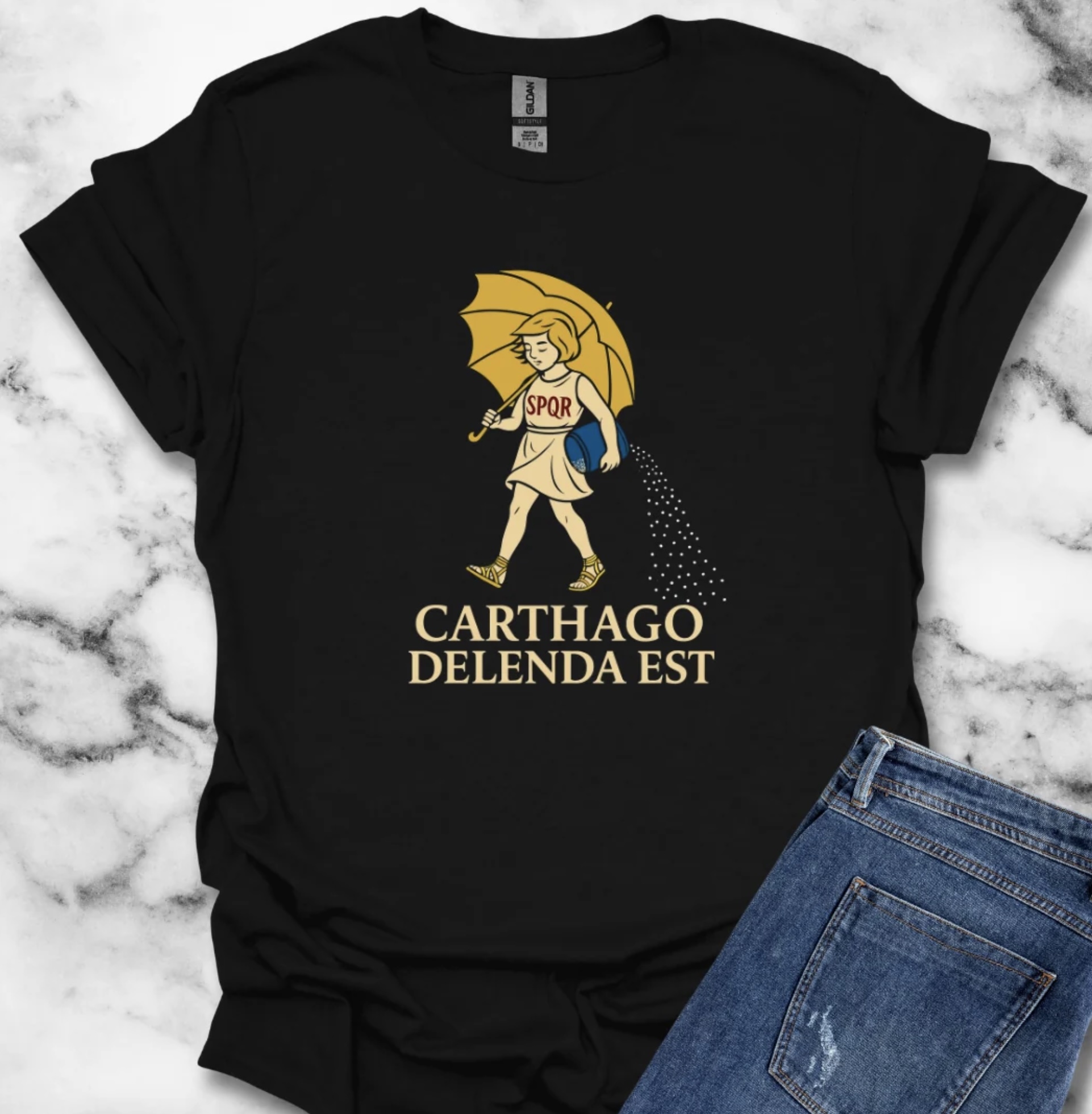 He saw the t-shirt shown here, sold by
Echos of Antiquity.
(No, they are not sponsoring this blog in any way. They just happen to be brilliant, and I
just happen to admire brilliance of this sort.) Now, they’ve chosen a slight syntactic variant
which is not my favorite (“delenda est” vs “delendam esse”), but it’s in the zone.
He saw the t-shirt shown here, sold by
Echos of Antiquity.
(No, they are not sponsoring this blog in any way. They just happen to be brilliant, and I
just happen to admire brilliance of this sort.) Now, they’ve chosen a slight syntactic variant
which is not my favorite (“delenda est” vs “delendam esse”), but it’s in the zone.
And this metaphor is just about perfect, in eleventeen separate dimensions. Please permit my inner pedant to squee all about it for you:
-
First, it’s making fun of a logo which is extremely recognizable to anyone who’s bought salt in the US over the last century. The Morton Salt company in 1911 adopted the logo [1] of a girl walking in the rain with an umbrella, trailing salt behind her from a leaky salt package.
What does a girl spilling salt while walking in the rain have to do with anything? Basically, pure salt in wet or humid weather absorbs water and clumps up to the point where it won’t flow, or won’t come out of a shaker. This is why some restaurants in humid climates put uncooked rice in the salt shakers, to absorb the water. The food chemists at Morton discovered adding magnesium carbonate (later replaced with calcium silicate) would fix this problem. [2]
The salt would flow freely even in moist conditions, hence the phrase “When it rains, it pours.” The little girl absent-mindedly unaware of the leak in the package while walking in the rain is a near-perfect illustration of this.
Step 1 in any good satire is to pick an easily recognizable trope as a target, or at least as a carrier meme. So far, mission accomplished!
Now… how has that been altered for this joke’s purposes?
-
She’s wearing sandals, especially ones with the leather laces that go around the ankles, very suggestive of ancient Mediterranean culture. The legions would wear caligae that look like this; ordinary people would wear lighter-weight versions of that called crepidae. (Though I may be a bit supra crepidam here! :-)
-
She’s wearing a singlet/shift with a tie around the waist, resembling a Roman tunic. These were often dyed/bleached white, as that was cheap to do. So even the color is correct here.
-
Her tunic is emblazoned “SPQR”, which in Roman times meant “Senatus Populusque Romanus”, or “the Roman Senate and People” (the “Q” is for the “-que” enclitic which encodes an “and” between the nominative-case nouns which precede it).
This was blazoned on coins, documents, and the sigils carried in front of legions. It emphasized the governmental authority of whatever document or group of soldiers were using it.
It fairly screams “by the authority of the Roman government”.
-
Spilling salt specifically is on point: it was of great value in the ancient world, with salt mining likely under a local monarch’s control.
A slightly doubtful tradition says portion of the compensation of Roman soldiers was paid in salt to add to their food. This was the salarium, which is where English gets the word “salary” and the expression that someone is “worth their salt,” i.e., worth their pay.
-
At the end of the 3rd Punic War (See? Cato was right, Carthage kept coming back), the Roman general Scipio Aemilianus (aka Scipio Africanus the Younger) pretty much nuked Carthage: sacked the city, killed the men, enslaved the women & children, and destroyed all the buildings.
A dubious tradition, sometimes ambiguously reported in medieval times, but really established in modern times in the 19th century, says he also had all the fields plowed up and then salt plowed back into them. This would have made the land into a desert unsuitable for agriculture for many generations, perhaps forever.
This would complete the destruction of Carthage, making it nigh impossible to rebuild.
So our innocent little girl is… reprising & commemorating a Roman genocide, with enthusiastic detail? (Though, to be fair, Carthaginian culture was not exactly admirable. Their Moloch worship, involving torturing children to death, is just the start, really. My sympathy for them is quite limited. Maybe not zero, but certainly not a lot.)
It’s really hard for nerds of a certain stripe to resist this!
(Yeah, I bought the shirt. Did you really think I had enough self-control to resist? I mean, it’s kind of you to think so… but a bit delusional.)
The Weekend Conclusion
 Sometimes it’s hard for us Asperger-ish nerds to communicate to all the NT folk just how
wonderful our obsessions are. So it is, often, with oddities of Latin and other ancient
languages. Most people don’t get it, even outright refuse to get it, and won’t even
try to get it.
Sometimes it’s hard for us Asperger-ish nerds to communicate to all the NT folk just how
wonderful our obsessions are. So it is, often, with oddities of Latin and other ancient
languages. Most people don’t get it, even outright refuse to get it, and won’t even
try to get it.
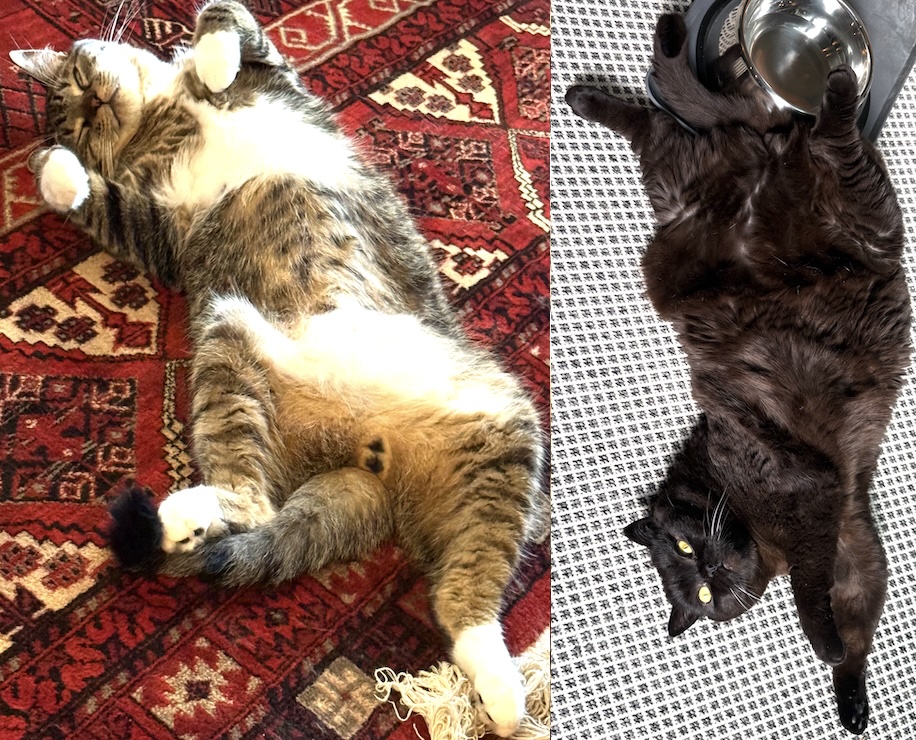
For example, like all good editors with a cool story, I tried to explain it to the Weekend Publisher and the Assistant Weekend Publisher. However, as you can see here, they were engaged in yoga classes perfecting their heso-ten poses. (Japanese: “navel to the heavens”. No, it’s not a real yoga pose. Did you really expect that? It’s just how we speak Cat Japanese here at Château Weekend.)
Still, in these difficult times, I envy their ability to relax.
We should help create a world to which that level of relaxation is a proper response.
And, of course, once more with feeling: Ceterum censeo, Trump incarcerandam esse.
Addendum 2025-Jul-27: On Needing the Gerundive
Latin has long been used to torture middle schoolers and high schoolers about grammar. (It’s the way I finally understood English grammar, because finally somebody would state the rules explicitly. Every English teacher before that was apparently afraid of being clear about the rules, for fear of exceptions.) Nonetheless, Latin is full of little pecularities of syntax and semantics. Some of them made me wonder, like physicist II Raabe upon hearing about the muon, “Who ordered that?”
The gerundive construction, as used above, is one such: a future passive participle meant to indicate not the nearly useless thing you’d think it would (“delenda” as in “will be being destroyed”), but instead a necessary or proper thing. In English, we use modals like “should” or “must”, but in Latin they torture the verb inflection. Did the Romans really need that?
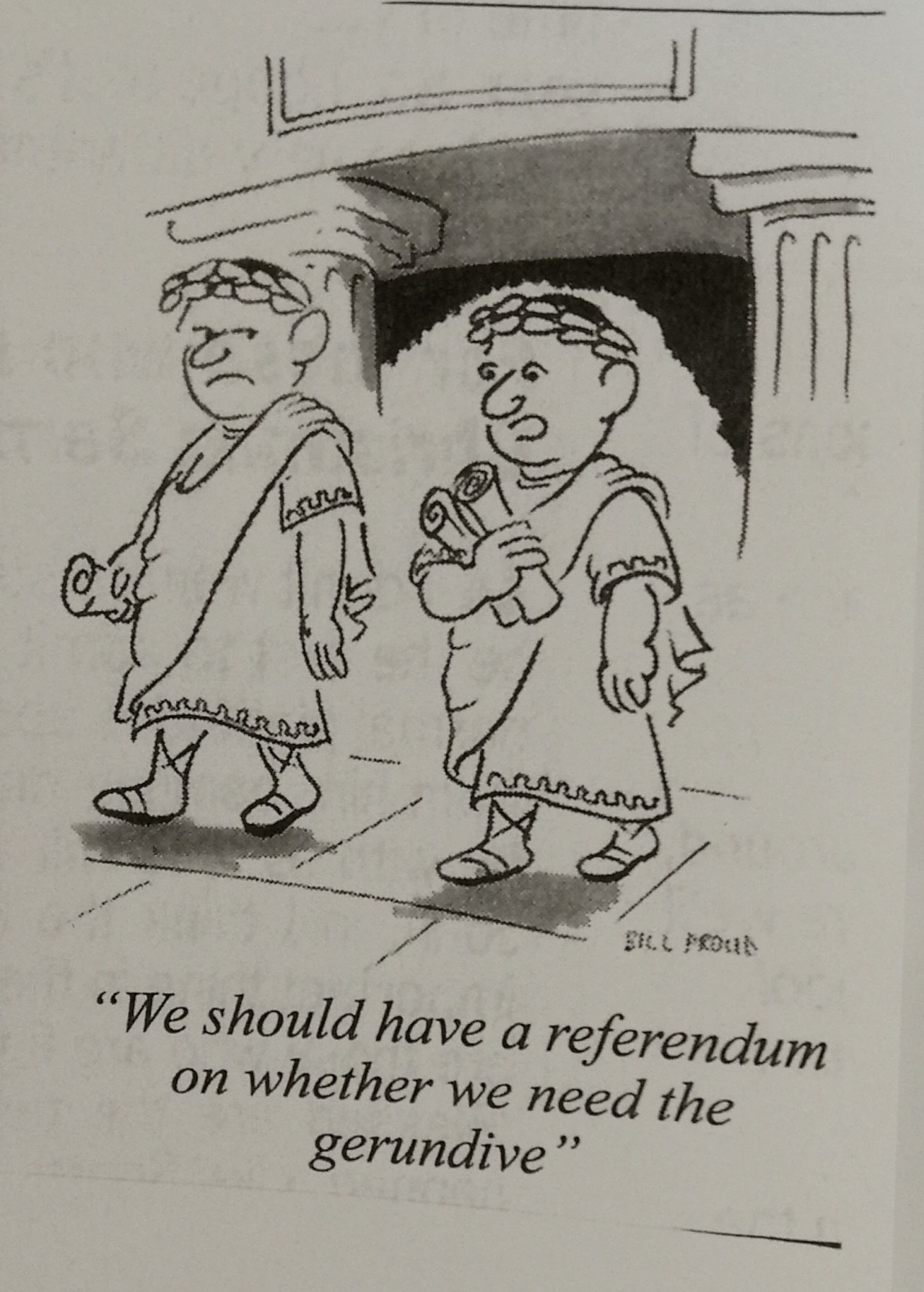 Mike, another eagle-eyed member of the Weekend Commentariat and himself a classics professor, sent
along this cartoon by way of illustration. It’s signed by
Bill Proud, an apparent pseudonym of Bill Tidy,
and likely appeared some time in Britain in Private Eye,
though I couldn’t easily nail down the date.
Mike, another eagle-eyed member of the Weekend Commentariat and himself a classics professor, sent
along this cartoon by way of illustration. It’s signed by
Bill Proud, an apparent pseudonym of Bill Tidy,
and likely appeared some time in Britain in Private Eye,
though I couldn’t easily nail down the date.
The caption is a bit peculiar in English, but quite funny when you translate it to Latin. Saying “we should have a referendum” is best translated using the gerundive, i.e., expressing the necessity of doing something. But when that something is questioning the necessity of the gerundive itself, then the sentence is doubting the utility of a verb tense that it is itself required to use! (Take that, Epimenides!)
Something like:
Referendum nobis habendum est quo quaeritur utrum gerundivum nobis requirendum sit.
That “habendum est” is a gerundive: “we should have”.
Look: you’re just gonna have to trust me that this is funny, if you know some Latin.
Addendum 2025-Aug-06: The Shirt Arrives!
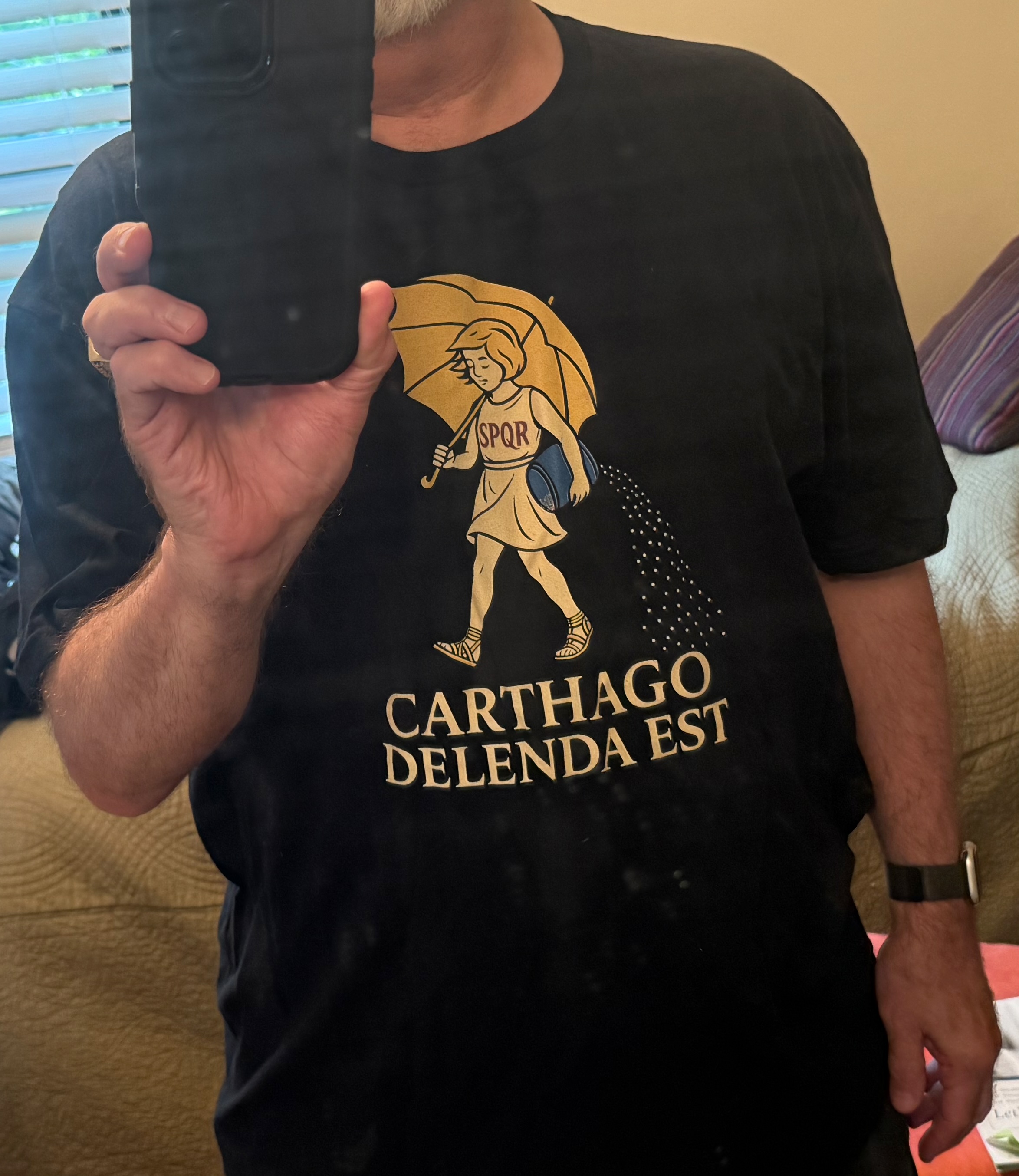 Over the weekend, while I was off kyoodling in the luminiferous æther in the Berkshires,
a Mysterious Package arrived. In due course, our excellent cat-sitter brought it inside
and, after permitting the Weekend Publisher and the Assistant Weekend Publisher to conduct
the required sniff test, they more or less ignored it.
Over the weekend, while I was off kyoodling in the luminiferous æther in the Berkshires,
a Mysterious Package arrived. In due course, our excellent cat-sitter brought it inside
and, after permitting the Weekend Publisher and the Assistant Weekend Publisher to conduct
the required sniff test, they more or less ignored it.
I opened it upon our return, and found within the excellent shirt you see here, on my rather less-than-excellent torso. (I’ve flipped left and right so the mirror selfie makes better sense, in case that puzzles you.)
It’s just about perfect, for all the historical, grammatical, and advertising reasons cited above. It’s also reasonably roomy – as I prefer – and smooth material in dark, high-saturation colors.
The cats and I pronounce ourselves fully satisfied. Recommended.
This may have to be one of the Official Weekend T-Shirts here at Château Weekend. The other contenders, at the moment, are:
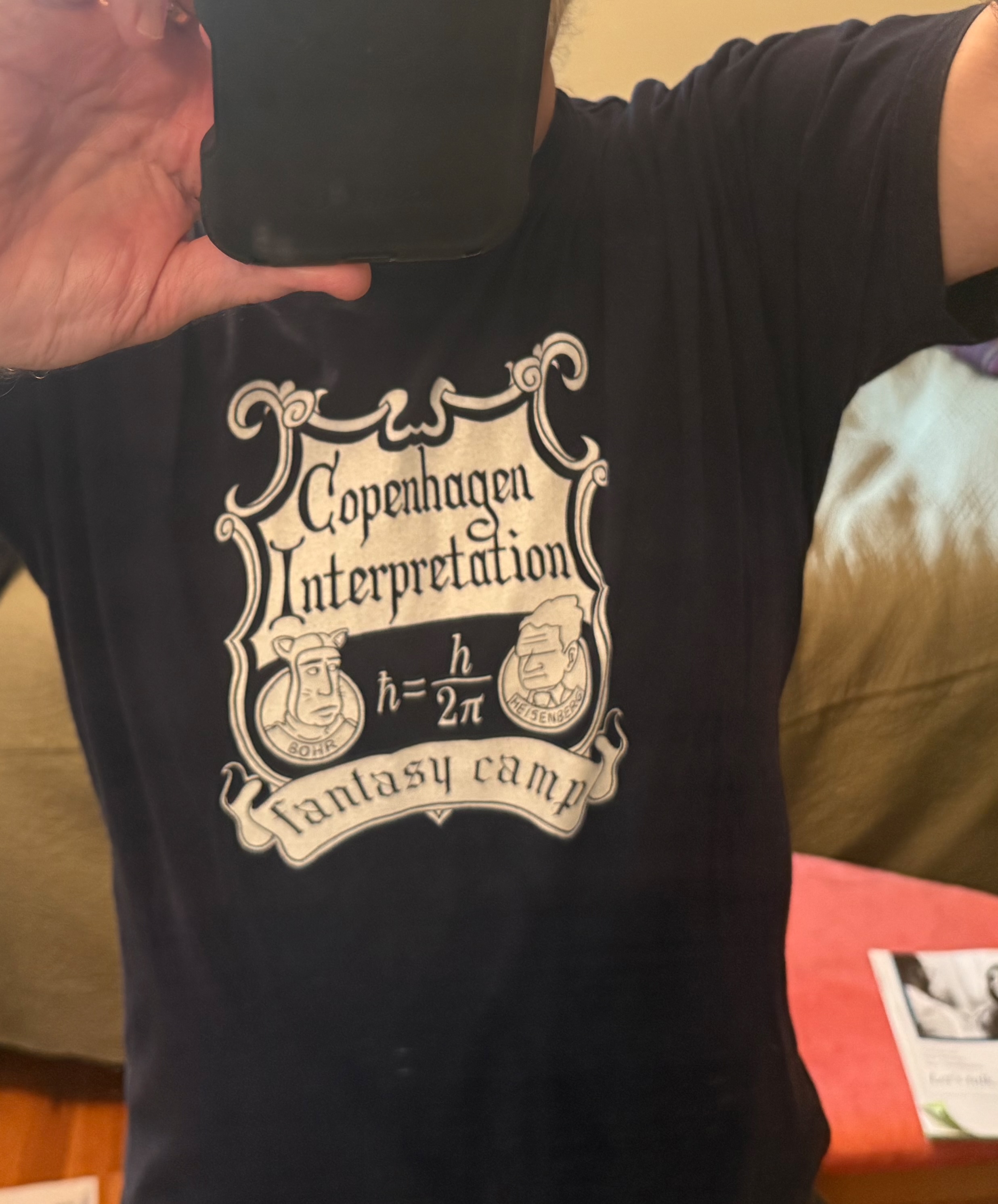
- Dresden Codak’s Cophenhagen Interpretation Fantasy Camp for quantum mechanics fans (apparently no longer available, so you’ll just have to look at it regrettably modeled on my pudgy, aging torso), and
- of course the Gunnerkrigg Court sigil, with wingèd bismuth.
Notes & References
1: Morton Salt Staff, “How A Little Girl Grew Up To Be An Icon “, Morton Salt web site, retrieved 2025-Jul-26. ↩
2: K Dobbs, “The Birth of a Brilliant Brand Identity”, TealHaus web site, retrieved 2025-Jul-26. ↩
Gestae Commentaria
Comments for this post are closed pending repair of the comment system, but the Email/Twitter/Mastodon icons at page-top always work.