Candlemas, and Other Observations of the Season
Tagged:MathInTheNews
/
R
/
Statistics
/
ϜΤΦ
So, Candlemas, eh? Also something about groundhogs. And – sadly – sportsball.
Candlemas
 This past Sunday, 2026-Feb-02, was a minor and usually unremarked holiday in the Christian
canonical calendar: Candlemas.
This past Sunday, 2026-Feb-02, was a minor and usually unremarked holiday in the Christian
canonical calendar: Candlemas.
Like most such holidays, it’s sort of pasted on top of an older Roman holiday, in this case Lupercalia.
Traditionally, Candlemas celebrated the presentation of Jesus at the Temple 40 days (inclusive) after his birth, and the ritual purification of Mary. It thus represents the end of the Christmas part of the canonical calendar, and in some places was the occasion for removing Christmas decorations. (In other places, they were removed on Twelfth Night. Here at Château Weekend, the Weekend Editrix and I have differing opinions on this subject. I rather like the lights on the long, dark nights, and hence want to hold out for keeping things going until Candlemas. She, on the other hand, notes that New Year’s Day is, in Japan, a Very Big Deal with its own decoration requirements, and wants the other stuff out of the way as soon as possible.)
The name “Candlemas” comes from having new candles in church, and having domestic candles blessed for use throughout the year. There’s a whole light-sharing thing going on, though sometimes I suspect it’s just a matter of, “It’s dark. It’s cold. We want to have a holiday about sharing light and warmth.”
That works for me, too.
Conclusion: It’s good to seek wisdom & light, and it’s good to be with your neighbors.
Weather Divination by Hibernating Rodents
Then the history takes a turn for the weird, which is how you know it’s true history.
 The candle-blessing thing made its way to Germany, where the locals decided that if it was
sunny on Candlemas, as measured by the ability of a hedgehog to see its shadow, then more
winter was on the way. Just why they decided this is left as an exercise for the reader.
The candle-blessing thing made its way to Germany, where the locals decided that if it was
sunny on Candlemas, as measured by the ability of a hedgehog to see its shadow, then more
winter was on the way. Just why they decided this is left as an exercise for the reader.
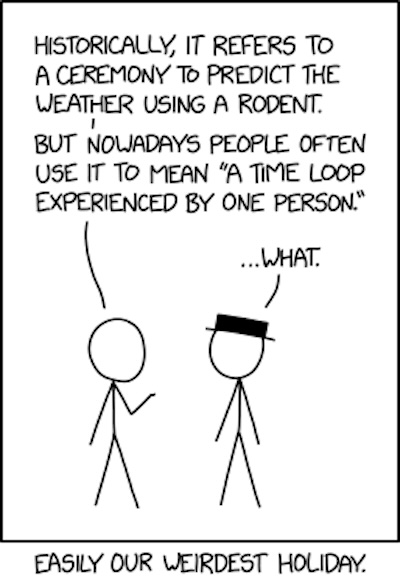
Later, many of the settlers in the US state of Pennsylvania came from Germany, so they brought this custom with them. And that’s when it gets really weird. As always, XKCD has the goods, in this case XKCD #3202, shown here. Munroe’s pointing out the absurdity of weather divination from shadows of usually hibernating rodents, as well as the more modern film comedy, Groundhog Day, which involves inexplicable time loops instead of, or in addition to, inexplicable weather divination by rodents.
As to why it’s now a groundhog and not the original German hedgehogs & badgers, the XKCD mouseover text offers the usual surreal ‘explanation’:
Originally, the ceremony used a variety of rodents and mustelids, but over time most people agreed it made sense to standardize on a specific individual ground squirrel in Pennsylvania.
(There’s a lot to be said of the alternative, and saner, French tradition: one simply eats crêpes on this day, “La Chandeleur”. I think the groundhogs would also prefer we do that, and just left them to hibernate.)

 Still, it’s become a big deal here.
The Pennsylvania town of Punxsutawney, population about 5700 and otherwise unremarkable as far as I can tell, is the epicenter. They have a ceremony in which they announce whether “Punxsutawney Phil”, as he is inevitably called, has seen his shadow or not. (I have no idea how they know what the groundhog sees or does not see.)
As you can see here, the ceremony involves handling an otherwise hibernation-adjacent groundhog in front of news cameras by a rather large number of older white men, mostly bearded, all in top hats. It’s difficult to know what the groundhog makes of all that. It’s difficult to know what I should make of all that.
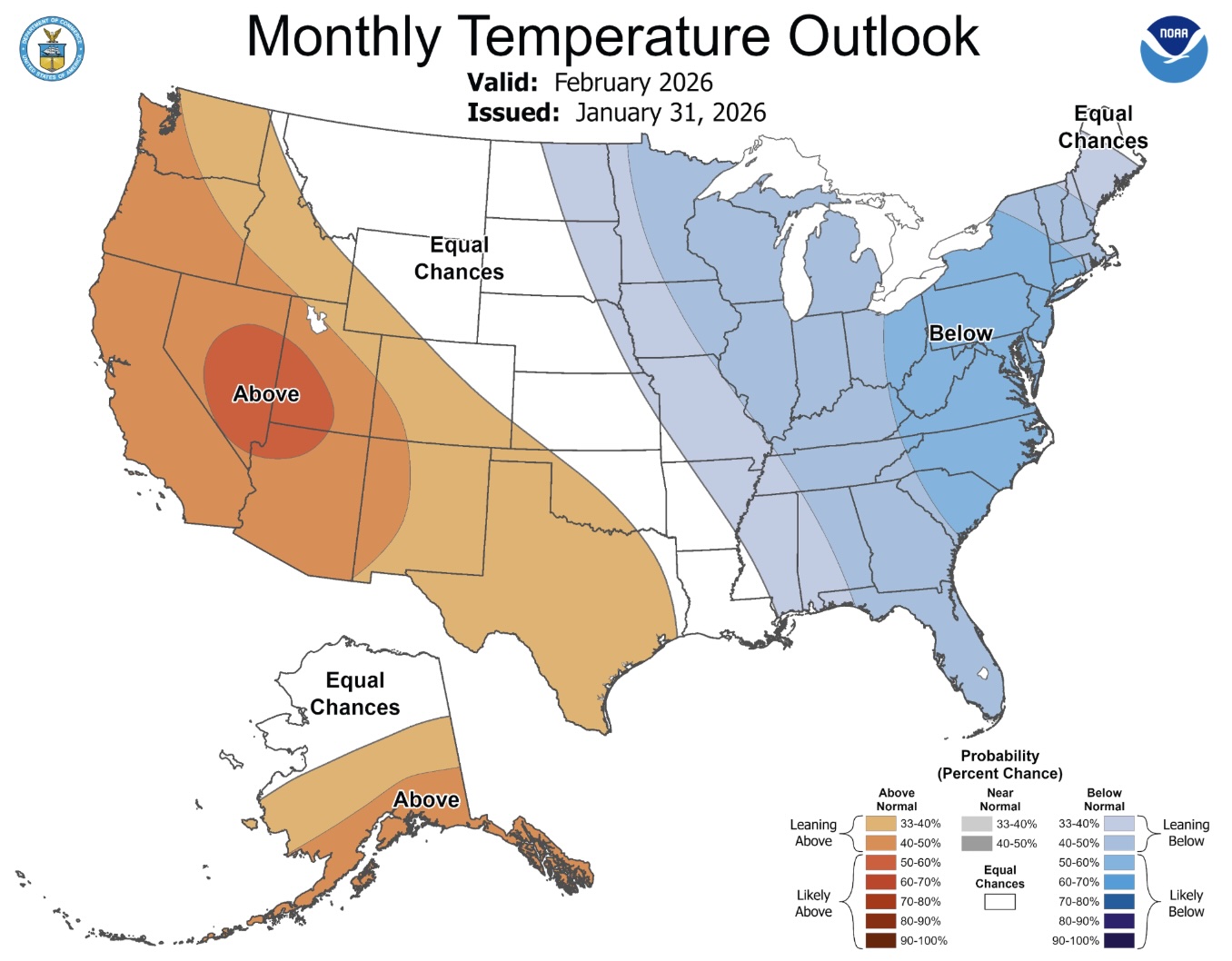
This year, they declared that the shadow was indeed seen, and thus there would be 6 more weeks of winter. The accompanying temperature forecast for the month of February from the National Oceanographics and Atmospheric Administration (what’s left of it), agrees that the eastern half of the US will be colder than usual.
Still… are groundhogs at all accurate in this regard? I mean, there must be some reason that people have held on to this custom, beyond just the surreal fun of it!
I am (not at all reliably) informed that this mishegoss has been going on for 139 years, and that the groundhog has been accurate about 35% of the time.
Sniff… sniff… That smells like data!
We know what to do with data, here on this Crummy Little Blog That Nobody Reads (CLBTNR).
The Null Hypothesis is always something of the form “there’s nothing going on here”. In this case, it’s a binary decision (“more winter” vs “less winter”). So if the weather prediction is a guess, then it should be right about 50% of the time. Anything which deviates from that (up or down!) indicates that something is happening, which is the Alternative Hypothesis.
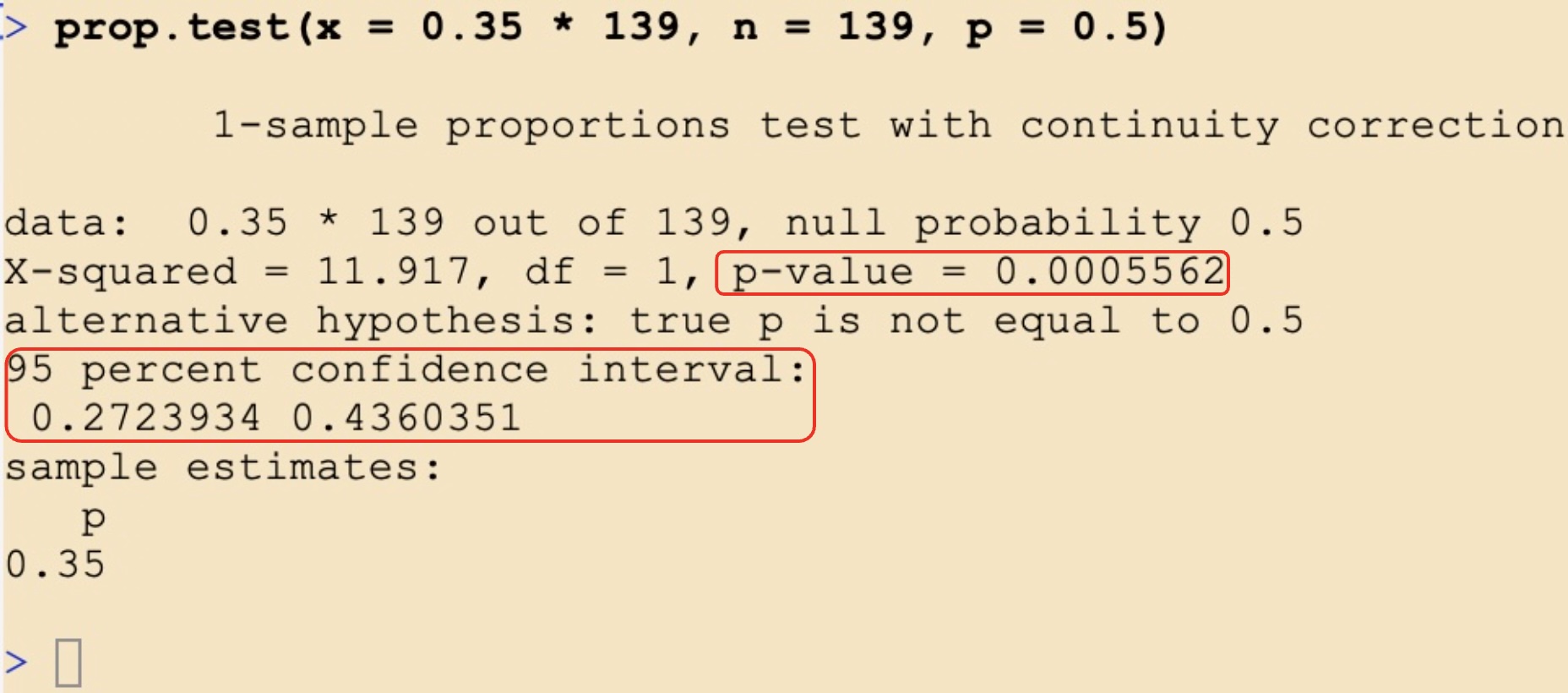 So we performed a
test of proportion
in R, as shown here.
So we performed a
test of proportion
in R, as shown here.
The result is shown in the 2 red boxes:
-
The probability that the predictions are truly random coin flips, and we still got it right only 35% of the time in 139 tries is very tiny: $p \sim$ 0.000056, or about 5 one hundredths of one percent.
In other words, there is not a chance we should buy the Null Hypothesis!
-
The probability of a correct prediction at 35% after 139 tries has a 95% confidence interval of 27.2% – 43.6%.
Note that this does not overlap 50%!
Conclusion: Weather divination by rodent is statistically significantly worse than random. Either:
-
That rodent is lying!
Maybe he’s mad at being awoken from a perfectly good hibernation, or is just scared of all the old white guys with beards & top hats. If they woke you out of a sound sleep and waved you around in the sun in front of cameras, you’d be a mite tweaked too, I’ve no doubt.
-
That poor, innocent rodent has been miscalibrated!
We’ve been reading his predictions backwards for 139 years: if we just decided seeing his shadow meant early spring, then he’d have been correct a very solid 65% of the time.
From this we learn that: (a) accuracy of prediction is uncannily not one of the things people care about, and (b) we can nonetheless seek wisdom & light by looking objectively at data.
So far, the Candlemas theme of seeking wisdom & light is holding up. (Sort of.)
Sportsball and Its Discontents
There is, alas, in the US, yet another ritual at this time of the year, involving sportsball. I try very hard to speak of the Super Bowl in terms that are only mildly derisive, but I often fail at that level of restraint.
 The only interesting fact about the Super Bowl for me is that they are mysteriously
numbered consecutively with Roman numerals. This year is Super Bowl LX, i.e., the 60th
iteration of this ritual of concussions and puzzlement over Roman numerals.
The only interesting fact about the Super Bowl for me is that they are mysteriously
numbered consecutively with Roman numerals. This year is Super Bowl LX, i.e., the 60th
iteration of this ritual of concussions and puzzlement over Roman numerals.
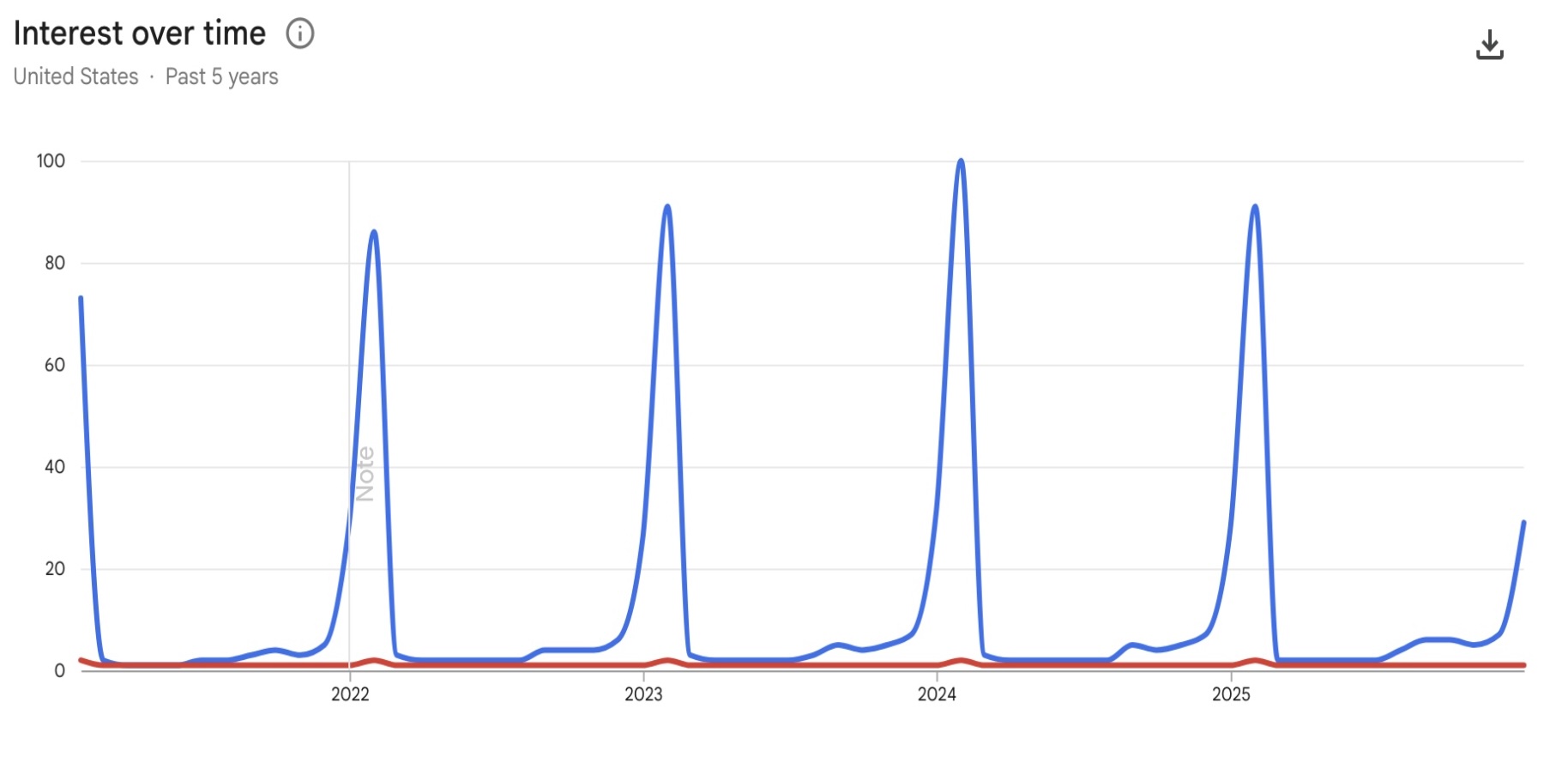
Someone showed me a Google Trends plot of queries for the Super Bowl and how to read Roman numerals over the years, showing uncanny correlations. However, that particular graph seems to be at least exaggerated, and thus is not in good odor at Snopes.
But I couldn’t resist checking the data personally, because that’s what we do here on this CLBTNR. The graph shows a 5 year retrospective of queries for the Super Bowl in blue, and queries for how to read Roman numerals in red. They’re both on the same scale, so of course the Super Bowl dwarfs the Roman numeral queries. But… there is a germ of truth here: every year, around Super Bowl time, people wonder how to read MMCMDXLVII or the like. (That example, BTW, is malformed.)
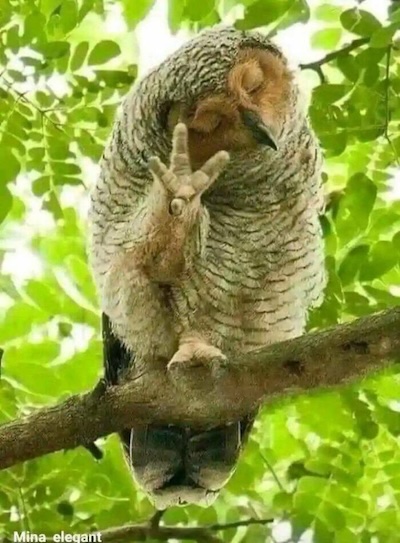
So every year, people do seek a bit of wisdom. Just like this superb owl, raising a claw and reminding us that “No, actually… there’s a great deal more to be experienced in the world beyond sportsball.” (Listen to the owl. He is, after all, a symbol of wisdom.)
In fact, this has been true pretty much forever. The first owl is reminding us of his venerable colleague, possibly an owl forebear of his, shown below him. This is a bit of cave art is from the Grotte Chauvet-Pont d’Arc, or Chauvet Cave, in France. It was apparently a bustling scene of Upper Paleolithic life, but then fell out of use and was undiscovered until 1994-Dec-18. It contains some of the best preserved ancient cave paintings currently known to humanity.
This especially Superb Owl painting is thought to be about 32,000 years old. To compare with the age of the Super Bowl, I remind you that in Roman numerals one uses a vinculum, or bar above the numbers, to mean “times a thousand”. You’d write XXXII for 32, and then put a line over it for 32,000.
So, which ya gonna watch: a mere Super Bowl LX or a Superb Owl $\overline{\mbox{XXXII}}$?
Conclusion: We can look up from the sportsball gladiatorial ceremonies, and celebrate Superb Owl Sunday by looking at some of these absolutely gorgeous animals, traditionally symbols of wisdom.
(And yes, ‘Sportsball and Its Discontents’ is yet another Nerd Tribe joke. Do not tell me you are surprised by this.)
The Weekend Conclusion
Coulda been worse; just be thankful I didn’t go with Super Bowel as a metaphor.
(Ceterum censeo, Trump incarcerandam esse.)
Notes & References
Nope.
Gestae Commentaria
Comments for this post are closed pending repair of the comment system, but the Email/Twitter/Mastodon icons at page-top always work.