
Boston Go BOOM!
Tagged:Beauty
/
CatBlogging
/
Physics
/
ϜΤΦ
Where’s the kaboom? Boston, that’s where!
One Rainy Afternoon
Last Saturday, 2026-May-30, at 2:06pm EDT (18:06 GMT) here at Château Weekend, we were just sitting on the couch reading. It was raining, so it was no particularly shocking thing to hear the boom of thunder. But… it was particularly loud thunder that shook not only the windows, but the entire house, too.
I thought maybe it was a nearby lightning strike, or at any rate thunder just above the house. But there was no flash, and the Weekend Editrix was correctly suspicious.
Later, it transpired that everybody in eastern Massachusetts thought the thunder was right above wherever they were. And it was strong enough to register (slightly) on seismometers, like a potential earthquake. (I’ve experienced very, very minor earthquakes in the US, but recently I got to experience a moderate Japanese earthquake. We were eating dinner, and the house began shaking with an amplitude of about 0.5cm at a frequency between 0.5 Hz - 1.0 Hz. I carefully watched my family: they looked around, waited for the shaking to stop, and resumed dinner conversation without comment.)
This was… not an earthquake, and not thunder!
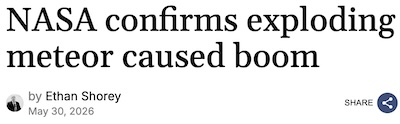
 Both local news [1] and MSN [2]
cite NASA for the fact that it was a meteor:
Both local news [1] and MSN [2]
cite NASA for the fact that it was a meteor:
- The diameter was about 1 meter, and it entered the atmosphere at about 120,000 km/hr.
- It exploded more or less over the middle of Cape Cod Bay, which explains the wide reports all over Boston and the Cape.
-
The explosion was equivalent to about 300 tons of TNT.
\[300 \mbox{ tons } \times 4.184 \mbox{ gigajoules / ton } = 1.255 \mbox{ terajoules }\]
TNT equivalent measurements for explosions work from the fact that 1 ton of TNT is about 4.184 gigajoules, or ironically enough, 1 gigacalorie (small c). So this explosion released about:of energy, which is… impressive! (A smallish nuclear weapon, though, would be 10-20 kilotons TNT equivalent, so 30 - 60 times larger.)
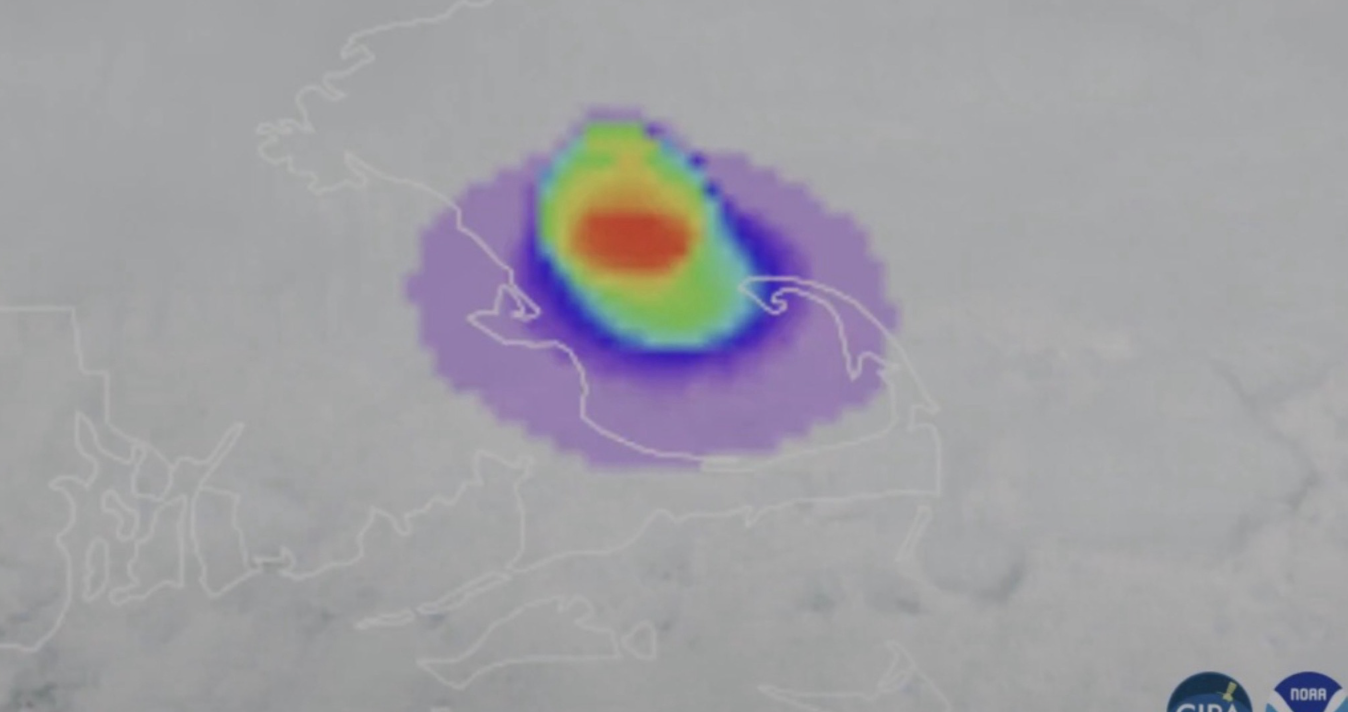 Here is, according to The Local Insider, some data from the GOES-19 satellite, yclept
the GLM (geostationary lightning mapper). It’s (apparently, since there was little
accompanying explanation) showing the energy release concentrated almost exactly over the
center of Cape Cod Bay.
Here is, according to The Local Insider, some data from the GOES-19 satellite, yclept
the GLM (geostationary lightning mapper). It’s (apparently, since there was little
accompanying explanation) showing the energy release concentrated almost exactly over the
center of Cape Cod Bay.
It’s worth reflecting for a moment on what makes meteors first glow, and then explode.
A meteor air burst is not due to atmospheric friction, for the most part. Instead, things coming in at speeds on the order of 120,000 km/hr are going to leave a trail of near vacuum behind them and extremely compressed air ahead of them due to the shock wave of their hypersonic passage. (The speed of sound is about 1,200 km/hr depending on air pressure, temperature, and humidity. So we’re talking about 100x the speed of sound, in this case.)
If you suddenly (without allowing time to come to equilibrium with surroundings) compress air that hard, it heats up enormously. There are nuances that make this statement not completely right, but think of taking all the energy in the air atoms in a large volume and compressing it suddenly down to a small volume. Suddenly the energy density is dramatically higher, and hence (approximately) the temperature also.
 So the air in front is highly compressed and high temperature, which makes it glow
brightly. Then it finds every single little crevice in the meteor and infiltrates it at
high speed and high pressure. This more or less blows the meteor apart: a good chunk of
its kinetic energy upon entry to the atmosphere goes into the bow shock wave, which
compresses air to incandescence, which then pushes into the meteor and blows
it apart. The energy source is the kinetic energy of entry at orbital speeds; the
transfer to the air is structurally fatal to anything other than smallish chunks, which
themselves usually burn up chemically at high temperatures.
So the air in front is highly compressed and high temperature, which makes it glow
brightly. Then it finds every single little crevice in the meteor and infiltrates it at
high speed and high pressure. This more or less blows the meteor apart: a good chunk of
its kinetic energy upon entry to the atmosphere goes into the bow shock wave, which
compresses air to incandescence, which then pushes into the meteor and blows
it apart. The energy source is the kinetic energy of entry at orbital speeds; the
transfer to the air is structurally fatal to anything other than smallish chunks, which
themselves usually burn up chemically at high temperatures.
As you can see here, the Weekend Publisher and the Assistant Weekend Publisher took Official Notice of the disturbance, but were not otherwise perturbed. They’re both Good Boys – mostly – who know they’re safe and loved at home.
The Weekend Conclusion
 There’s an old gag in Bugs Bunny/Daffy Duck cartoons involving a character called
Marvin the Martian, pictured here. He
wants to destroy Earth. (Why? Because it blocks his view of Venus, of course.) His first
attempt at blowing up Earth fails, for some stupid reason or other, and he has a famous
line:
There’s an old gag in Bugs Bunny/Daffy Duck cartoons involving a character called
Marvin the Martian, pictured here. He
wants to destroy Earth. (Why? Because it blocks his view of Venus, of course.) His first
attempt at blowing up Earth fails, for some stupid reason or other, and he has a famous
line:
Where’s the kaboom? There’s supposed to be an Earth-shattering kaboom!
Now, 77 years after Marvin’s first appearance, his question can be answered:
The kaboom from space was in Boston, just 77 years later and a lot smaller than he thought it would be.
(Ceterum censeo, Trump incarceranda est!)
(Et ceterum censeo, index Epsteiniani divulganda est!)
Notes & References
1: E Shorey, “NASA confirms exploding meteor caused boom”, The Local Insider, 2026-May-30.
I know approximately nothing about The Local Insider. It appears to be an amalgam of what used to be in the now-lamentably-late town newspapers. I wish them well! ↩
2: M Dixit, “75,000 mph-speeding meteor behind massive sonic boom over Massachusetts, NASA says”, MSN, no specific date but likely 2026-Jun-01. ↩
Gestae Commentaria
Comments for this post are closed pending repair of the comment system, but the Email/Twitter/Mastodon icons at page-top always work.