Autism and Acetaminophen
Tagged:CatBlogging
/
JournalClub
/
MathInTheNews
/
PharmaAndBiotech
/
Politics
/
Sadness
/
Statistics
So, Trump and Kennedy announce ex cathedra that acetaminophen during pregnancy causes autism. Is this stupid or not?
What Has He Tried to Claim Now?
After the CDC ACIP vaccine fiasco, and amidst the continuing debacle of failing to release the Epstein files, the Trumpists need a distraction. RFKJr of course can be relied upon to supply controversial distractions at a moment’s notice.
He’s been teasing that he’ll tell us all what the cause of autism is, despite literally decades of evidence involving mostly genetics and a few environmental insults. Today was the day, when Trump (of course) seized the spotlight and announced that the New Correct Opinion in Trumpland was that use of acetaminophen (paracetamol/Tylenol) during pregnancy was somehow to blame.
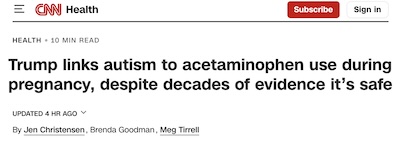 CNN [1], for example, reports:
President Donald Trump announced Monday that the US Food and Drug Administration will notify doctors that the use of Tylenol during pregnancy can be associated with a “very increased risk of autism,” despite decades of evidence that it is safe.
Trump was unable to pronounce “acetaminophen”, despite offering medical advice on the subject. So he said the brand name “Tylenol” instead, a brand with an army of lawyers to defend it. That should be interesting to watch.
Not content with dispensing unqualified medical advice on a subject about which they know nothing, they proceeded to say the FDA will recommend leucovorin for the treatment of autism. Leucovorin is a high-dose calcium/folinic acid drug, typically used with cancer patients whose minerals are out of whack from chemotherapy.
The commercially branded version, Wellcovorin, was made by Glaxo-Smith Kline. However, since GSK stopped marketing it 27 years ago, the FDA withdrew approval. Now the FDA will be forced to re-approve it, with an indication for autism where it has never been tested.
 Somewhat more disturbingly, there are generic versions of leucovorin (or its main
ingredient) supplied by various unregulated or very lightly regulated supplement
companies. They stand to make a bundle if there’s significant demand for leucovorin.
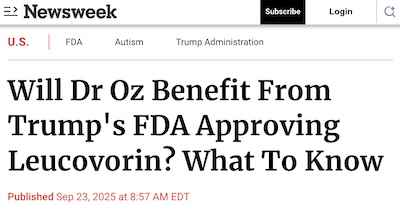
Dr. Mehmet Oz, known as “Dr Oz”, is a wealthy, controversial, celebrity doctor, and now
Trump’s administrator for the Centers for Medicare and Medicaid Services (CMS). He’s also
a significant investor in iHerb [2], a California supplement
company that sells the folinic acid part of leucovorin.
Somewhat more disturbingly, there are generic versions of leucovorin (or its main
ingredient) supplied by various unregulated or very lightly regulated supplement
companies. They stand to make a bundle if there’s significant demand for leucovorin.
Dr. Mehmet Oz, known as “Dr Oz”, is a wealthy, controversial, celebrity doctor, and now
Trump’s administrator for the Centers for Medicare and Medicaid Services (CMS). He’s also
a significant investor in iHerb [2], a California supplement
company that sells the folinic acid part of leucovorin.
It stinks that the wildly weird recommended therapy is now something that will profit Trump people. Oz says he will divest, but in the Trump administration nobody divests.
CNN concludes with some real medical evaluation of their autism medical advice:
Dr. Arthur Caplan of the NYU Grossman School of Medicine Division of Medical Ethics called the announcement “the saddest display of a lack of evidence, rumors, recycling old myths, lousy advice, outright lies, and dangerous advice I have ever witnessed by anyone in authority in the world claiming to know anything about science.”
“What was said was not only unsupported and wrong but flat out malpractice in managing pregnancy and protecting fetal life,” he wrote in an email.
Sounds about right.
Let’s Consult the Science
AsapSCIENCE is a Canadian YouTube channel run by two people who are pretty good at explaining science with a dash of humor. (Occasionally one of them will be flamboyantly, performatively gay in a way that makes it all the more charming and hilarious. As in, a quote I half-remember: “Think of me as your cool gay science uncle.”) They are both qualified as actual scientists.
Here’s their latest video explainer on autism and acetaminophen:
- Autism is complicated, mostly genetic with implications for many genes.
- Acetaminophen has nothing to do with it.
- Any purported rise is due to better diagnostic tools and expanding of the criteria (to include adults, include Asperger’s, and so on – in the 60s, you basically had to be nonverbal to be considered autistic).
It’s a good summary for those of you who don’t want to wade through a paper.
But let’s face it: you know what kind of Crummy Little Blog That Nobody Reads (CLBTNR) this is. You wouldn’t be here if you didn’t want to wade through the relevant science papers. So the latest meeting of Some Weekend Reading Journal Club is now in session!
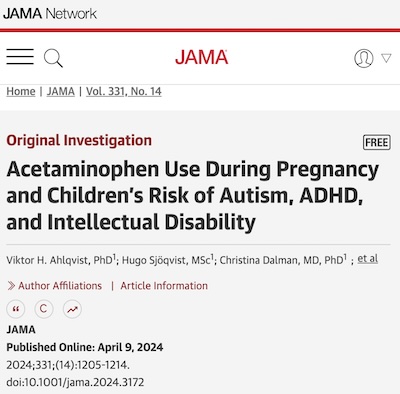
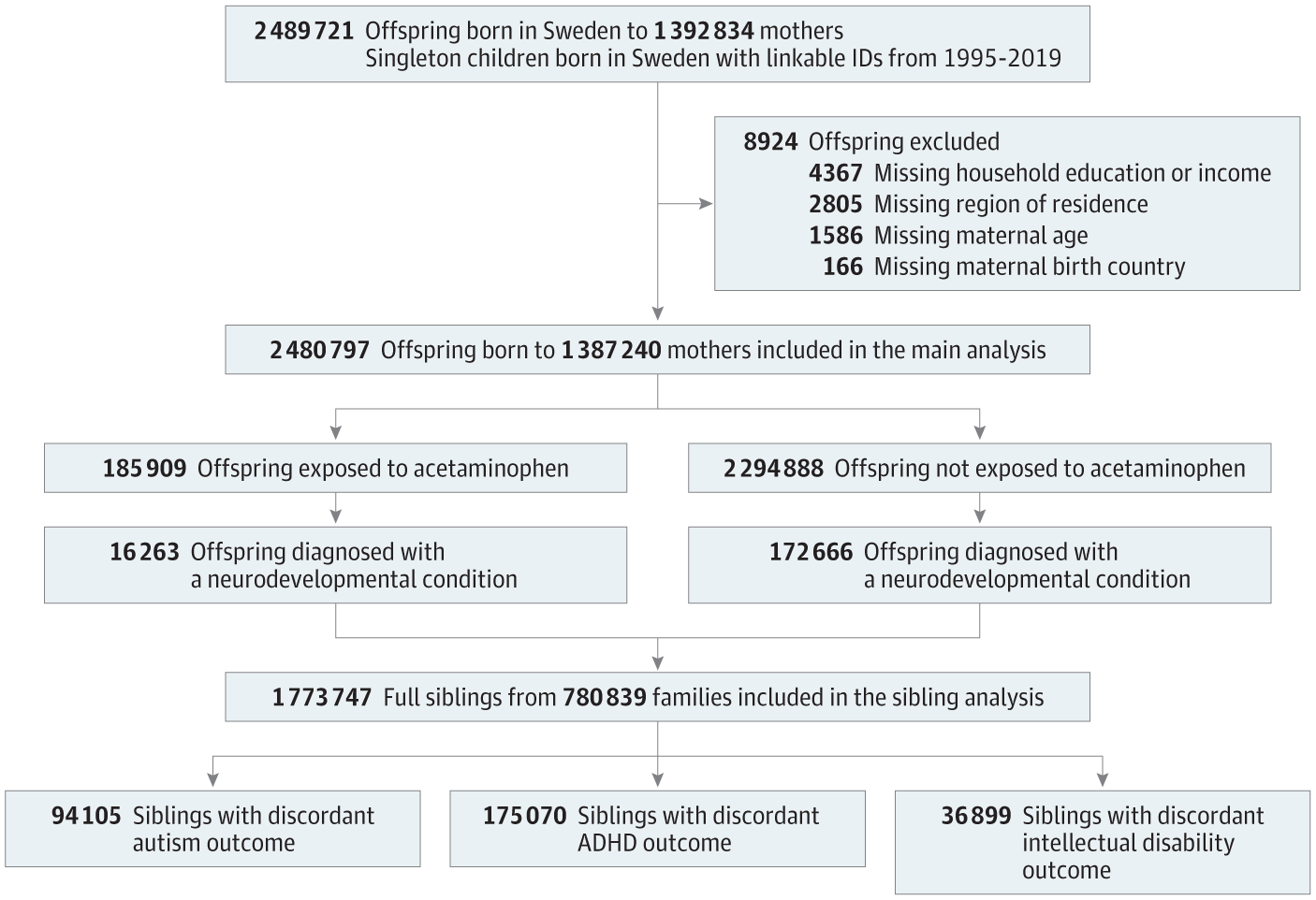 Our paper today is not only fully peer reviewed, but published in the prestigious Journal
of the American Medical Association (JAMA).
Our paper today is not only fully peer reviewed, but published in the prestigious Journal
of the American Medical Association (JAMA).
It’s a big study by Ahlqvist, et al. [3] of a nationwide cohort of 2,480,979 children born in Sweden in 1995 - 2019 to 1,387,240 birthing parents. (Let’s hear it once again for the positive impact on research of universal health care and universal electronic medical records!)
- After filtering for one thing and another, as shown in the CONSORT flow diagram reproduced here, they had 185,909 children exposed to acetaminophen during pregnancy and 2,294,888 children who were not so exposed.
- They then diagnosed who among each group of children had a neurodevelopmental condition. In this particular study, that amounted to autism, ADHD, or intellectual disability.
- They first did a comparison between all the kids in each group, and then later did a genetics-sensitive comparison using only siblings that were exposed to acetaminophen vs not. (The latter will become important, anon!)
- The differences in rates between the acetaminophen vs no acetaminophen kids was
measured, as is absolutely standard, with hazard ratios and their 95% confidence
intervals.
- First, the “hazard rate” is the probability that a certain event occurs, conditional on not occurring at a previous time. In this situation, it’s just the probability of a neurodevelopmental condition.
- Second, the “hazard ratio”, or HR, is
the ratio of the hazard rates between 2 groups. Here it’s the ratio of the
probability of neurodevelopmental condition in the acetaminophen exposed group vs the
non-acetaminophen group.
- If HR > 1 then the acetaminophen group has a higher risk; if HR < 1 then it has a lower risk.
- We then use statistics to get a 95% confidence interval on HR. To draw a statistically significant conclusion, we want either HR < 1 or HR > 1 and the 95% confidence interval all on the same side of 1. That is, we want to be 97.5% confident that the hazard ratio is on the side we think it is.
Now let’s consider Alqvist, et al.’s results, shown in the figure below.
- If the HR is to the left, it’s < 1 and the drug involved was protective against the
problem. If it’s to the right, then the drug is a risk for the problem.
- It’s only statistically significant if the error bar is wholly above or below 1.
- They considered separately the neurodevelopmental conditions of autism, ADHD, and intellectual disability.
- They computed HR and its 95% confidence interval for multiple kinds of groups:
- Those exposed vs not exposed to acetaminophen, aspirin, non-aspirin NSAIDs (e.g., ibuprofen?), opioids (who takes opioids when pregnant?!), and antimigraine drugs.
- They compared the exposed/non-exposed groups in the whole population, and then did a more refined comparison using only siblings in the same family who had been exposed/non-exposed.
The latter distinction, i.e., using matched sibling pairs only, is important. If you just look at the general population, you’re assuming there is no genetic component to the neurodevelopmental condition and thus exposure to the drug is the only relevant thing to measure. But we know, for example in autism, that genetics is a big factor! So by measuring between siblings, we control for genetics and ask if the drug was an additional risk factor, above and beyond genetics.
The latter is The Correct Question to be asking here.
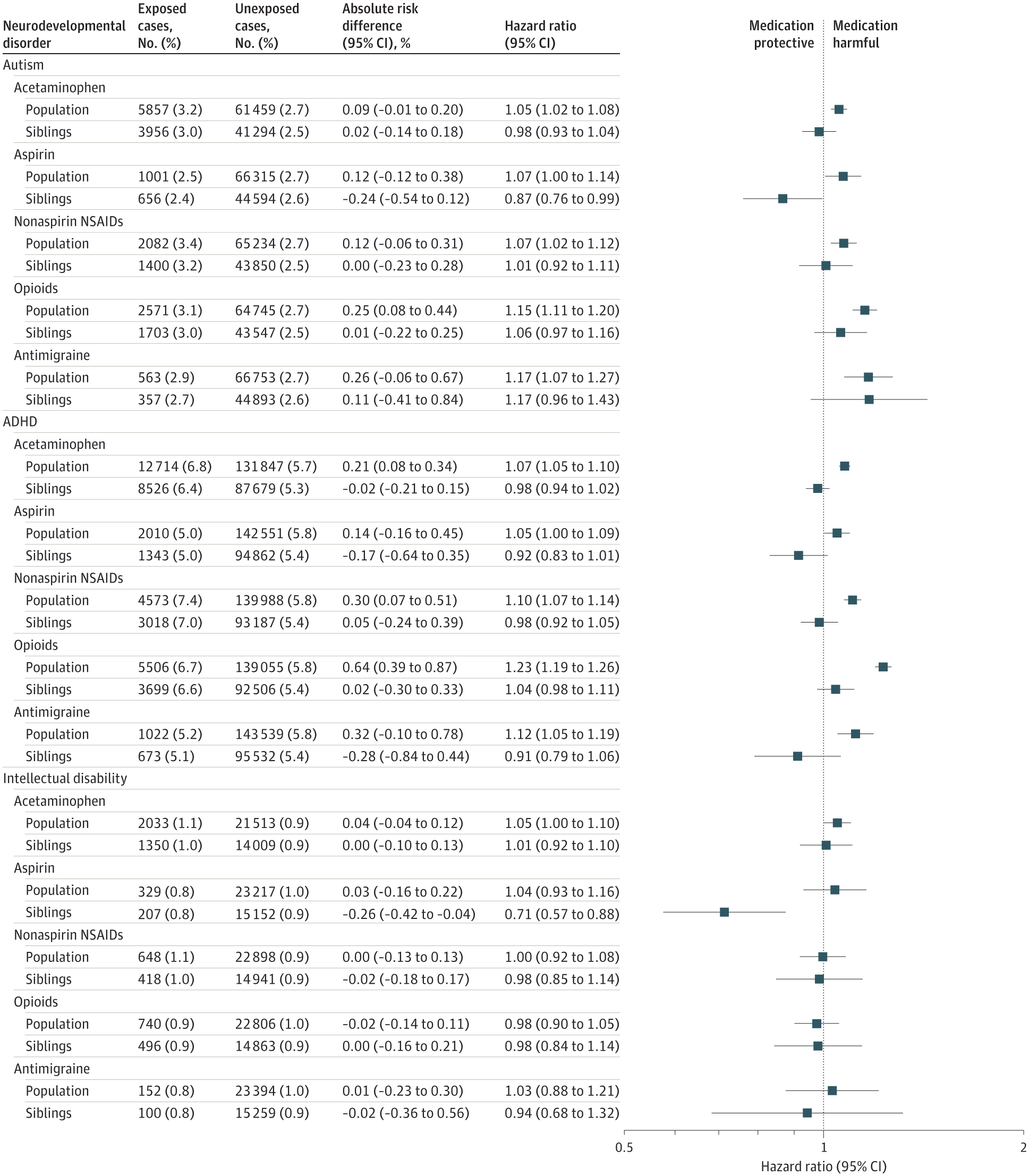 Look at the first 2 lines in the figure (click to embiggen), which are the influence of
acetaminophen on autism:
Look at the first 2 lines in the figure (click to embiggen), which are the influence of
acetaminophen on autism:
-
The first line, showing the Hazard Ratio for the general population, is ever so slightly greater than 1: HR = 1.05 (95% CL: 1.02 - 1.08).
This is what all the shooting is about!
-
However, in the second line, we see the effect of controlling for genetics: HR = 0.98 (95% CL: 0.93 - 1.04).
That is, the central estimate says acetaminophen is mildly protective against autism, though the error bar says it’s not statistically significant. In other words, there is no effect.
Result: There is no evidence whatsoever that associates acetaminophen with autism. Studies saying this are poorly controlled, failing to account for the known genetic component of autism. As shown here, when using siblings to control for genetics being the same on both sides, there is no effect.
Now look at the rest of the figure. In every single case, the result is the same! If there is a mild effect when doing a genetics-ignorant comparison of the whole population, the effect goes away when you do a proper sibling comparison.
The sole exception is near the bottom, considering the risk of aspirin for intellectual disability:
- The general population comparison shows a mild, not statistically significant risk. However, the genetically proper sibling comparison shows a statistically significant result that aspirin is protective against intellectual disability: HR = 0.71 (95% CL: 0.57 - 0.88).
- At the top of the chart, there’s a just-barely significant result showing aspirin is protective against autism too.
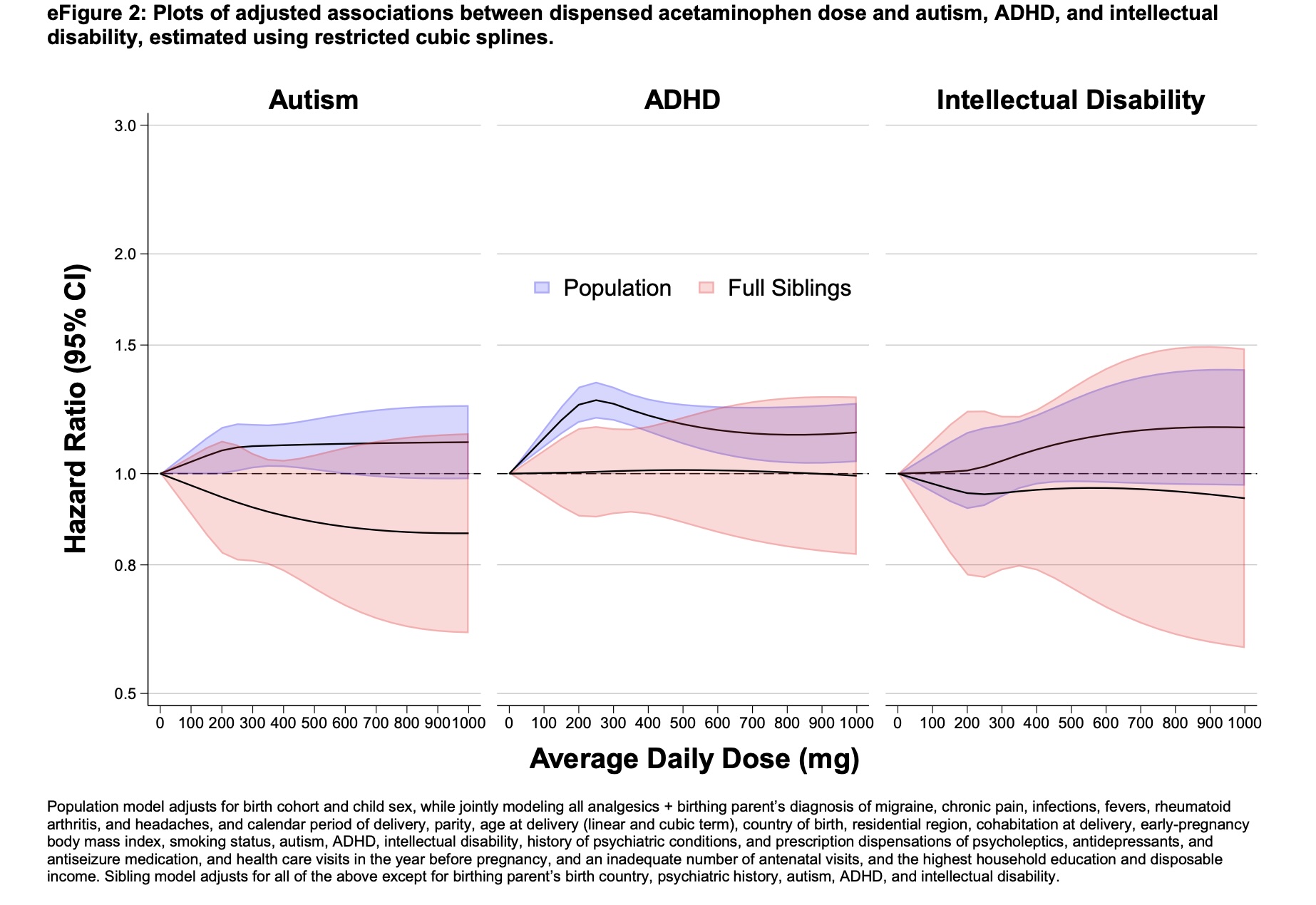 Interestingly – but unfortunately buried in the supplement – they did a test for
dose-responsiveness of acetaminophen. If acetaminophen were really a cause, you’d expect
high dose situations to produce a higher likelihood of autism, ADHD, or intellectual
disability. This should show up in a hazard ratio that rises monotonically with dose.
Interestingly – but unfortunately buried in the supplement – they did a test for
dose-responsiveness of acetaminophen. If acetaminophen were really a cause, you’d expect
high dose situations to produce a higher likelihood of autism, ADHD, or intellectual
disability. This should show up in a hazard ratio that rises monotonically with dose.
This figure shows the hazard ratios as a function of acetaminophen dose. The blue bands are for the (bogus) population-wide comparison, and the pink bands are for the (properly genetics-controlled) sibling comparison. There is no meaningful, monotonic trend with acetaminophen dose. At all doses, the sibling comparison shows no effect at all, when genetics is properly taken into account.
Any acetaminophen/autism link is very, very thoroughly debunked!
Conclusions:
- This study is awesomely well powered, using essentially the entire population of Sweden over a period of 3 years.
- Acetaminophen, and pretty much everything else studied except aspirin (q.v.), is not associated with autism, ADHD, or intellectual disability.
- Anybody saying otherwise is doing a genetics-ignorant comparison, attempting to ignore the known strong genetic influence on those conditions.
- Checking for dose-responsiveness further rules out any association of acetaminophen with autism, ADHD, and intellectual disability.
- The single exception is favorable: aspirin looks mildly protective against autism and rather more strongly protective against intellectual disability.
The Weekend Conclusion
Summary: Yes, what they said is stupid.
Acetaminophen, during pregnancy or not, has nothing to do with autism. It has everything to do with Republican disdain for science, even for the very notion of evidence. (And, possibly, with making a corrupt profit for Dr. Oz; still waiting to see if he divests.)
And their desire to distract from their massive policy failures and destruction of democracy.
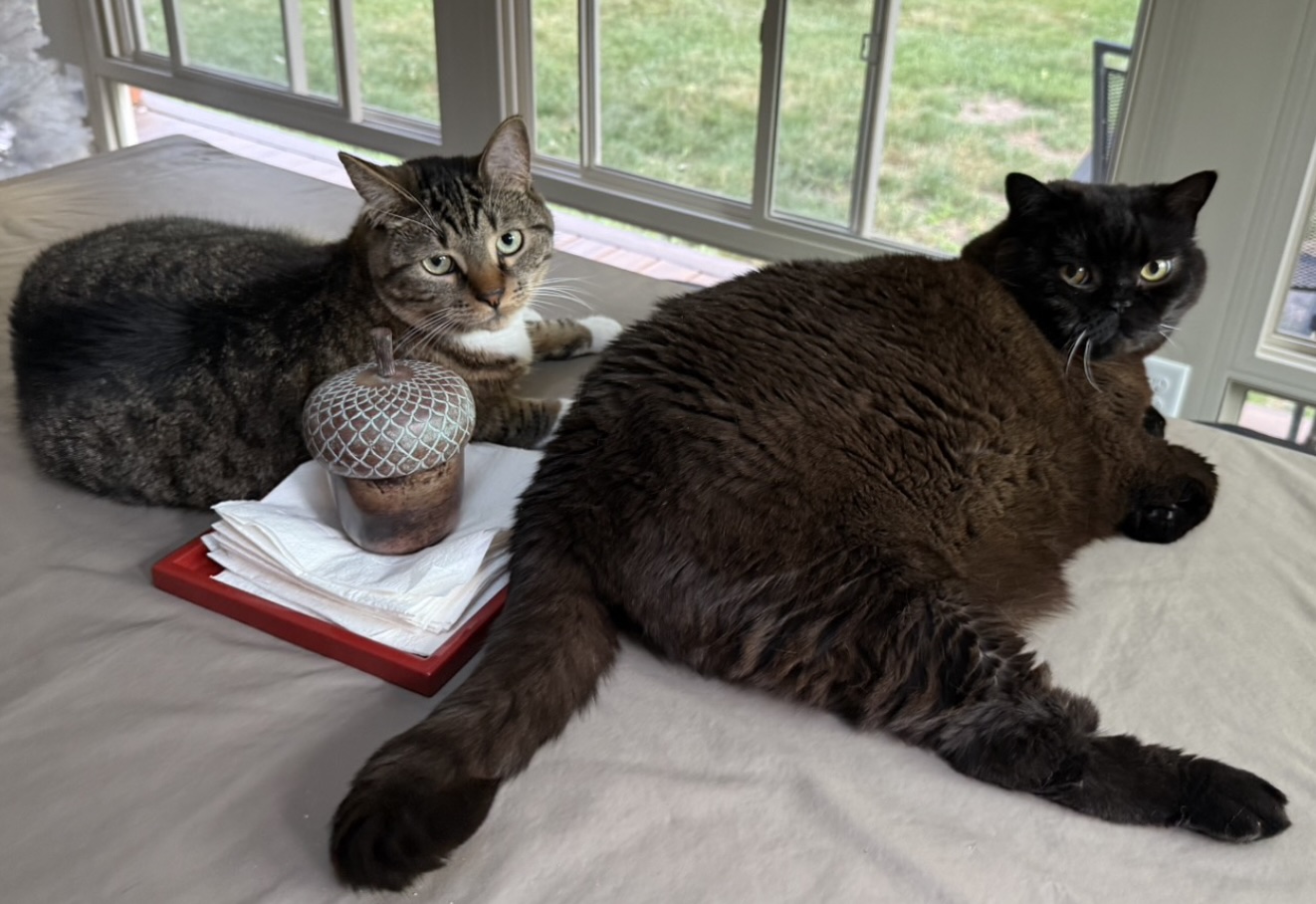 Don’t be distracted.
Here, as an instructive example, are the Weekend Publisher and the Assistant Weekend Publisher. (Given l’affaire Jimmy Kimmel, I thought I should consult with my publishers before offering an anti-Trump editorial opinion.) As you can see, they are not distracted by the latest Trump… emissions. In fact, they are not even much distracted from their nap schedule.
We should ignore the idiotic pronouncements, and keep up the grassroots political activity to throw out the idiots ASAP.
(Ceterum censeo, Trump incarcerandam esse.)
Addendum 2025-Sep-25: The APA Weighs In
 The American Psychiatric Association is the oldest medical association in the United
States, with more than 39,200 physician members specializing in the diagnosis, treatment,
prevention, and research of mental illnesses.
The American Psychiatric Association is the oldest medical association in the United
States, with more than 39,200 physician members specializing in the diagnosis, treatment,
prevention, and research of mental illnesses.
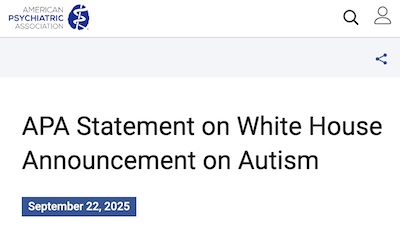
Today the APA weighed in [4] with a reaction to the Trump’s & Kennedy’s weirdly stupid pronouncements on autism and acetaminophen (emphasis added):
“It is essential that the administration prioritizes evidence-based support for individuals on the autism spectrum and invests in long-term comprehensive research about the disorder.
Vaccines do not cause autism. Claims of any such association have been repeatedly discredited in peer reviewed studies.
Autism is a complex disorder, and it is incorrect to imply that a handful of studies have established causation. A strong base of evidence shows that acetaminophen, when taken as directed, is safe for use during pregnancy. Any decisions around a course of treatment should be determined by a patient and their doctor.
Leucovorin (folinic acid) has not been a recommended treatment for autism. It will require many more years of research before we know if leucovorin is an appropriate treatment for individuals with autism.
Autism spectrum disorders exist on a spectrum of neurodiversity. The country must focus its resources on expanding access to care and to building the evidence-base for future treatments.”
Summary:
- Vaccines don’t cause autism.
- Acetaminophen doesn’t cause autism.
- Leucovorin doesn’t treat autism.
Notes & References
1: J Christensen, B Goodman, M Tirrell, “Trump links autism to acetaminophen use during pregnancy, despite decades of evidence it’s safe”, CNN, 2025-Sep-23. ↩
2: K Plummer, “Will Dr Oz Benefit From Trump’s FDA Approving Leucovorin? What To Know”, Newsweek, 2025-Sep-23. ↩
3: VH Ahlqvist, et al., “Acetaminophen Use During Pregnancy and Children’s Risk of Autism, ADHD, and Intellectual Disability”, JAMA 331:14, pp. 1205-1214, 2024-Ap4-09. DOI: 10.1001/jama.2024.3172. ↩
4: APA Staff, “APA Statement on White House Announcement on Autism”, American Psychiatric Association News Releases, 2025-Sep-22. ↩
Gestae Commentaria
Comments for this post are closed pending repair of the comment system, but the Email/Twitter/Mastodon icons at page-top always work.